The Licensed Behavioral Health Workforce in Nebraska: 2010 to 2025
Purpose
This data snapshot examines changes in the number of licensed behavioral health providers in Nebraska from 2010 to 2025.
Key Takeaways
-
From 2010 to 2025 the number of Nebraska behavioral health providers grew 64% overall and 34% in rural areas.
-
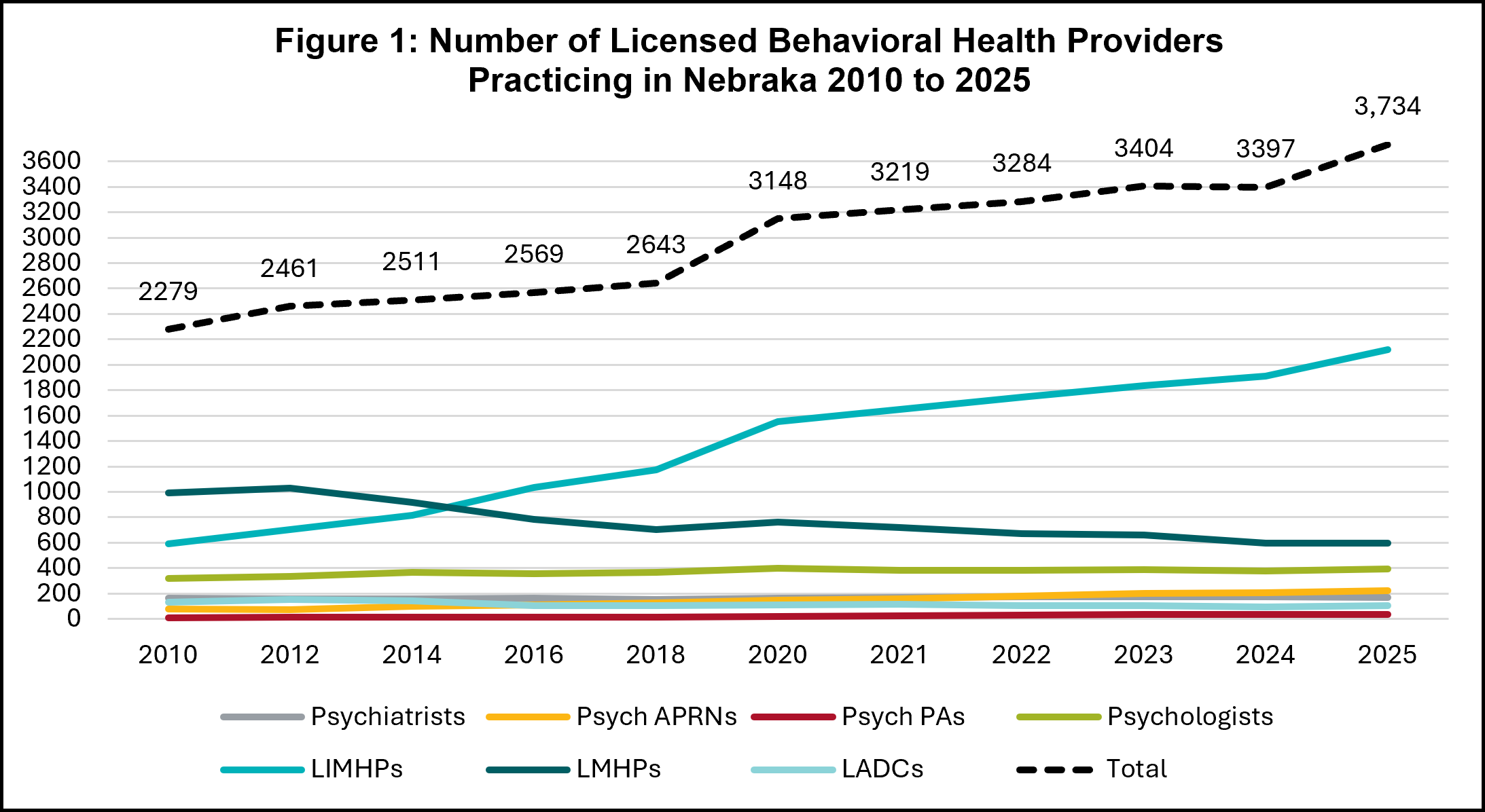
Behavioral health workforce growth primarily has been driven by large increases in the number of LIMHPs. Psychiatrists and psychologists have seen comparatively slower growth.
-
Access to the full continuum of behavioral health care remains difficult in many rural areas due to provider shortages.
-
Information about four new provider types was added in 2025.
Methods
Since 2010, BHECN has tracked behavioral health workforce trends for psychiatrists, psychiatric advanced practice registered nurses (APRNs), psychiatric physician assistants (PAs), psychologists, licensed independent mental health practitioners (LIMHPs), licensed mental health practitioners (LMHPs), and licensed alcohol and drug counselors (LADCs). Starting in 2025, BHECN also began tracking board certified psychiatric pharmacists (BCPPs), licensed behavioral analysts (LBAs), licensed assistant behavioral analysts (LABAs), and certified peer support specialists (CPSSs).
BHECN analyzes data provided by the Health Professions Tracking Service (HPTS) to determine the number and type of licensed behavioral health professionals practicing in Nebraska. HPTS receives monthly licensure information from the Nebraska Department of Health and Human Services. Licensure data does not include practice location, and an active license does not necessarily indicate that a provider is currently practicing in Nebraska, as providers may maintain a license after moving or practicing in another state, leaving clinical practice, or retiring. To address these gaps in the licensure data, HPTS also sends annual surveys to all licensed behavioral health care providers that ask about practice location(s) and provider and patient demographic characteristics. BHECN continually reviews and refines its data collection procedures and verification protocols to increase provider engagement. While this approach may yield more conservative estimates than licensure counts alone, it provides a more realistic picture of the workforce available to deliver behavioral health services in Nebraska. The number of BCPPs, LBAs, LABAs, and CPSSs practicing in Nebraska is not available prior to 2025, as those professions were added to the survey data collection in 2025.
Behavioral Health Workforce Trends: 2010-2025
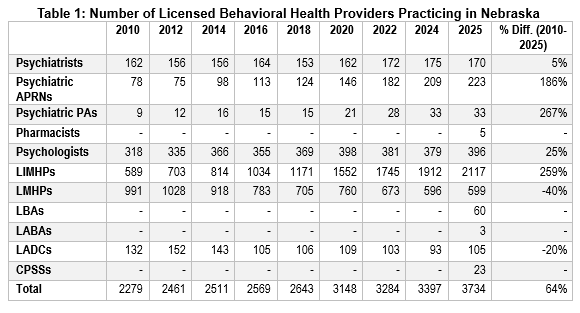
Figure 1 and Table 1 summarize information about the number of licensed behavioral health providers practicing in Nebraska from 2010 to 2025.1 There was substantial growth in the behavioral health workforce during this period, including a 64% increase in providers (from 2,279 to 3,734).2 This translates to an estimated 1.6 million additional behavioral health appointments available in 2025 compared to 2010.3
Psychiatric PAs, LIMHPs, and psychiatric APRNs experienced the greatest growth. The number of LMHPs decreased as the number of LIMHPs increased, suggesting a conversion of LMHP to LIMHP licenses. Although hierarchical counts of LADCs show a 27% decrease from 2010 to 2025 (from 132 to 105), non-hierarchical counts4 show a 67% increase (from 362 to 605). This discrepancy suggests increases in dual licensure over time.
Rural Workforce Trends
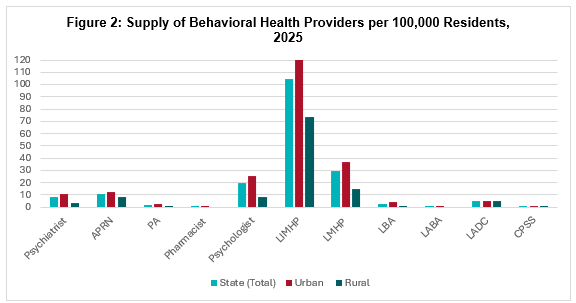
The number of providers in rural counties increased 34% since 2010 (from 584 to 782). Still, rural counties continue to have fewer providers per 100,000 residents compared to urban areas (see Figure 2), and residents of several counties still must drive more than an hour to reach a provider for in-person services. The professions that have seen the greatest growth in rural areas since 2010 are LIMHPs (248%), APRNs (142%), and LADCs (49%). Currently, LADCs and APRNs come closest to parity between rural vs. urban availability per 100,000 population.
Provider Age and Retirement Plans
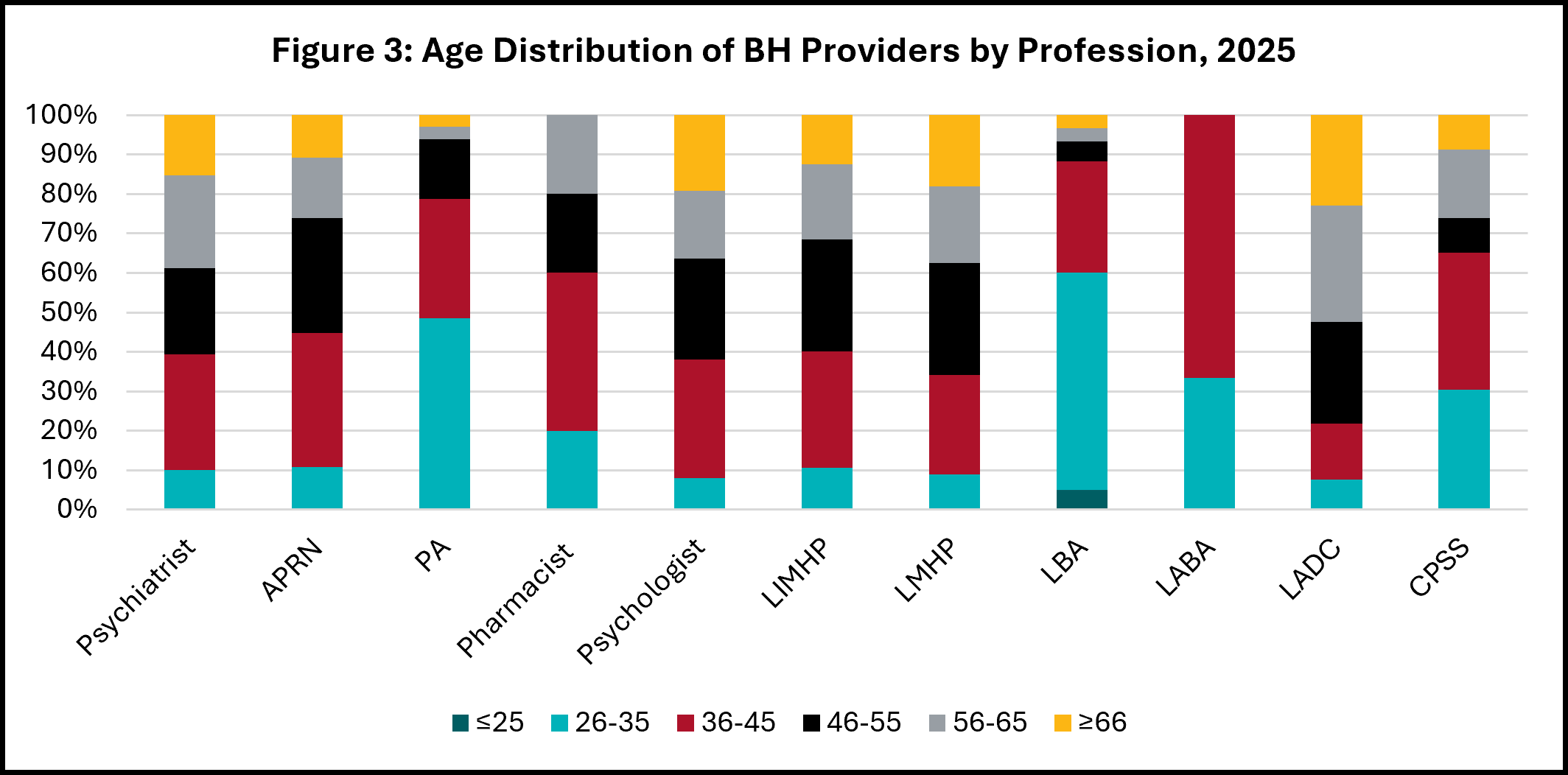
The age distribution of behavioral health providers in Nebraska varies by profession. PAs, LBAs, and LABAs had the largest proportion of the workforce under age 45, while LADCs and Psychiatrists had the largest proportion of providers age 56 and older. Only LADCs had >50% of their workforce being 56 or older (see Figure 3).
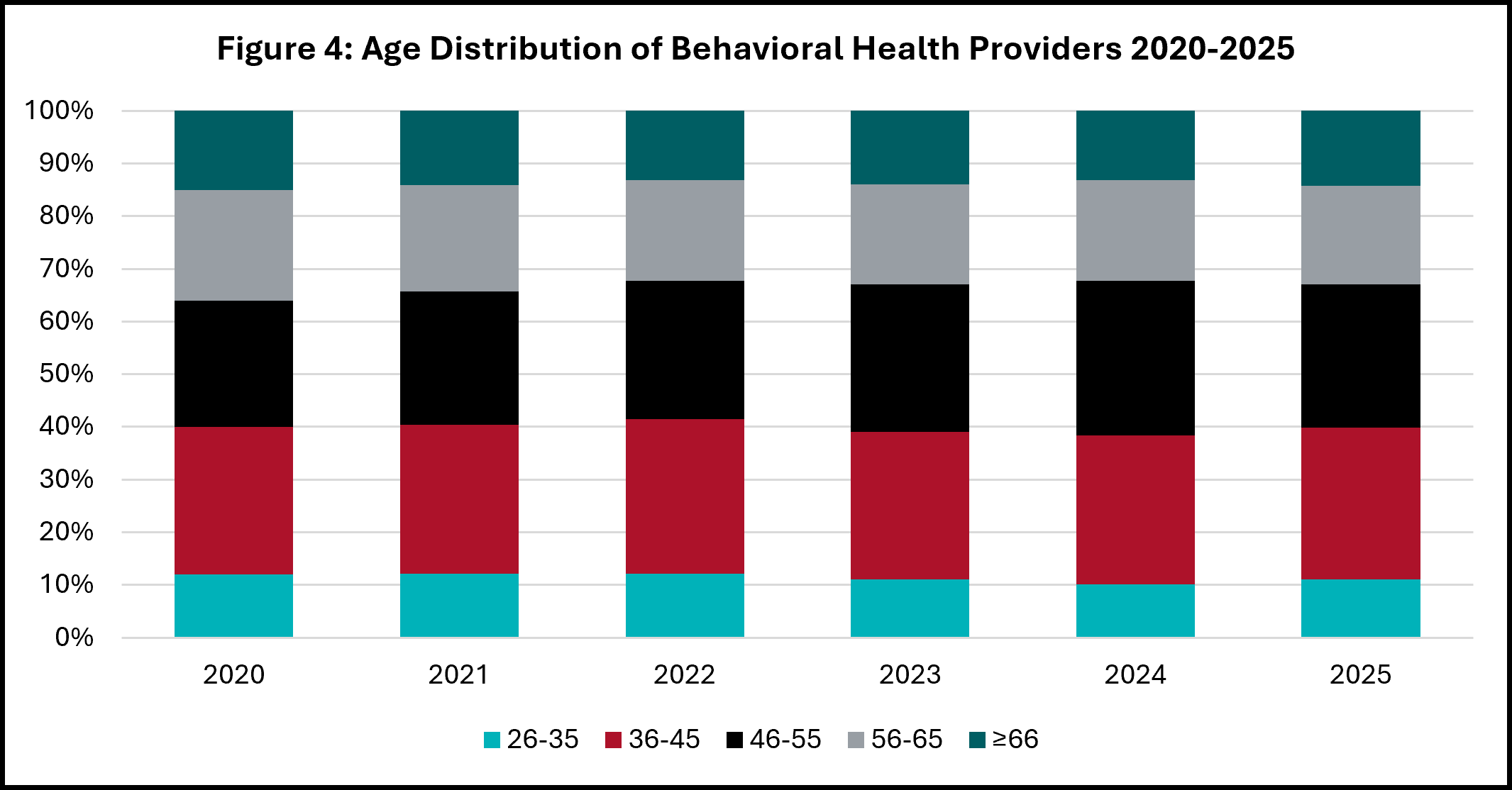
In 2025, 6% of providers indicated they plan to retire in the next 5 years. Since 2020, the age distribution of the licensed behavioral health workforce has remained relatively stable, with the number of providers in the youngest age group (26-35) and the oldest age group (66 and older) being similar (see Figure 4).
Interpretation and Recommendations
Nebraska's licensed behavioral health workforce grew from 2,279 providers in 2010 to 3,734 in 2025, representing a 64% increase statewide. Rural areas also experienced substantial growth, with the number of providers increasing by 34%, from 584 to 782 providers.
Despite these gains, provider growth varied across professions. The largest increases occurred among master's-level mental health providers, while growth among psychiatrists increased 5% and psychologists increased 25% from 2010 to 2025. Because psychiatrists and psychologists provide services such as assessment, diagnosis, medication management, and specialty care, trends within these professions are an important component of understanding Nebraska’s overall behavioral health workforce capacity.
Workforce distribution remains an ongoing challenge. Although rural workforce numbers increased, provider-to-population ratios remain substantially lower than in urban counties. Rural areas have less than one-third the psychiatrist availability of urban areas and significantly lower availability of psychologists and other specialists, and residents in some counties still travel over an hour to access in-person services.
In sum, these findings suggest that Nebraska's investments in workforce development have been effective, but future efforts must focus not only on workforce growth, but also on workforce distribution, specialization, and retention.
BHECN implements the Nebraska Model for Behavioral Health Workforce Development, which provides a holistic framework for this work. The Model includes six interconnected components, including career awareness and preparation, training experiences, professional support, outreach and engagement, and workforce research and evaluation that together create a system designed to recruit, train, and retain behavioral health professionals. Specific recommendations aligned with the Nebraska Model include:
1. Continue Long-Term Investment in Workforce Development
2. Expand Rural Workforce Pipeline Programs
Evidence consistently shows that providers with rural backgrounds or rural training experiences are more likely to practice in rural communities.5 Nebraska could expand:
- Rural clinical rotations and internship and practicum placements
- Grow-your-own workforce programs
- Financial incentives tied to rural service commitments
- Rural graduate training partnerships
These efforts are likely to have the greatest impact on reducing geographic disparities.
3. Increase Paid Supervision and Licensure Support
Limited opportunities for supervision remain a bottleneck to full licensure. Nebraska could expand statewide supervision initiatives, reimbursement mechanisms, and employer incentives that increase paid supervision opportunities, particularly in rural and underserved areas. This strategy could accelerate conversion from provisional to independent practice.
4. Strengthen Recruitment and Retention of Doctoral-Level Providers
Given the workforce trends observed among psychiatrists and psychologists, Nebraska should consider targeted strategies including:
- Residency and fellowship expansion
- Expanded capacity and the creation of new rural psychiatric training opportunities
- Recruitment incentives for shortage areas
- Exploration of opportunities to add in-state doctoral-level graduate training programs
5. Advance Workforce Data Collection and Analytics
Continue building on Nebraska’s existing behavioral health workforce data infrastructure to strengthen understanding of where providers practice, how the workforce changes over time, and where emerging needs may exist. Opportunities for continued innovation, in collaboration with state agencies, licensing bodies, educational institutions, employers, and other partners include:
- Enhancing methods for validating provider practice locations
- Identifying and monitoring emerging workforce needs and geographic trends
- Strengthening the ability to track workforce movement and distribution across regions
- Exploring opportunities to integrate and leverage complementary data sources
Suggested citation: Behavioral Health Education Center of Nebraska. (2026). The Licensed Behavioral Health Workforce in Nebraska: 2010 to 2025.
Footnotes:
[1] We present hierarchical counts, where each licensed provider practicing in Nebraska is counted once, according to their highest license. Hierarchical counts allow us to examine changes in the total number of licensed behavioral health providers practicing in Nebraska.
[2] This number includes 2025 data for the four new license types.
[3] Based on mid-range estimates about weeks worked per year, time spent in clinical care, and number of patients seen per hour.
[4] Given that LADCs also frequently hold a higher license, trends for LADCs are more difficult to determine from the hierarchical counts. Non-hierarchical counts for LADCs include all LADCs practicing in Nebraska, regardless of whether they also have a higher license.
[5] Poppert Cordts, K. M., Mone, V., Diao, J., Schneider, E., Doyle, M., Ratnapradipa, K., Watanabe-Galloway, S., Buckland, S., Horner, R. (Manuscript Under Review) Tracing Workforce Outcomes of In-State Behavioral Health Graduate Programs: The Nebraska Experience.
[6] Buche, J., Wayment, C., Buckland, S., Doyle, M., & Tibbits, M. (2026). Reducing behavioral health licensure barriers through supervision incentives. Journal of Rural Mental Health, 50, 157–170.