The Licensed & Licensed Independent Mental Health Practitioner Workforce in Nebraska: 2020 to 2025
Purpose
This data snapshot includes information about the Licensed Mental Health Practitioner (LMHP) and Licensed Independent Mental Health Practitioner (LIMHP) workforce in Nebraska from 2020 to 2025.1 A LMHP/LIMHP creates purposeful relationships that empower diverse individuals, couples, families, children, adolescents and groups to accomplish mental health, wellness, education and career goals. They apply mental health, psychological, human development, or family systems principles and interventions to help clients adjust their thoughts, feelings or actions. They also diagnose and treat mental and emotional disorders, such as anxiety and depression. LIMHPs may practice more independently and diagnose and treat major mental illnesses or disorders without supervision or consultation, while LMHPs must consult with a LIMHP, qualified physician, or licensed clinical psychologist to diagnose and treat conditions that fall under major mental illness.
Key Takeaways
- The Nebraska LIMHP workforce grew by 37% from 2020 to 2025, while the LMHP workforce decreased by 16% over the same period.
- Nebraska has mental health practitioner educational programs in 5 of the 6 regions, which could contribute to the growth of the workforce.
- Rural areas still have fewer LMHPs and LIMHPs than urban areas of the state.
- The number of LIMHPs per 100,000 residents is below the national average.
LMHP/LIMHP Training Programs
There are various education programs that lead to a career as a mental health practitioner, but all LMHP/LIMHPs are required to obtain an undergraduate degree and a Master’s degree or equivalent in a mental health-related field. This process typically takes 6-8 years: 4 years to complete a Bachelor’s degree and 2-4 years for the Master’s degree.
There are 9 institutions of higher education in Nebraska that offer a Master’s degree in Social Work, Clinical Mental Health Counseling, or Marriage & Family Therapy, leading to mental health practitioner licensure: Chadron State College (Region 1 - online); University of Nebraska Kearney (Region 3); Wayne State College (Region 4); Doane University, Concordia University, Nebraska Wesleyan University, and University of Nebraska Lincoln (Region 5); and Bellevue University, Crown College, and University of Nebraska Omaha (Region 6). Individuals with a Master’s in Psychology who are enrolled in a doctoral program accredited by the American Psychological Association are also eligible for licensure as a mental health practitioner. There are two such programs in Nebraska, both at the University of Nebraska Lincoln.
Although the mental health practitioner workforce is supported by the large number of graduate programs in Nebraska, they still face known challenges on the path to graduation and licensure. Master’s programs require intensive applied training experiences such as practica and internships that are often unpaid. Students with other employment and commitments are forced to make difficult choices about how and when to complete these requirements. Further, licensed professionals must decide whether to supervise students, as providing quality supervision is time-consuming and often cost-prohibitive.
Graduates of approved programs can apply to become provisionally licensed (PLMHP), then can become fully licensed as an LMHP after completing 3,000 hours of supervised experience in mental health practice in Nebraska. PLMHPs or LMHPs can apply to be LIMHPs if 1,500 hours of psychotherapy experience is with individuals having major mental or emotional disorders under the supervision of a qualified supervisor. Findings from BHECN’s Nebraska Health Workforce Partnership (NEBWP) 2025 Summit2 and BHECN’s own research into their ARPA awardees3 indicate that provisionally licensed providers and their supervisors need additional financial support to address supervision, licensing, and credentialing challenges.
Regional Trends
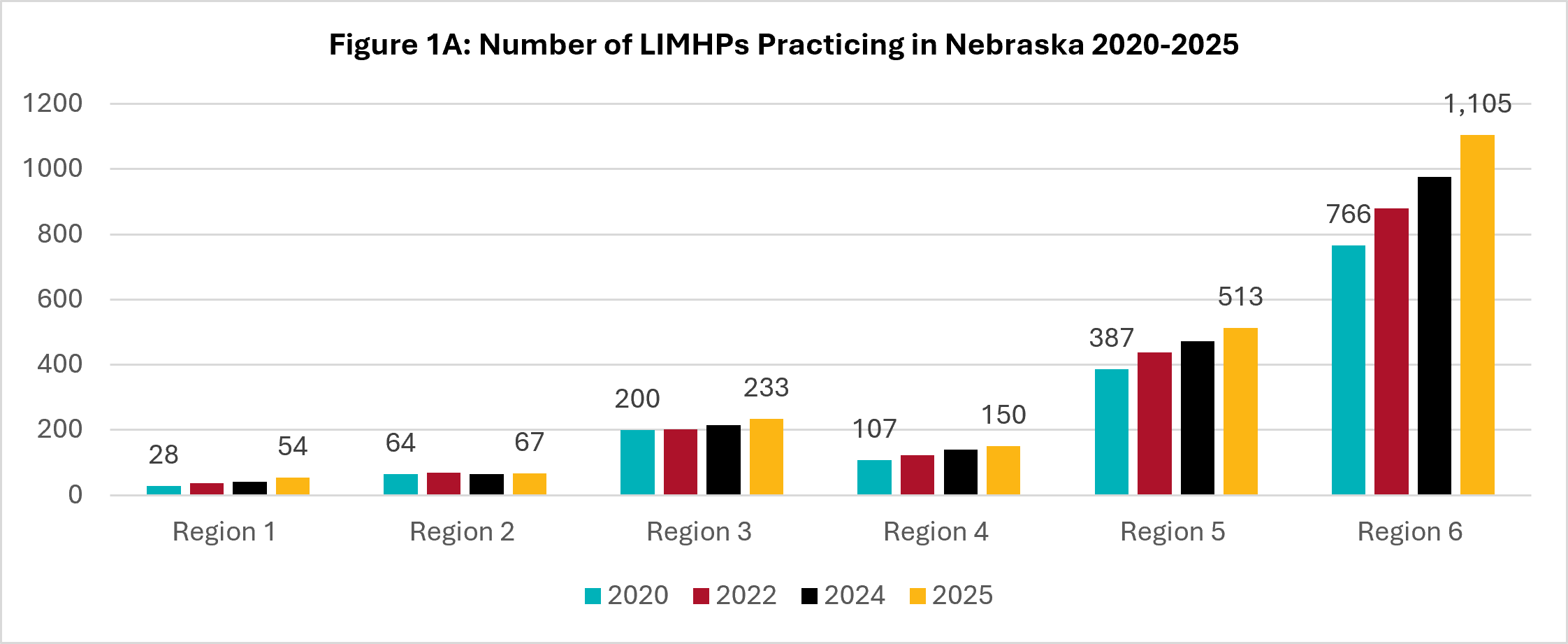
The number of licensed LIMHPs practicing in Nebraska increased 37% from 2020 to 2025 (from 1,552 to 2,112). The number of LIMHPs increased in every Nebraska behavioral health region (see Figure 1A).
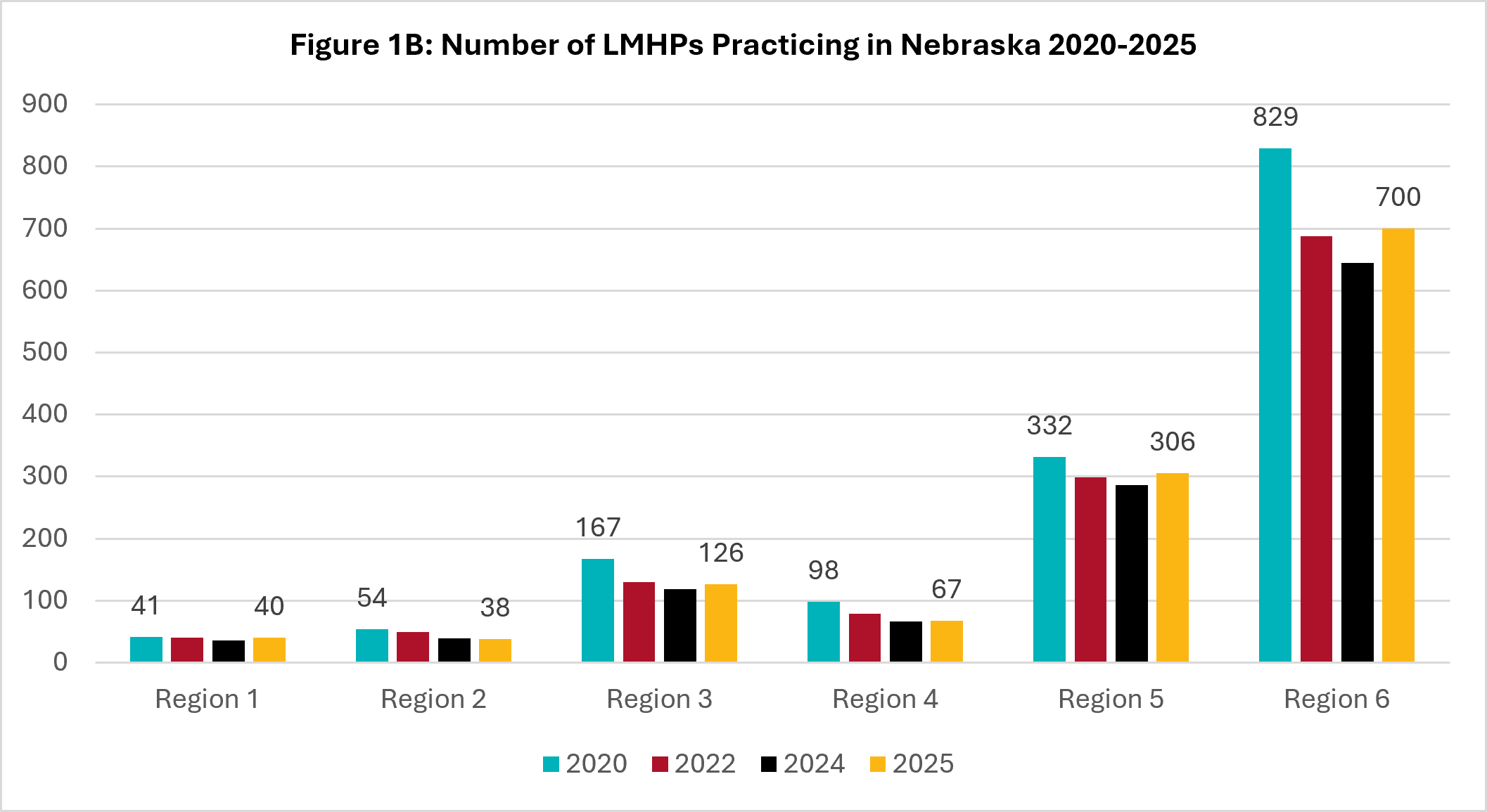
The number of licensed LMHPs practicing in Nebraska decreased 16% (from 1,524 to 1,276) between 2020 and 2025, decreasing in all regions (see Figure 1B). These decreases are expected as LMHPs transition to the LIMHP license. However, 2025 is the first year since 2020 that LMHP numbers have increased compared to the prior year.
Rural and Urban Distribution of LIMHPs
The number of LIMHPs in both urban and rural areas of Nebraska increased from 2020 to 2025 (see Figure 2). However, the number of LIMHPs per 100,000 residents is still below the national average of 129 practitioners per 100,000 population.4
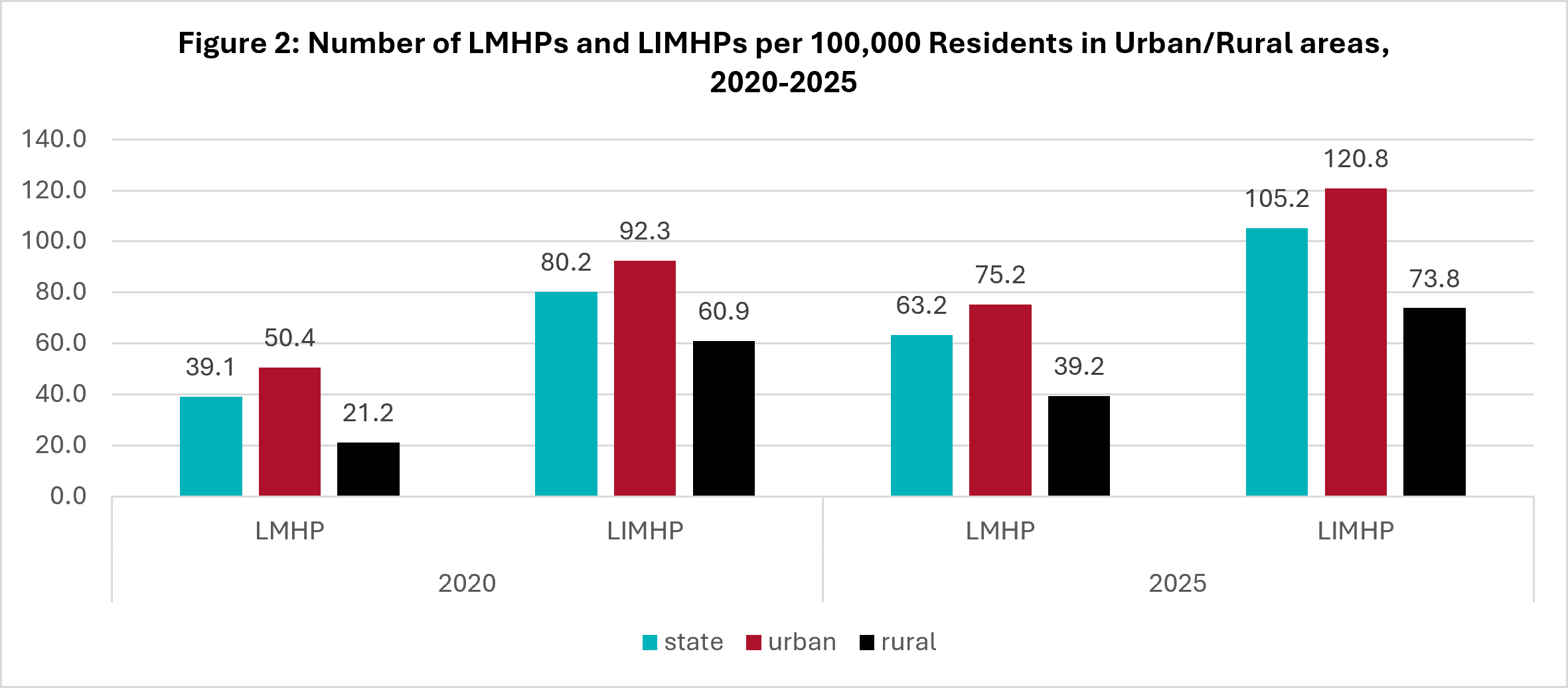
The number of practitioners per 100,000 residents is significantly lower in rural areas of Nebraska compared to urban areas: about 2/3 as many LIMHPs, and about half as many LMHPs per 100,000 residents.
Age of LMHPs and LIMHPs
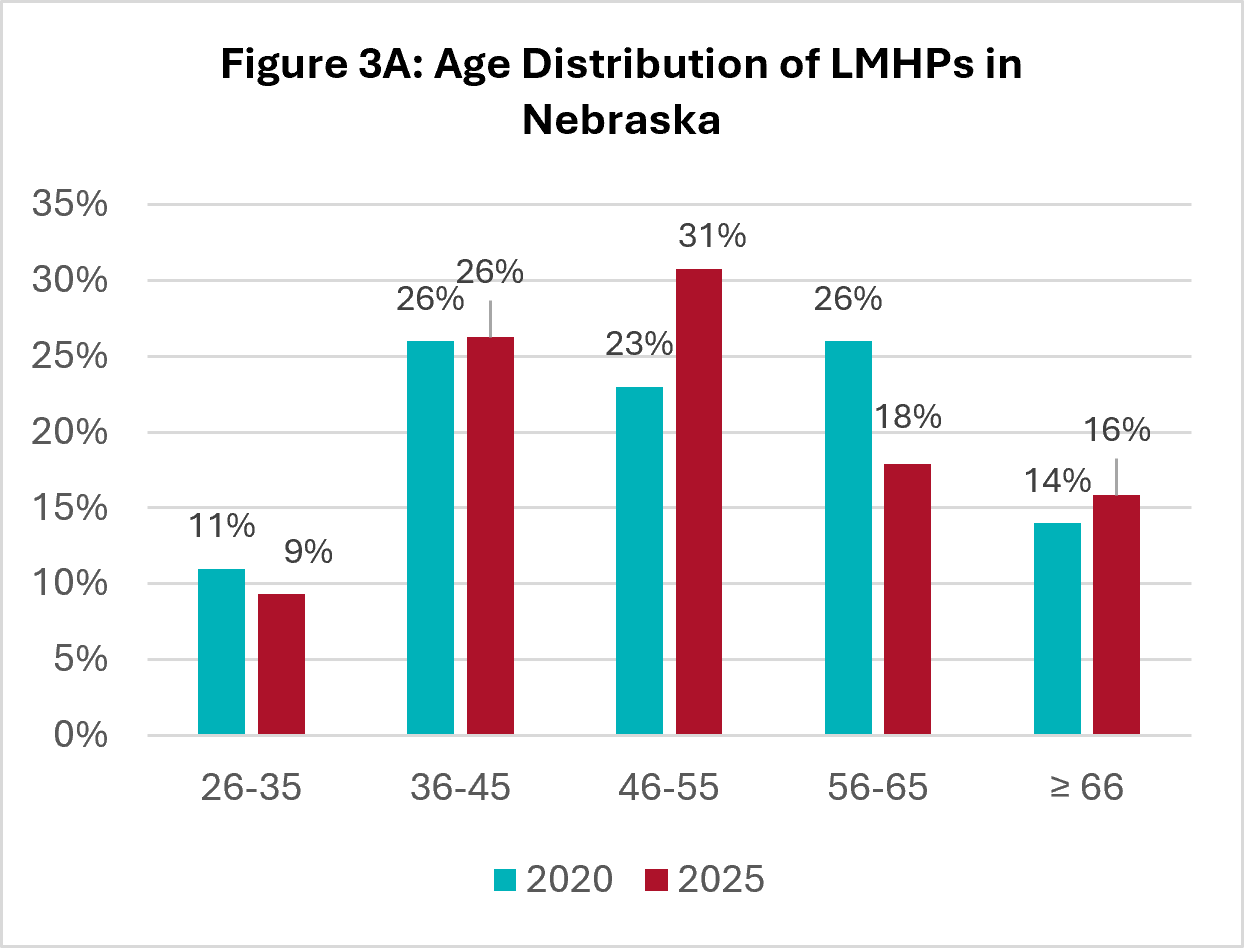
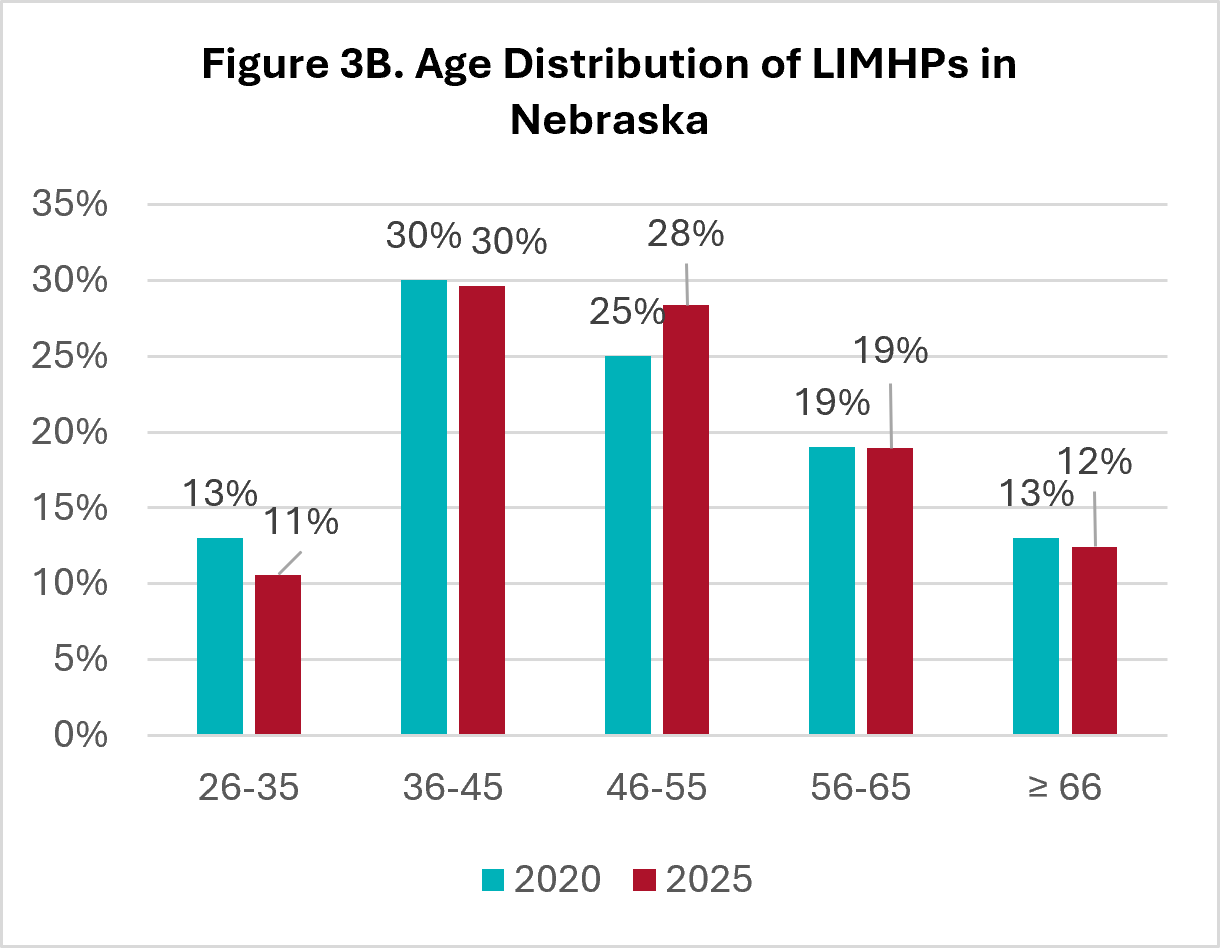
Since 2020, the number of LMHPs and LIMHPs both entering the workforce and nearing retirement age has decreased slightly, and the number of LMHPs and LIMHPs aged 46-55 has increased (see Figures 3A & 3B). More LMHPs continued to work beyond retirement age in 2025 compared to 2020.
Conclusions
The LIMHP workforce has grown in all 6 behavioral health regions across Nebraska since 2020. The concurrent reduction in the number of LMHPs most likely represents conversion to the independent license, thus offering patients across the state practitioners who are prepared to practice at a higher level with less oversight and constraints. The small uptick in the number of LMHPs in 2025 compared to 2024 across nearly all regions does not appear to reflect an increase in traditional-age new graduates. The availability of LIMHPs remains higher in urban areas compared to rural areas, and the number of providers per 100,000 residents is lower than the national average. Nebraska has strong mental health practitioner educational programs in nearly every behavioral health region. Overall, these findings highlight positive changes in the Nebraska LIMHP workforce along with the need for continued efforts to ensure the positive trends continue.
Suggested citation:
Behavioral Health Education Center of Nebraska. (2026). The Licensed & Licensed Independent Mental Health Practitioner Workforce in Nebraska: 2020 to 2025.
Footnotes
[1] BHECN analyzes data provided by the Health Professions Tracking Service (HPTS) to determine the number and type of licensed behavioral health professionals practicing in Nebraska. HPTS receives monthly licensure information from the Nebraska Department of Health and Human Services. Licensure data does not include practice location, and an active license does not necessarily indicate that a provider is currently practicing in Nebraska, as providers may maintain a license after moving or practicing in another state, leaving clinical practice, or retiring. To address these gaps in the licensure data, HPTS also sends annual surveys to all licensed behavioral health care providers that ask about practice location(s) and provider and patient demographic characteristics. BHECN continually reviews and refines its data collection procedures and verification protocols to increase provider engagement. While this approach may yield more conservative estimates than licensure counts alone, it provides a more realistic picture of the workforce available to deliver behavioral health services in Nebraska. This document presents non-hierarchical counts, which means all providers are included in these numbers, regardless of whether they hold other license types.
[2] BHECN (2025). Nebraska Behavioral Health Workforce Partnership Summit 2025 Report.
[3] Buche, J., Wayment, C., Buckland, S., Doyle, M., & Tibbits, M. (2026). Reducing behavioral health licensure barriers through supervision incentives. Journal of Rural Mental Health, 50(3), 157–170. https://doi.org/10.1037/rmh0000331
[4] U.S. Bureau of Labor Statistics. Occupational Employment and Wage Statistics Query System. https://data.bls.gov/oes/#/occGeo/One%20occupation%20for%20multiple%20geographical%20areas