The Psychiatric Physician Assistant Workforce in Nebraska: 2020 to 2025
Purpose
This data snapshot includes information about the psychiatric physician assistant (PA) workforce in Nebraska from 2020 to 2025. Psychiatric PAs practice medicine under physician supervision. Psychiatric PAs conduct medical histories and physicals, perform psychiatric evaluations and assessments, order and interpret diagnostic studies, and establish and manage treatment plans, which includes prescribing medications and placing referrals as needed.
Key Takeaways
- The Nebraska psychiatric PA workforce grew 57% from 2020 to 2025.
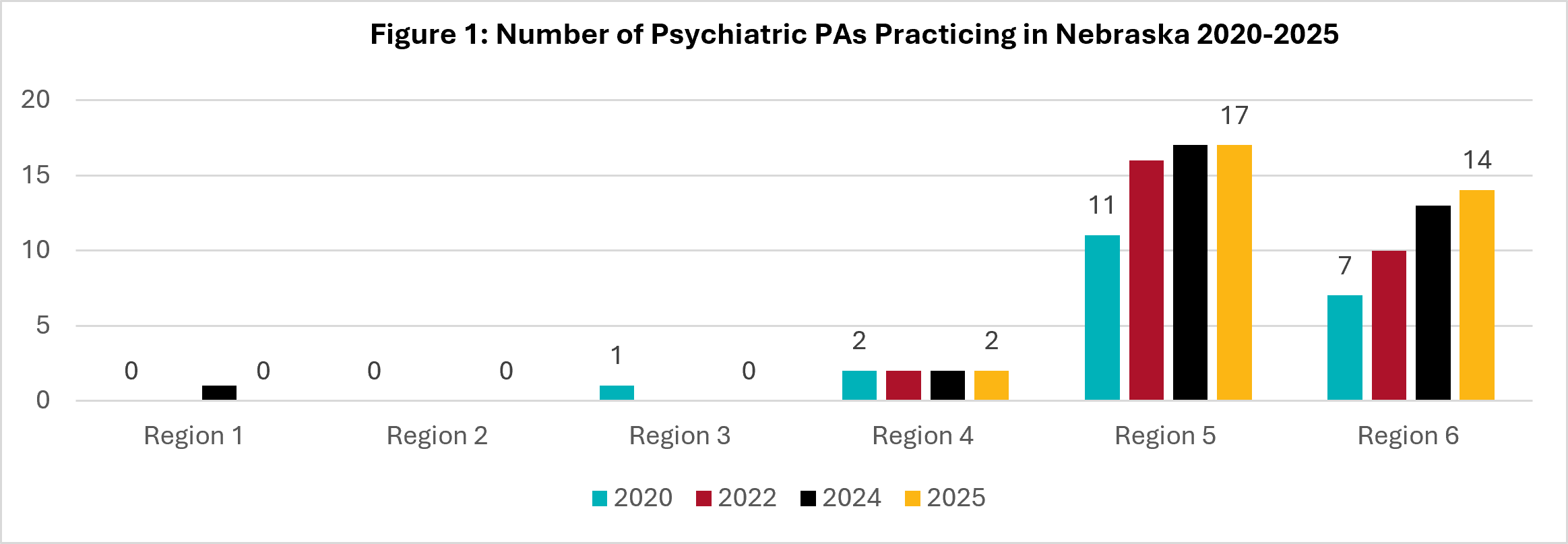
- The number of psychiatric PAs increased in 2 of the 6 Nebraska behavioral health regions and remain concentrated in urban areas of the state.
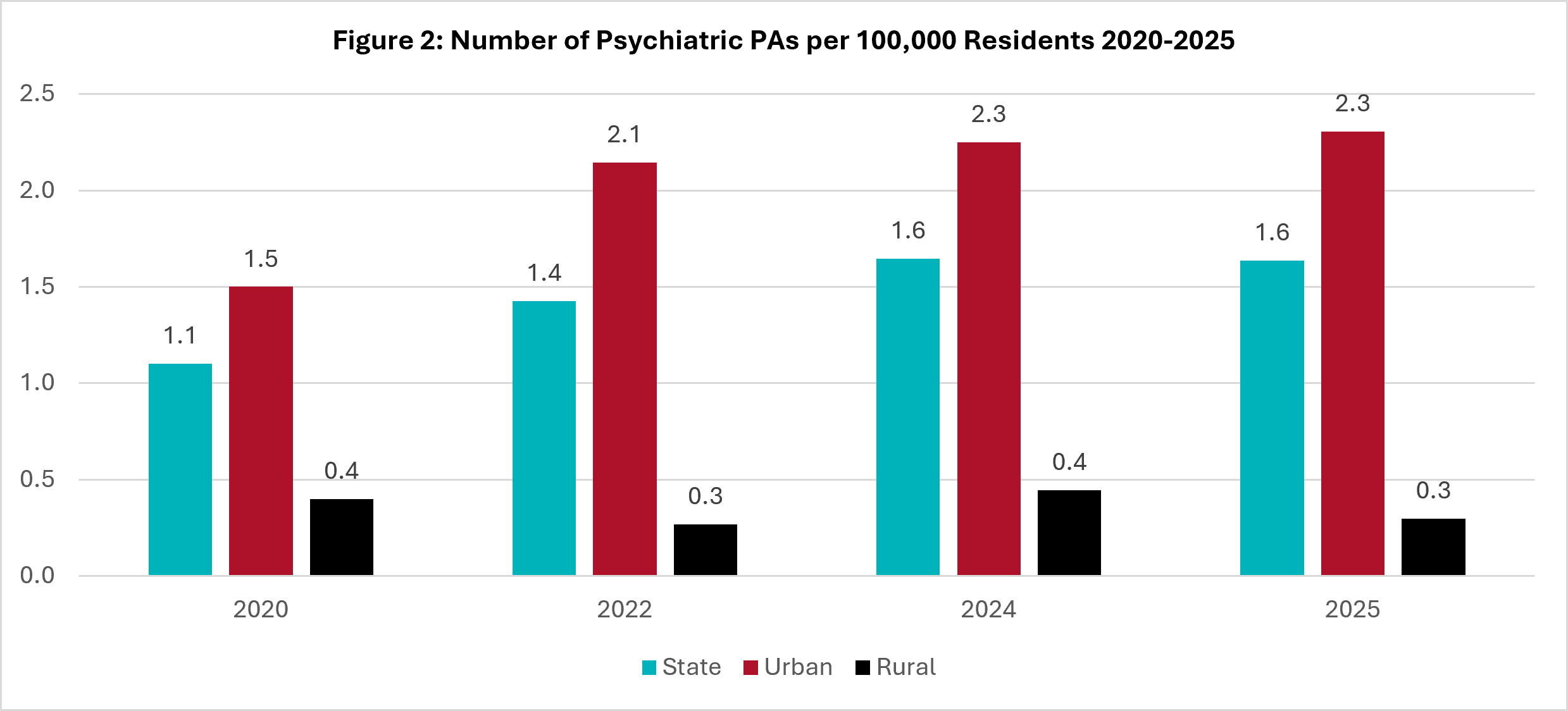
- Nebraska rural counties are below the national average of 0.95 psychiatric PAs per 100,000 population.
- Nebraska has no accredited residency programs for PAs to gain advanced training in psychiatry.
Psychiatric PA Training Programs
PA education takes six to seven years to complete (an undergraduate degree plus a 24-33 month Master’s degree). There are 4 PA programs in Nebraska: Union Adventist University in Lincoln (started in 1997), Creighton and College of St. Mary in Omaha (started in 2019 and 2016, respectively), and University of Nebraska Medical Center in both Omaha and Kearney (started in 1973 & 2015, respectively).
PAs are trained in a broad range of medical specialties, including primary care, and can receive additional education in providing psychiatric-specific care through post-graduate continuing education, on-the-job learning, and mentoring. PAs in psychiatry can also earn the Certification of Added Qualifications in Psychiatry (CAQ-Psych) from the national certifying body. Some states offer residency training programs in psychiatry for PAs, though no such program is currently available in Nebraska.
Regional Trends
The number of psychiatric PAs practicing in Nebraska increased 57% from 2020 to 2025 (from 21 to 33). However, psychiatric PAs remain largely concentrated in Nebraska Department of Health and Human Services behavioral health Regions 5 and 6 (see Figure 1).
Rural and Urban Distribution of Psychiatric PAs
The state’s average number of psychiatric PAs per 100,000 residents has grown from 1.1 to 1.6 since 2020, but rural areas still have significantly fewer psychiatric PAs per 100,000 residents compared to urban areas (see Figure 2). At 0.3 psychiatric PAs per 100,000 residents, Nebraska rural counties are below the national average of 0.95 psychiatric PAs per 100,000 population.
Age of Psychiatric PAs
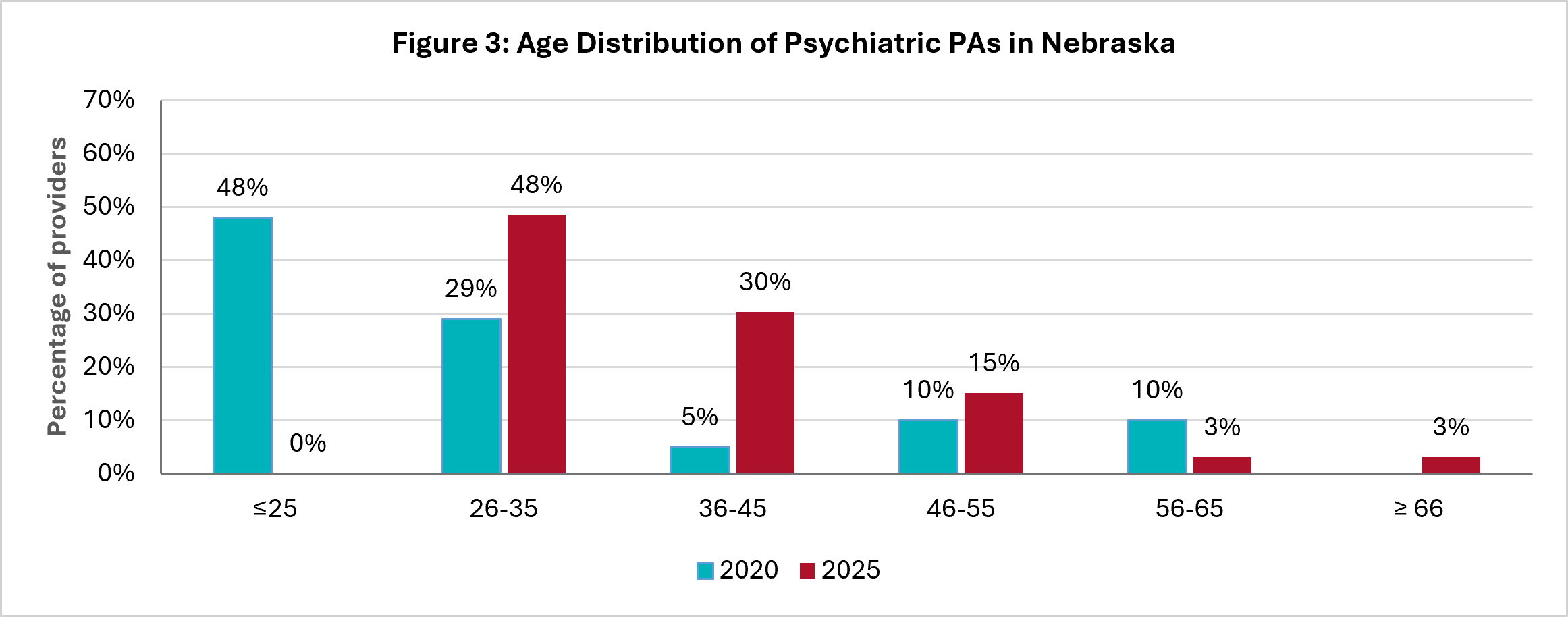
Since 2020, the number of psychiatric PAs at or nearing retirement age has decreased. The number of psychiatric PAs aged 26-45 increased significantly, with 78% of this provider population ≤ age 45 (see Figure 3).
Conclusions
The Nebraska psychiatric PA workforce has grown since 2020, and numbers exceed the national average per 100,000 population in urban areas. Still, the profession faces important challenges including few training programs, no psychiatry residency opportunities in Nebraska, and stagnant workforce growth in rural areas.
Suggested citation:
Behavioral Health Education Center of Nebraska. (2026). The Psychiatric Physician Assistant Workforce in Nebraska: 2020 to 2025.
Footnotes
[1] BHECN analyzes data provided by the Health Professions Tracking Service (HPTS) to determine the number and type of licensed behavioral health professionals practicing in Nebraska. HPTS receives monthly licensure information from the Nebraska Department of Health and Human Services. Licensure data does not include practice location, and an active license does not necessarily indicate that a provider is currently practicing in Nebraska, as providers may maintain a license after moving or practicing in another state, leaving clinical practice, or retiring. To address these gaps in the licensure data, HPTS also sends annual surveys to all licensed behavioral health care providers that ask about practice location(s) and provider and patient demographic characteristics. BHECN continually reviews and refines its data collection procedures and verification protocols to increase provider engagement. While this approach may yield more conservative estimates than licensure counts alone, it provides a more realistic picture of the workforce available to deliver behavioral health services in Nebraska.
[2] National Commission on Certification of Physician Assistants (2024). Statistical Profile of Board Certified PAs by Specialty, annual report. https://www.nccpa.net/wp-content/uploads/2025/08/2024-Statistical-Profile-of-Board-Certified-PAs-by-Specialty.pdf