The Psychiatry Workforce in Nebraska: 2020 to 2025
Purpose
This data snapshot includes information about the psychiatry workforce in Nebraska from 2020 to 2025.1 Psychiatrists are licensed physicians who specialize in the diagnosis, treatment, and prevention of mental illnesses. Psychiatrists prescribe medications and provide therapy and care for patients with complex medical problems. Psychiatrists work in numerous settings, including academic health centers, private practices, hospitals and emergency rooms, primary care clinics, community agencies, courts and prisons, long-term care/assisted living/hospice, industry, government, military settings, schools and universities, and substance use programs.
Key Findings
- The Nebraska psychiatry workforce grew 5% from 2020 to 2025.
- The number of psychiatrists increased in half of the Nebraska behavioral health regions, including some rural areas, but rural areas still are underserved.
- Nebraska rural counties are substantially below the national average of 8 psychiatrists per 100,000 population.
- Growth in the number of psychiatrists in Nebraska is potentially constrained by the long training period and limited number of training programs and statewide training opportunities.
Psychiatry Training Programs
Of all the behavioral health professions, it takes the longest to become a psychiatrist. The average length of training is 12 years (4 years to complete a Bachelor’s degree; 4 years of medical school; and 4 years of psychiatry residency). Additionally, post-residency fellowships of 1-2 years are common. Nebraska has two psychiatry residency programs: Creighton University and the University of Nebraska Medical Center (UNMC). The Creighton program was established in 1987, and the UNMC program was established in 2020. Each program supports up to 6 new residents per year (an increase of 1 spot from 2024).
Psychiatry training spots in Nebraska are much more limited than other behavioral health specialties, due in part to the intensive training required. Furthermore, the residency match process may require students to leave Nebraska to complete training. The National Resident Matching Program® pairs residency program choices of graduating medical students from across the US with those of residency programs seeking trainees. While some Nebraska students may choose to leave for residency, others who may have wanted to stay in Nebraska may match to a program that is elsewhere. In 2025, only 48% of graduating medical students matched to their first-choice program.2
In general, Nebraska retained 51% of the residents who trained here in 2025, ranking it 37th out of the 50 states + D.C. and Puerto Rico.3 In contrast, California (ranked #1) retained 76% of its medical residents.4 More psychiatrists remain in the state where they complete their residency than other specialties (66% vs 56%),4 meaning that if they train outside of Nebraska, they are more likely to stay there than return to Nebraska.
Although both psychiatry residency programs are in Omaha (Region 6), BHECN funding supports rotations in rural areas. Creighton University has the Psychiatry Rural Track Program, which includes rotations in Kearney in Years 3 & 4 of training, and the UNMC program offers rural rotations in Year 2 of training. Residents also can become involved in rural outreach via telehealth.
Regional Trends
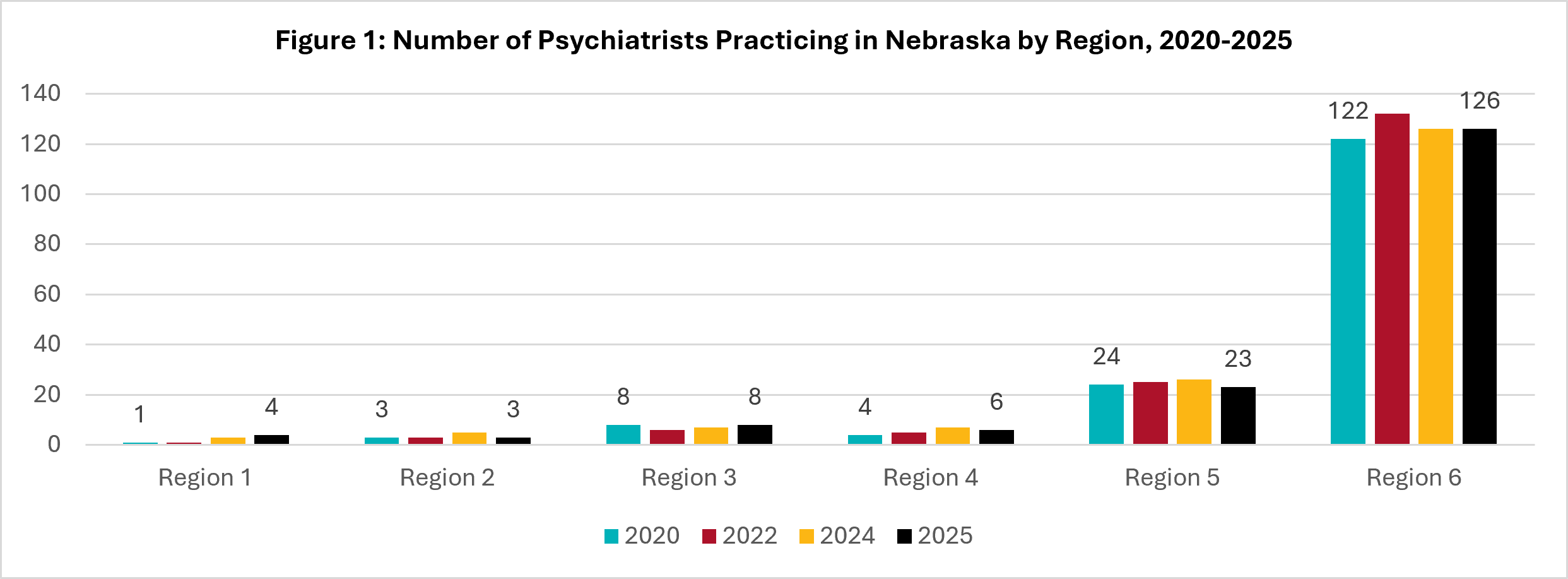
The number of licensed psychiatrists practicing in Nebraska increased 5% from 2020 to 2025 (from 162 to 170). The number of psychiatrists increased in Nebraska Department of Health and Human Services behavioral health Regions 1, 4, and 6; remained the same in Regions 2 and 3; and decreased in Region 5 (see Figure 1).
Rural and Urban Distribution of Psychiatrists
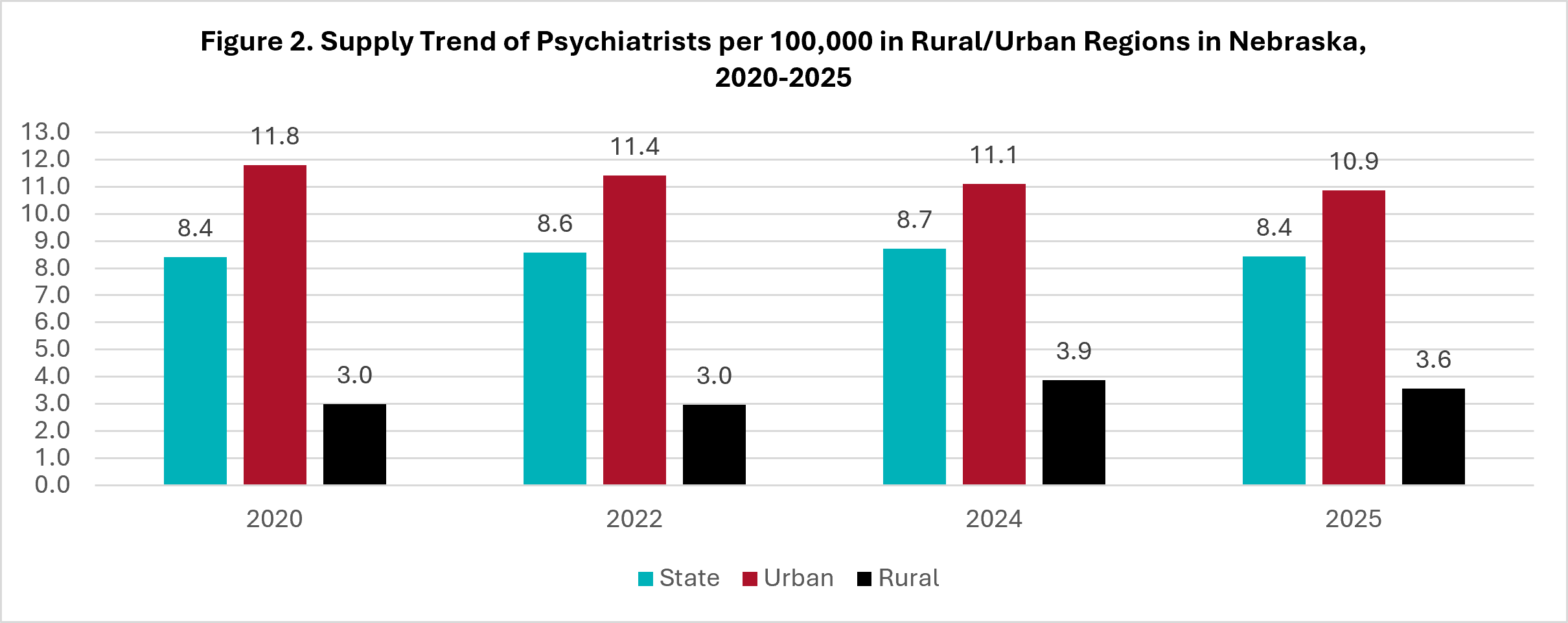
The number of psychiatrists in rural areas increased in 2025, but rural areas still have fewer psychiatrists per 100,000 population compared to urban areas (see Figure 2). At just under 4 psychiatrists per 100,000 population, Nebraska rural counties are substantially below the national average of 8 psychiatrists per 100,000 population.5 According to a 2026 study, psychiatry is already experiencing the greatest supply/demand mismatch among physician specialties across the US in comparison to 20 other specialties including family medicine, general internal medicine, and pediatrics.6 Demand for psychiatrists is expected to increase over the next 12 years while supply is expected to drop over the same period, widening the gap of supply adequacy from 72% currently down to 50% by 2038, with adequacy numbers being lowest in non-metropolitan areas and the Midwest.2
Age of Psychiatrists
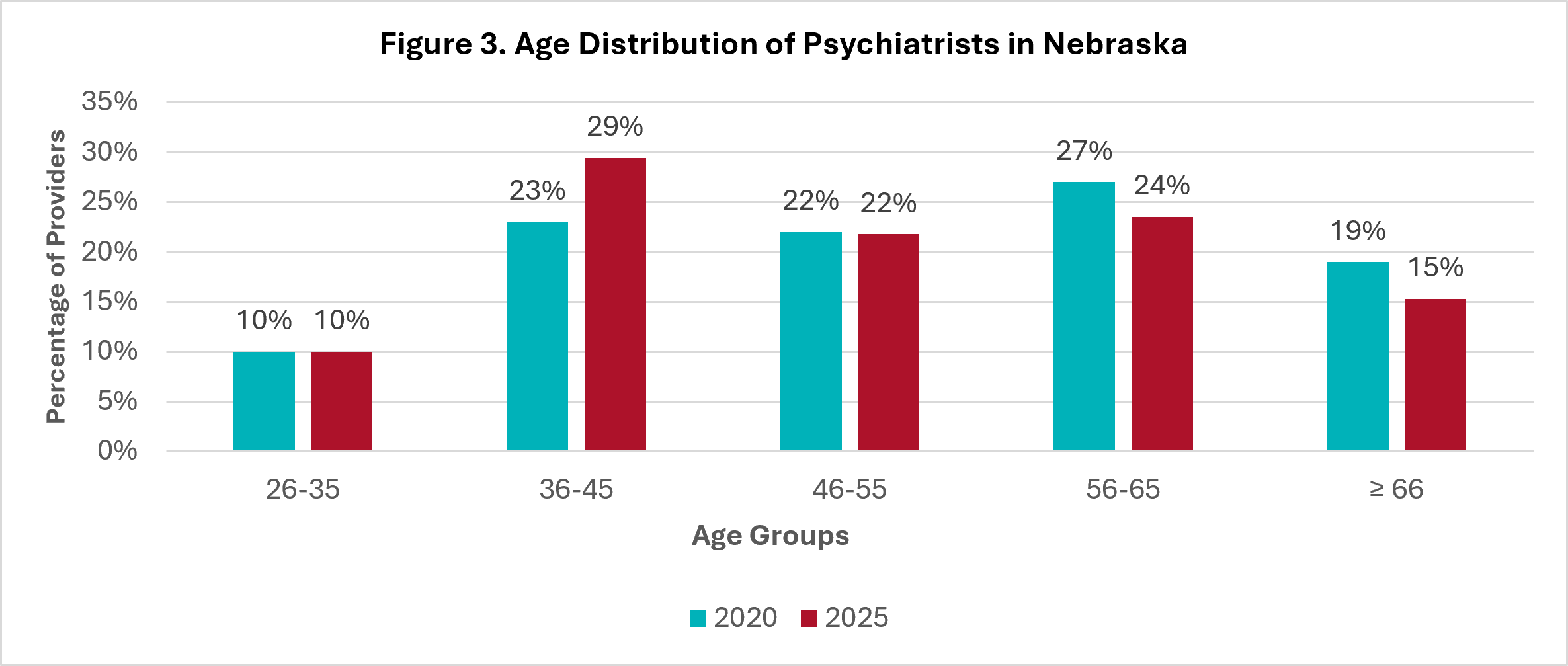
Since 2020, the number of psychiatrists at or nearing retirement age has decreased and the number of psychiatrists aged 36-45 has increased (see Figure 3).
Conclusions
Changes in the psychiatry workforce in Nebraska since 2020 are mixed, with half the behavioral health regions experiencing an increase in number. However, the availability of psychiatrists remains higher in urban areas compared to rural areas, and the number of providers per 100,000 residents is substantially lower than the national average. Growth in the supply of psychiatrists in Nebraska is constrained by the long training period and limited number of statewide training opportunities, and demand is expected to grow over the next decade.
Suggested citation:
Behavioral Health Education Center of Nebraska. (2026). The Psychiatry Workforce in Nebraska: 2020 to 2025.
Footnotes
[1] BHECN analyzes data provided by the Health Professions Tracking Service (HPTS) to determine the number and type of licensed behavioral health professionals practicing in Nebraska. HPTS receives monthly licensure information from the Nebraska Department of Health and Human Services. Licensure data does not include practice location, and an active license does not necessarily indicate that a provider is currently practicing in Nebraska, as providers may maintain a license after moving or practicing in another state, leaving clinical practice, or retiring. To address these gaps in the licensure data, HPTS also sends annual surveys to all licensed behavioral health care providers that ask about practice location(s) and provider and patient demographic characteristics. BHECN continually reviews and refines its data collection procedures and verification protocols to increase provider engagement. While this approach may yield more conservative estimates than licensure counts alone, it provides a more realistic picture of the workforce available to deliver behavioral health services in Nebraska.
[2] AAMC (2025). Results and Data: 2025 Main Residency Match. https://www.nrmp.org/wp-content/uploads/2025/05/Main_Match_Results_and_Data_20250529_FINAL.pdf
[3] AAMC (2025). Report on Residents. https://www.aamc.org/data-reports/students-residents/data/report-residents/2025/table-c6-physician-retention-state-residency-training-state
[4] AAMC. (2025). Physician Retention in State of Residency Training, by Last Completed GME Specialty, 2015-24. https://www.aamc.org/data-reports/students-residents/data/report-residents/2025/table-c4-physician-retention-state-residency-training-last-completed-gme
[5] Association of American Medical Colleges (Oct. 26, 2023) Who's Your Therapist? Examining the Behavioral Health Workforce | AAMC
[6] Silvestre, J., Seeger, S., Reitman, C. A., & Dube, B. (2026). Supply, demand, and adequacy of the adult psychiatry workforce in the United States: Projecting a shortage to 2038. Journal of Psychiatric Research, 199(2026), 98-103. DOI: 10.1016/j.jpsychires.2026.04.019
[7] AAMC (2025). Results and Data: 2025 Main Residency Match. https://www.nrmp.org/wp-content/uploads/2025/05/Main_Match_Results_and_Data_20250529_FINAL.pdf
[8] AAMC (2025). Report on Residents. https://www.aamc.org/data-reports/students-residents/data/report-residents/2025/table-c6-physician-retention-state-residency-training-state
[9] AAMC. (2025). Physician Retention in State of Residency Training, by Last Completed GME Specialty, 2015-24. https://www.aamc.org/data-reports/students-residents/data/report-residents/2025/table-c4-physician-retention-state-residency-training-last-completed-gme