The Psychology Workforce in Nebraska: 2020 to 2025
Purpose
This data snapshot includes information about the licensed psychology workforce1 from 2020 to 2025. A licensed psychologist is an independently licensed behavioral health professional who performs psychological assessments, provides therapy, and conducts research on mental health disorders. Licensed psychologists must have a doctoral degree in an applied area of psychology, such as clinical, school, or counseling psychology. Only psychologists licensed through the Department of Health & Human Services are included here.
Key Takeaways
- The number of psychologists in Nebraska has remained relatively flat (-0.3%) between 2020 and 2025.
- Although there is a shortage of psychologists across the state, the shortage is especially pronounced in rural areas.
- The number of psychologists in Nebraska is below the national average.
- There is only one university in Nebraska that offers doctoral programs in school, clinical and counseling psychology, and there are limited internships and postdoctoral fellowship positions.
Psychology Training Programs
Psychology requires the second-most years of education (behind psychiatry) for licensure in the state of Nebraska. The average length of training for psychologists is 10+ years: 4 years to complete a Bachelor’s degree; 5 years to earn a doctoral degree, including a 1-year internship; and another year of post-doctoral supervised experience while holding a provisional license. There are three American Psychological Association (APA) accredited doctoral psychology programs in Nebraska, all at the University of Nebraska Lincoln (School, Clinical, and Counseling Psychology).
BHECN supports psychology training in several ways, including direct financial support for several psychology intern stipends and a rural housing stipend for 3-4 trainees completing training in rural areas each academic year. In 2025-26, trainees in Kearney, Norfolk, and Chadron received support. In 2026-27, a Hastings trainee will also be supported.
Findings from BHECN’s Nebraska Health Workforce Partnership (NEBWP) 2025 Summit2 and the evaluation of the BHECN ARPA program3 indicate that after graduation, provisionally licensed providers and their supervisors need additional financial support to address supervision, licensing, and credentialing challenges.
Regional Trends
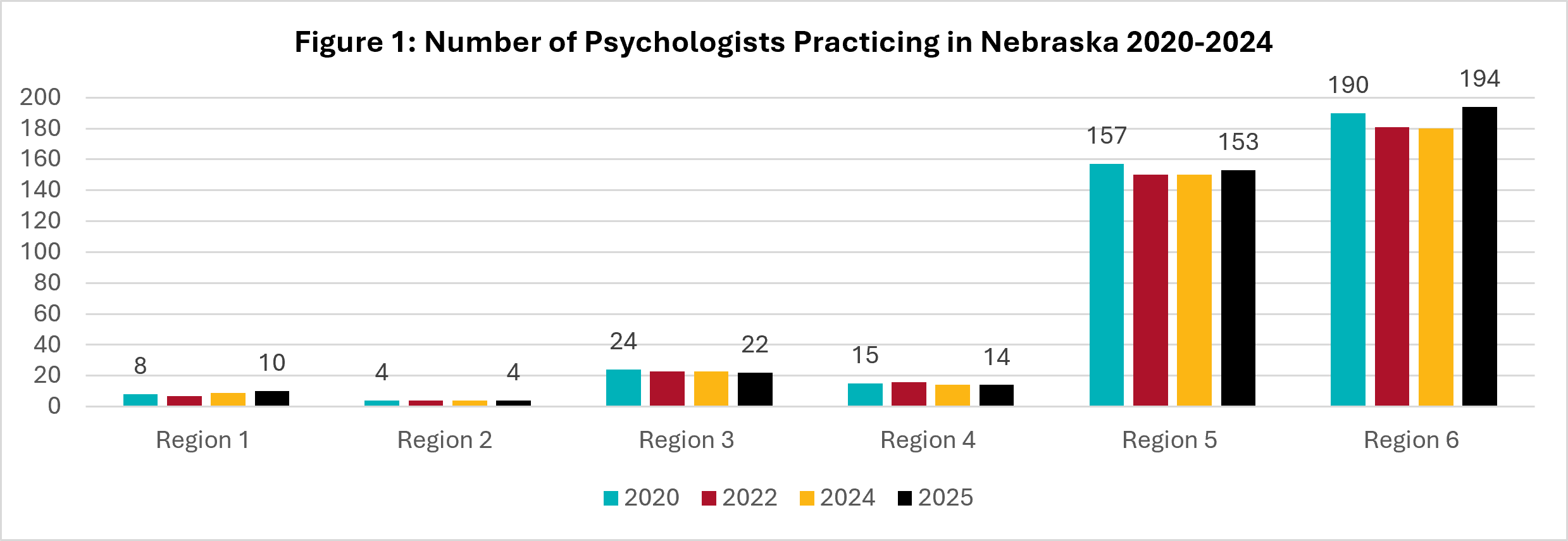
The number of licensed psychologists practicing in Nebraska increased 25% from 2010 to 2020 (from 318 to 398) but then decreased 0.3% from 2020 to 2025 (from 398 to 397). From 2020 to 2025, the number of psychologists increased in Nebraska Behavioral Health Regions 1 and 6, remained stable in Region 2, and decreased in Regions 3-5 (see Figure 1).
Rural and Urban Distribution of Psychologists
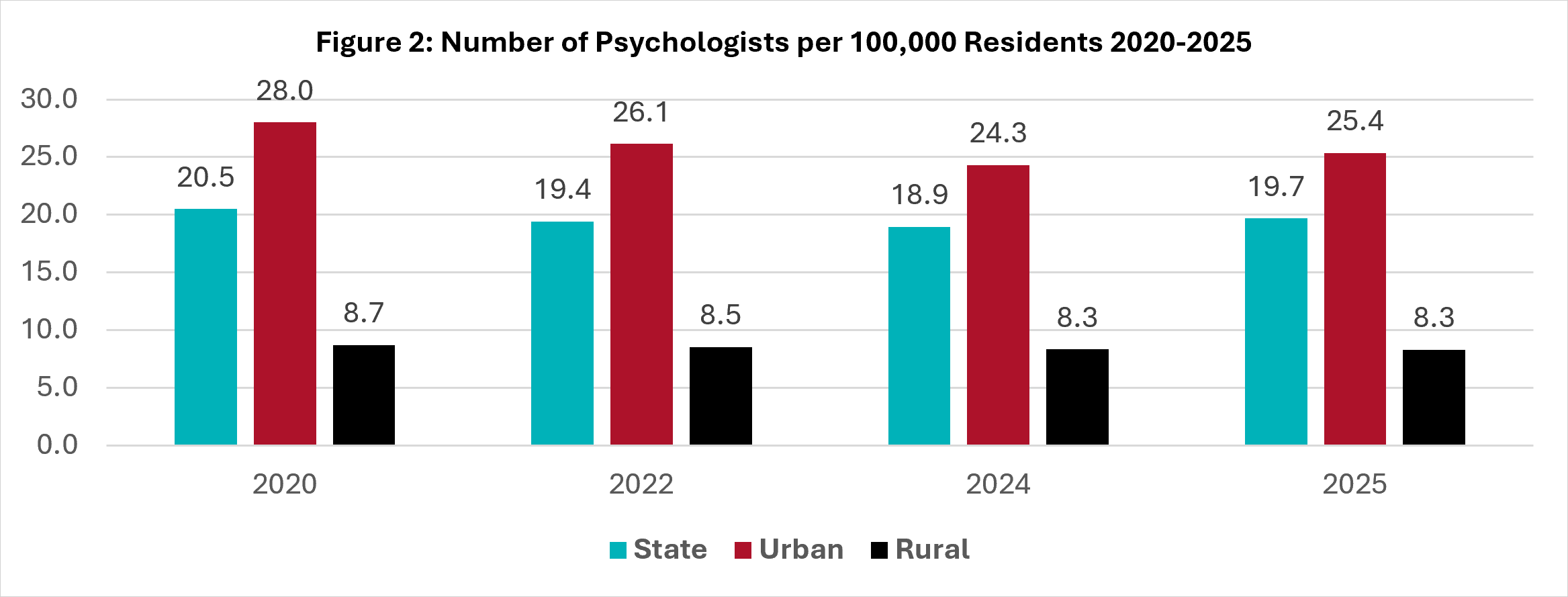
The number of psychologists per 100,000 population decreased in both rural and urban areas of Nebraska from 2020 to 2025 (see Figure 2). The availability of psychologists is more than twice as high in urban areas as in rural areas. Further, the number of psychologists in Nebraska is below the national average of 30 providers per 100,000 population in both rural and urban areas.4
Age of Psychologists
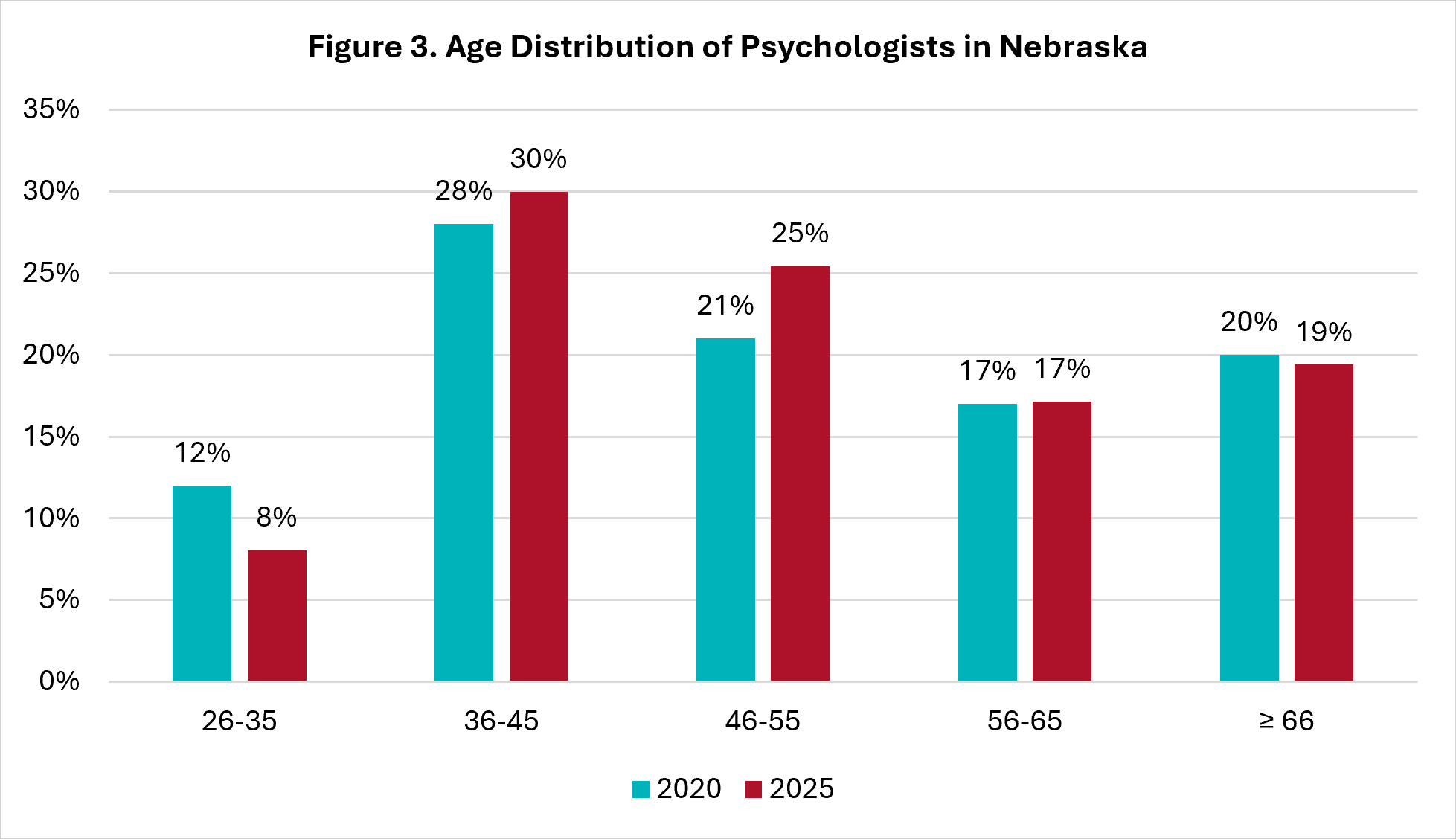
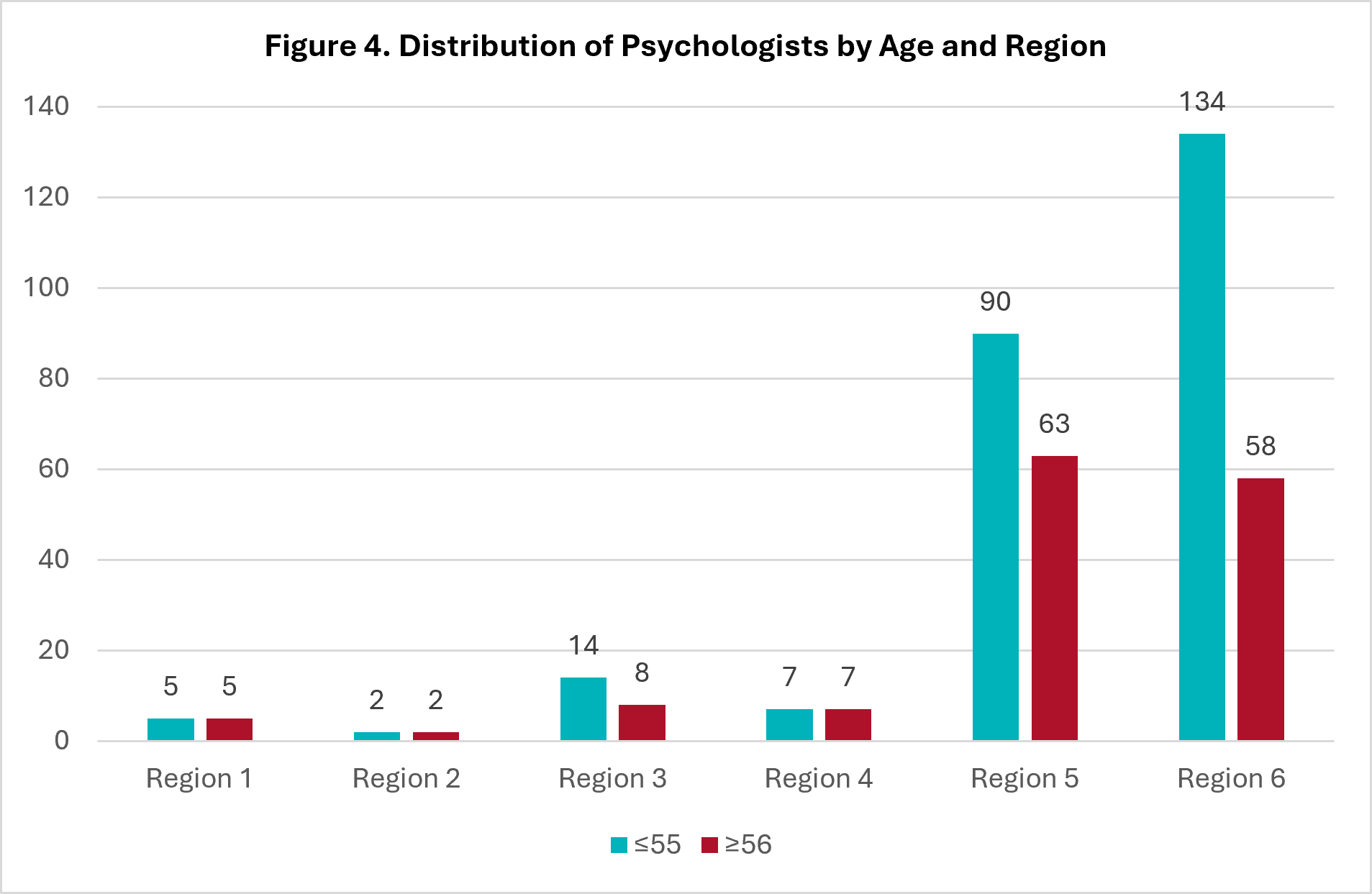
Since 2020, the number of psychologists at or nearing retirement age has decreased slightly and the number of psychologists aged 36-55 has increased (see Figure 3). However, the younger providers are heavily clustered in Regions 5 and 6, with the distribution of provider ages in Regions 1-4 split fairly evenly between ≤55 and ≥56 (see Figure 4).
Conclusions
After steadily increasing for 10 years, the number of psychologists in Nebraska remained flat between 2020 and 2025, with more early-career psychologists clustered in the larger metropolitan areas of the state. Although the number of psychologists per 100,000 residents is lower than the national average in all areas, the shortage of psychologists is especially pronounced in rural areas. There is only one university in Nebraska that offers APA-accredited doctoral programs in school, clinical, and counseling psychology. There are also several known challenges in Nebraska that prevent substantial increases in the psychology workforce, including a shortage of internships and supervised post-doctoral positions.
Suggested citation:
Behavioral Health Education Center of Nebraska. (2026). The Psychology Workforce in Nebraska: 2020 to 2025
Footnotes
[1] BHECN utilizes data from the UNMC Health Professions Tracking Service to determine the number and type of licensed behavioral health professionals who practice in Nebraska. Licensure data is received by HPTS from NE DHHS monthly and is then verified via annual employment verification, surveys, phone calls, and other means. HPTS uses annual employment verification and surveys to collect demographic information about providers, particularly practice location, so individuals who have not completed these are not included in the HPTS count. DHHS does not require individuals to provide a practice location, so DHHS data only indicates who is allowed to practice in Nebraska, not who is actually practicing in Nebraska or where.
[2] BHECN (2025). Nebraska Behavioral Health Workforce Partnership Summit 2025 Report.
[3] Buche, J., Wayment, C., Buckland, S., Doyle, M., & Tibbits, M. (2026). Reducing behavioral health licensure barriers through supervision incentives. Journal of Rural Mental Health, 50(3), 157–170. https://doi.org/10.1037/rmh0000331
[4] National Center for Health Workforce Analysis. (2024). State of the Behavioral Health Workforce, 2024. https://bhw.hrsa.gov/sites/default/files/bureau-health-workforce/state-of-the-behavioral-health-workforce-report-2024.pdf