The Licensed Behavior Analyst & Licensed Assistant Behavior Analyst Workforce in Nebraska: 2025
Purpose
This data snapshot includes information about the Licensed Behavior Analyst (LBA) and Licensed Assistant Behavior Analyst (LABA) workforce in Nebraska in 2025.1
LBAs assess behavior and environment to design, implement, and monitor behavior interventions to produce socially significant improvements for individuals across the lifespan. LBAs frequently work with individuals with intellectual and developmental disabilities, including autism, and may work in clinical, school, or community agencies. LBAs must be Board Certified Behavior Analysts (BCBA) in order to practice in Nebraska.
LABAs are responsible for implementing behavioral treatment plans and working directly with clients; collecting behavioral data; working with parents, caregivers, teachers, and others; and communicating with the LBA so that they may modify treatment plans. They are supervised by LBAs in their work and must be a Board Certified Assistant Behavior Analyst (BCaBA) to practice in Nebraska.
Key Takeaways
- BHECN began tracking the LBA and LABA workforce in 2025.
- LBAs and LABAs are largely concentrated in Nebraska’s urban areas.
- Nebraska’s only LBA and LABA training programs are in or near Omaha.
- Most of the LBA and LABA workforce are under age 45.
- The number of LIMHPs per 100,000 residents is below the national average.
LBA Training Programs
Nebraska is one of 37 states that require a license to practice as a Behavior Analyst.2 It has one Applied Behavior Analysis education program, run jointly by the University of Nebraska at Omaha and the University of Nebraska Medical Center Monroe Myer Institute. LBA education requires a minimum set of prerequisite coursework (though most students obtain a Bachelor’s degree) followed by a 2-year Master of Science in Applied Behavior Analysis degree. The Master’s degree includes supervised fieldwork, which can be completed in one of three emphasis areas: Intensive Clinical Services, Clinical Outpatient Behavioral Health, and School-based Services. Once the Master’s degree education and supervised fieldwork are completed, the student is eligible to sit for the Board Certified Behavior Analyst (BCBA) exam. Once board certified, they may apply for Nebraska licensure. Nebraska’s LBA program graduates about 10 students per year.
LABA Training Programs
Two schools in Nebraska offer training leading to the LABA. The University of Nebraska at Omaha offers a Psychology undergraduate degree with a concentration in Applied Behavior Analysis. This concentration contains the coursework and opportunities for supervised fieldwork that are required to be eligible to sit for the Board Certified Assistant Behavior Analyst (BCaBA) exam.4 Midland University (located in Fremont, NE) offers a Bachelor of Arts in Applied Behavior Analysis which fulfills the requirements for BCaBA certification eligibility. Once board certification is obtained, the individual may apply for Nebraska licensure. LABAs must practice under the supervision of a BCBA.
Regional Trends
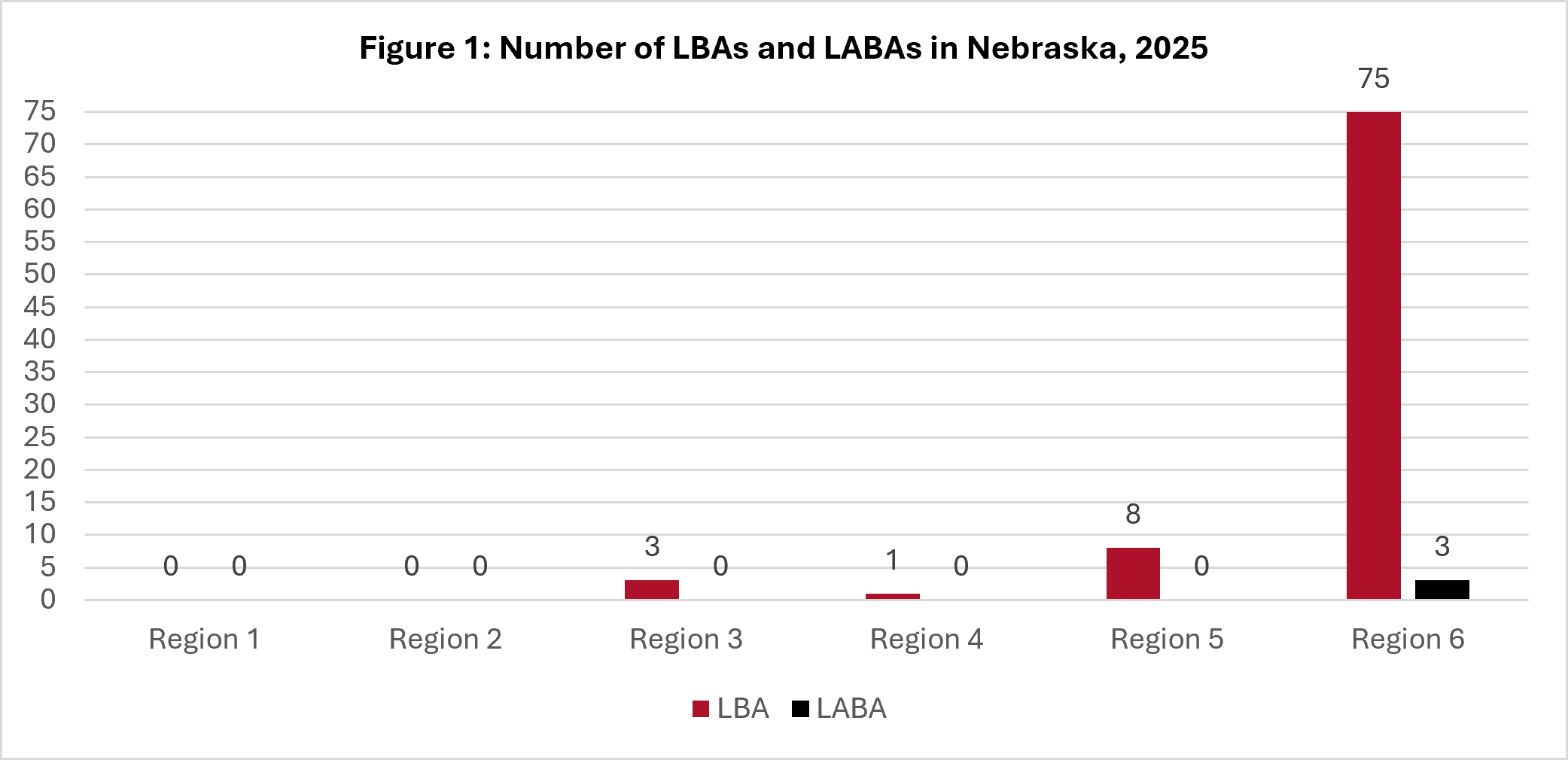
There were 87 LBAs in Nebraska in 2025. Two of the 6 Nebraska behavioral health regions have no LBA providers (Regions 1 and 2), and the vast majority are concentrated in Region 6. There are only 3 LABAs confirmed to be practicing in Nebraska, and all are in Region 6. (see Figure 1)
Age of LBAs and LABAs
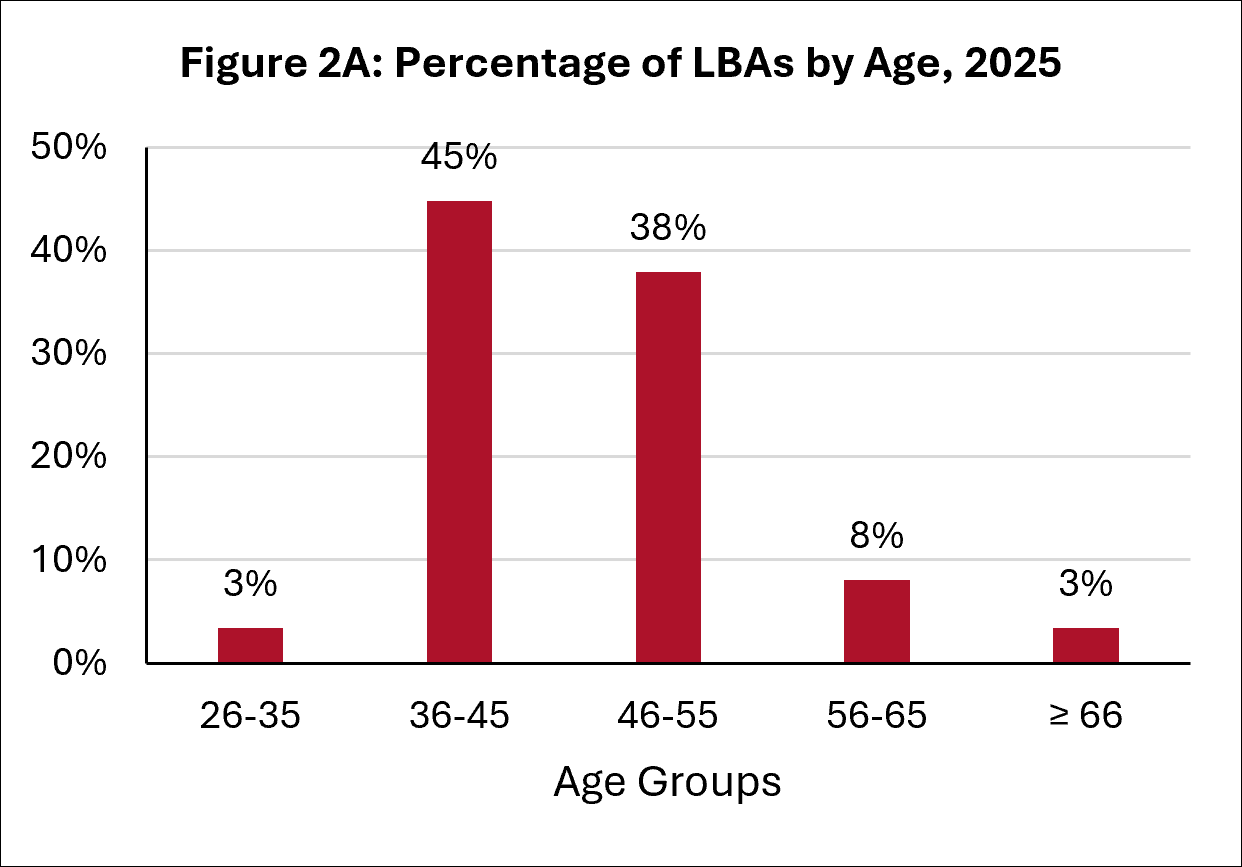
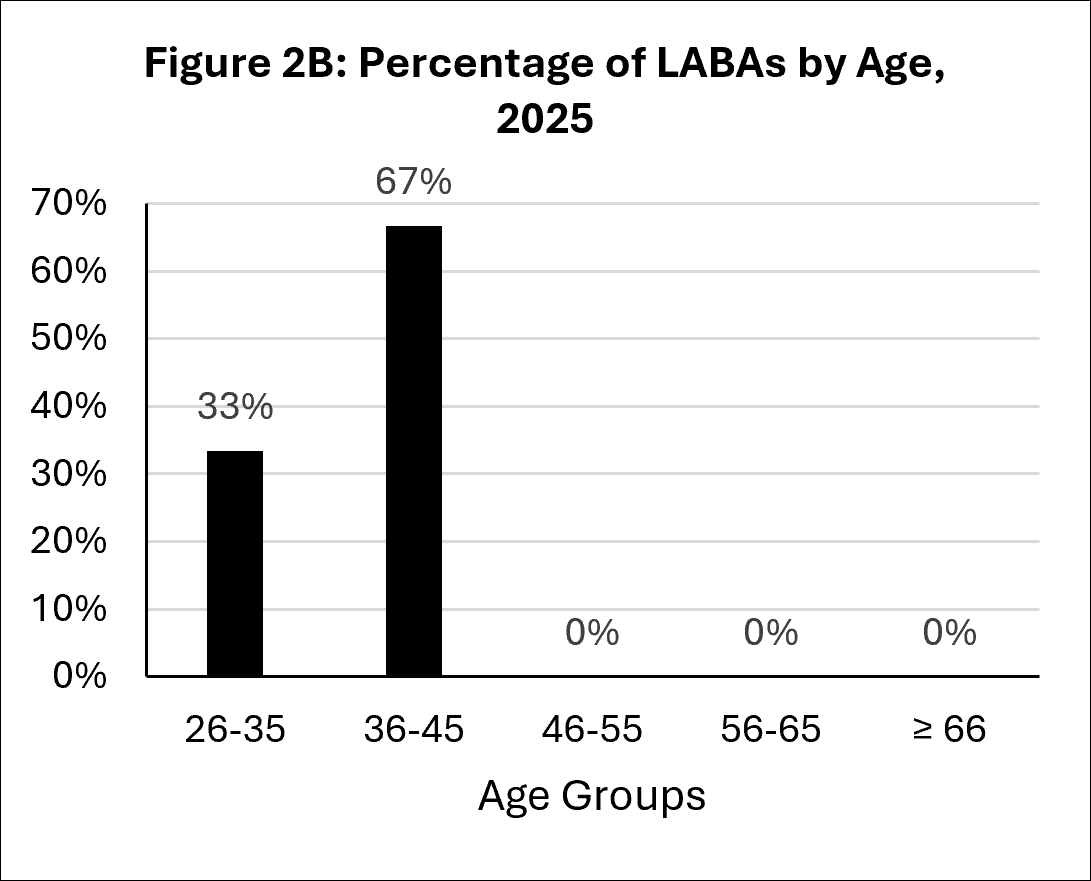
LBAs and LABAs are predominantly younger providers, with the majority being ≤45 years of age.
Conclusions
LBAs and LABAs make up a relatively small proportion of the behavioral health workforce in Nebraska and are largely concentrated in the metro areas. However, demand for their services is increasing. Nationally, demand is projected to increase by 17% over the next 10 years – significantly faster than the average. Currently, Nebraska only has one training program for LBAs and two for LABAs, all in or near Omaha.
Suggested citation:
Behavioral Health Education Center of Nebraska. (2026). The Licensed Behavior Analyst & Licensed Assistant Behavior Analyst Workforce in Nebraska: 2025.
Footnotes
[1] BHECN analyzes data provided by the Health Professions Tracking Service (HPTS) to determine the number and type of licensed behavioral health professionals practicing in Nebraska. HPTS receives monthly licensure information from the Nebraska Department of Health and Human Services. Licensure data does not include practice location, and an active license does not necessarily indicate that a provider is currently practicing in Nebraska, as providers may maintain a license after moving or practicing in another state, leaving clinical practice, or retiring. To address these gaps in the licensure data, HPTS also sends annual surveys to all licensed behavioral health care providers that ask about practice location(s) and provider and patient demographic characteristics. BHECN continually reviews and refines its data collection procedures and verification protocols to increase provider engagement. While this approach may yield more conservative estimates than licensure counts alone, it provides a more realistic picture of the workforce available to deliver behavioral health services in Nebraska. LABAs and LBAs began receiving the survey in 2025. This document presents non-hierarchical counts, which means all providers are included in these numbers, regardless of whether they hold other license types.
[2] University of Nebraska at Omaha. State Licensure Information Document. https://www.unomaha.edu/college-of-arts-and-sciences/psychology/_files/documents/aba/licensure-match-2024.pdf Accessed August 19, 2026
[3] University of Nebraska at Omaha. Applied Behavior Analysis Frequently Asked Questions. https://www.unomaha.edu/college-of-arts-and-sciences/psychology/academics/graduate-programs/aba-program/abaFAQ.php Accessed August 19, 2026
[4] University of Nebraska at Omaha. Applied Behavior Analysis Concentration. Concentration in Applied Behavior Analysis | Department of Psychology | University of Nebraska at Omaha. Accessed August 19, 2026
[5] AppliedBehaviorAnalysisEdu.org (2026). Careers in Applied Behavior Analysis https://www.appliedbehavioranalysisedu.org/careers/ Accessed August 19, 2026