Career Preparation: Supporting and Guiding Students Interested in Behavioral Health Careers
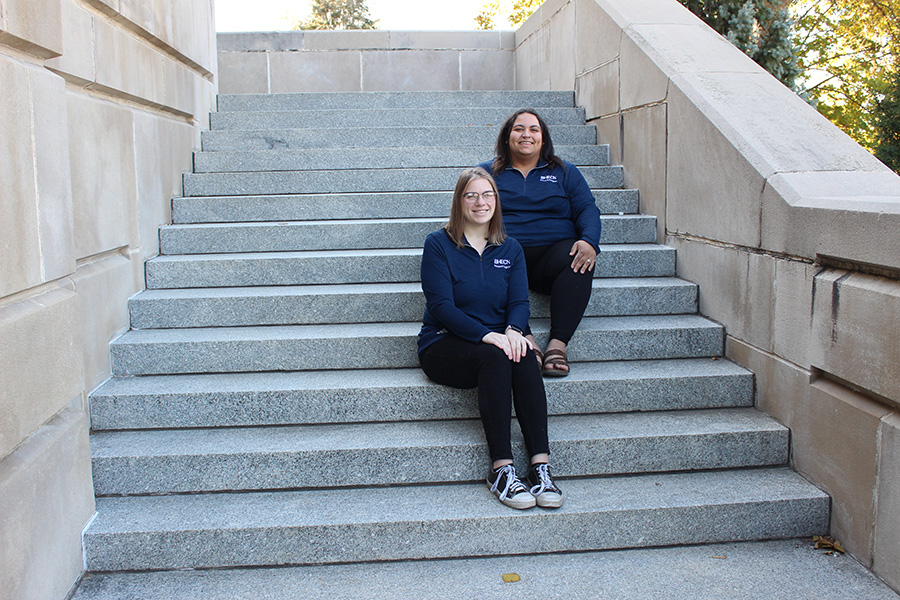
Patricia Parish (left) and Bianca Mullikin are members of the first BHECN Scholars cohort. Both are now enrolled in behavioral health master's degree programs.
Were it not for therapy and behavioral health practitioners, Patricia Parish isn’t sure her Lincoln-based family would have made it through the struggles they faced during her childhood.
“The issues and challenges our family experienced were numerous and intense — too much for us to handle without help,” Parish said.
The gratitude she felt toward the professionals who supported her family inspired her to pursue the field herself, so she could help others facing similar struggles.
After working through bouts of self-doubt and a brief stint as an education major at the University of Nebraska–Lincoln, Parish switched majors to follow her passion.
It was during her time as an undergraduate that she learned about the BHECN Scholars program — a pathway program that supports undergraduate seniors who plan to pursue master’s degrees in Nebraska-based behavioral health programs after graduation. The purpose of BHECN Scholars is to recruit students from across the state into the behavioral health workforce and ensure their success as practicing, licensed professionals in Nebraska.
Scholars receive tuition support, mentorship, and professional development, and they participate in social and learning opportunities built around a cohort model. The program is a key component of the Career Preparation pillar of the Nebraska Model.
As she considered graduate school and a career in marriage and family counseling, Parish again wrestled with self-doubt. But the support promised by the BHECN Scholars program gave her hope. She applied, was accepted, and found it was exactly what she needed to move forward with her career in behavioral health.
“The mentoring and professional development offered by the program were vital to me,” she said. “It really helped me see that pursuing this career path was the right move for me.”
The cohort model also proved to be vital to her progress, as it allowed her to connect with other students from across Nebraska who shared her aspiration to become behavioral health professionals.
One member of her cohort, Bianca Mullikin of Wauzeka, Wisconsin, who studied social work at Nebraska Wesleyan University, became one of her closest friends and provided vital social and emotional support.
Together, they completed their undergraduate studies and went on to pursue graduate programs in behavioral health at Nebraska institutions.
Parish is now earning her master’s in marriage and family therapy at UNL, while Mullikin is working toward a master’s degree in social work at Nebraska Wesleyan.
“It seemed like our paths were so connected,” Parish said of Mullikin. “It was so helpful to have someone going through the same things I was during this journey. It really helped me stay on course.”
Mullikin, who started in the Nebraska Wesleyan Master of Social Work program in the fall, said the relationship with Parish helped her maintain focus and drive when her studies became difficult. 
“Having a close relationship with another member of my cohort helped me find more connections within the behavioral health field,” she said. “It has allowed me to become more educated on different pathways while also developing a strong bond with someone who has similar experiences and goals for our careers.”
Of the 11 members of Parish and Mullikin’s BHECN Scholars cohort, nine have gone on to Nebraska-based graduate programs.
Parish and Mullikin’s experience — and the fact that so many of their cohort continued on to
Nebraska programs — demonstrates that the BHECN Scholars program is working exactly as intended, said Alison DeLizza, PhD, (right) BHECN’s associate director of education and interdisciplinary provider relations, who oversees the program.
“It’s incredibly gratifying to hear that Patricia and Bianca had such great experiences with the program and to see them continue on the path toward becoming behavioral health professionals in Nebraska,” Dr. DeLizza said. “Their experience perfectly illustrates our mission at BHECN — growing and strengthening our state’s workforce.”