Distinguished Lectureships
McFadden Lecture Series
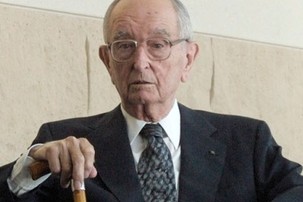
Harry W. McFadden Jr., MD
The Harry W. McFadden Jr., MD Lectureship was established in 1985 by Drs. David Purtilo and Samuel Cohen to honor his valuable and numerous contributions to the fields of pathology and microbiology, and in recognition of his service to the University of Nebraska Medical Center. This lectureship was expanded by the Class of 1964 College of Medicine Alumni in 1989 on their 25th reunion as a tribute to his role as an outstanding educator, practitioner, and friend. The first presenter of the lectureship, Dr. Tucker LeBein, had been one of Dr. McFadden’s graduate students. The lectureship has become one of the most notable occasions of the year at UNMC, and has included numerous outstanding lecturers, including three Nobel Prize laureates as well as a Nebraska governor. The lectures were always attended by both Dr. McFadden and his wife, Jo, until their deaths, and frequently also by their son, Dr. Harry E. McFadden and his family, and by their daughter, Mary Jean McFadden.
About Dr. McFadden
Dr. Harry W. McFadden, Jr., received an A.B. degree from the University of Nebraska, Lincoln (1943) and his M.D. degree from the University of Nebraska Medical Center (1943), being elected Phi Beta Kappa in college and Alpha Omega Alpha in medical school. Following completion of a rotating internship and pathology residency at the University of Nebraska Hospital (1944-1945, 1947-1949), interrupted by two years in the armed services (1945-1947), he joined the faculty at the University of Nebraska Medical Center (UNMC) in 1949 in the Department of Pathology and Bacteriology as an instructor, staying at UNMC his entire career. He was promoted to Assistant Professor (1952) and became the first (and only) chair of the newly formed Department of Medical Microbiology and Immunology in 1955, a position in which he served until his retirement in 1985. He was promoted to professor in 1968. He had joint appointments in Microbiology and in Pathology, and was the director of the Medical Microbiology Laboratories of the University Hospital. Upon his retirement, the separated departments of Pathology and Laboratory Medicine and Medical Microbiology and Immunology were remerged as the combined Department of Pathology and Microbiology.
Dr. McFadden was an outstanding educator, and was beloved by medical students. He received the Teaching Award by the senior class in 1953, was named the Outstanding Educator and Friend by the senior class of 1955, and he received the Basic Science Award for teaching by the senior class in 1958, 1959, 1961, 1962, and 1967. He also served as the interim dean for Graduate Studies (1972-1979) and as interim chancellor, twice (February–June 1972 and September 1976–July 1977).
He served as president of the Nebraska Association of Pathologists and Speaker of the House of Delegates of the Nebraska Medical Association. He was elected to the Council on Microbiology of the American Society of Clinical Pathologists and served as its chairman for two years. He served as a trustee of the American Board of Pathology (1970-1982), serving as its president in 1981. For his outstanding contributions to UNMC, he was awarded the Jack Elliott Award in 1985, and he was named one of the Nebraska Medical Center’s legends in 2006.
Greenfield Lecture Series
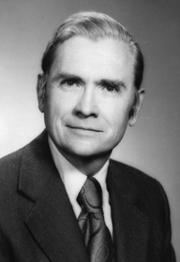
Robert E. Greenfield, MD
The Robert E. Greenfield, MD Lectureship in Carcinogenesis was established in 1985 by Drs. Purtilo and Cohen to honor their mentor. The first Greenfield lecturer was Dr. Takashi Sugimura, who was mentored by Dr. Greenfield while Dr. Sugimura was a fellow at NCI in the 1950s. Dr. Sugimura became the president of the National Cancer Center of Japan in Tokyo. The first 12 presenters of this lectureship had interacted with Dr. Greenfield in some aspect of his career.
About Dr. Greenfield
Dr. Robert E. Greenfield Jr. was born in 1920 and was a biologist at heart. It was only because of the enormous demand for physicians for World War II that he went to medical school, graduating from the University of Illinois in 1945. He interned at the U.S. Marine Hospital in Seattle (1945-1946) and then served a year at the Veteran’s Administration Hospital in Marion, Indiana. He returned to his love of biology, pursuing graduate research at the University of California in Berkeley and then joined the National Cancer Institute in 1950 as a research laboratory chemist, becoming head of the section on tumor-host relations in the laboratory in biochemistry in 1960.
In 1965, Dr. Greenfield began to combine his interests in cancer research with administrative duties, becoming a chief of the Awards Review and Technical Administration branch of extramural activities of the NCI in 1966, and then chief of the Program Analysis Formulation Branch in the office of the director of the NCI until 1971. During this latter period, he was one of the individuals involved with the development of President Richard Nixon’s War on Cancer, receiving one of the pens from President Nixon at the signing ceremony. After a year as associate director for program planning and evaluation at the National Institute of General Medical Sciences, he became deputy director of the National Bladder Cancer Project of the NCI, centered at St. Vincent Hospital in Worcester, Massachusetts, where he remained until his retirement in 1981. During his time at St. Vincent Hospital, he mentored two individuals who eventually became Chairs of the Department of Pathology and Microbiology at the University of Nebraska Medical Center, Dr. David T. Purtilo (chair, 1981-1992) and Dr. Samuel M. Cohen (chair, 1992-2007). Although officially retired, he continued in cancer research as a part-time faculty member in the Department of Pathology and Laboratory Medicine at the University of Nebraska Medical Center from 1981 until his untimely death from cancer in 1985.
In his personal and scientific pursuits, he was generous, uncompromisingly honest, and demanding of excellence. In addition to his busy career, he was active in civic affairs, schools, conservation programs, Indian art, and the Boy Scouts of America. Of greatest importance to Dr. Greenfield was his family, his wife Mary Frances, his children, Richard, Judy and Bruce and their spouses, and his grandchildren.
Previous Recipients
- 2018: Aron E. Lukacher, MD, PhD, Professor and Chair, Department of Microbiology and Immunology, Penn State University
"Polyomavirus CNS Immunovirology" - 2016: Joel Ernst, MD, Director, Division of Infectious Diseases and Immunology, NYU School of Medicine
"Immunity to a 3 million-year-old pathogen - tuberculosis in the 21st century" - 2015: Susan Sharp, PhD, ABMM, FAAM DirectorRegional Microbiology and Molecular Infectious Diseases Laboratories, Kaiser Permanente
“Genomics and Proteomics, is this the end of 'culture' in microbiology?” - 2011: Max Cooper, MD, Professor, Pathology & Georgia Research Alliance Eminent Scholar, Emory University School of Medicine
“Evolution of Adaptive Immunity” - 2010: Kim D. Janda, PhD, Chaired Professor, The Scripps Research Institute
"Interfacing Chemistry with Biology to Discover Molecules with Function” - 2010: Jay K. Kolls, MD, Chair, Department of Genetics, Louisiana State University
“The Role of Th17 Cytokines in Mucosal Immunology” - 2008: Olaf Schneewind, MD, PhD, Louis Block Professor & Chairman, Department of Microbiology, University of Chicago
“Protein Assembly in the Cell Wall Envelope of Gram-Positive Bacteria” - 2007: E. Peter Greenberg, PhD, Professor, Department of Microbiology, University of Washington
“Sociomicrobiology: Communication and Coordination of Group Activities in Bacteria” - 2006: Alexander Tomasz, PhD, Plutarch Papamarkou Professor, Head of the Laboratory of Microbiology, Rockefeller University
“Multiple Strategies of Vancomycin Resistance in Staphylococci” - 2005: The Honorable Dave Heineman, Governor of Nebraska
“Building on the Nebraska Model for Bioterrorism Preparedness” - 2000: Cornelis (Cox) P. Terhorst, PhD, Professor of Immunology, Harvard Medical School, Chief of Division of Immunology, Beth Israel Deaconess Medical Center
“X-Linked Lymphoproliferative Disease: How a Small Gene Prevents a Progressive Immunodeficiency” - 1999: Ralph van Furth, MD, PhD, Emeritus Professor of Internal Medicine and Infectious Disease, University of Leiden
“The Marriage Between Macrophages and Cytokines” - 1998: Peter Charles Doherty, DVSc, PhD, Professor and Nobel Laureate, Department of Pathology & Pediatrics, University of Tennessee
“Immunity in Acute and Persistent Virus Infections” - 1994: Robin A. Weiss, PhD, HonMRCP, PRCPath, Director of Research and Professor of Viral Oncology, Chester Beatty Laboratories, Institute of Cancer Research, London, England
“How Retroviruses Enter Cells” - 1993: David Baltimore, PhD, Professor and Nobel Laureate, Rockefeller University, New York, NY
“NFkB Story” - 1992: Robert A. Good, MD, PhD, DSc, Physician-in-Chief, All Children’s Hospital, Professor of Microbiology-Immunology, University of Florida
“Immunodeficiencies as Experiments of Nature: Continuing Value of a Perspective” - 1991: George Klein, MD, Head, Department of Tumor Biology, Karolinska Institute Stockholm, Sweden
“Tumor Biology of Burkitt’s Lymphoma” - 1989: Michael B. A. Oldstone, MD, Nobel Laureate, Department of Immunology, Scripps Clinic and Research Foundation
“How Viruses Cause Autoimmunity: The Mechanisms of Viral Mimicry” - 1988: Flossie Wong-Stall, PhD, Laboratory of Tumor Cell Biology, National Cancer Institute
“HIV Gene Regulation and Pathogenesis” - 1987: Tucker LeBein, PhD, Department of Pathology, University of Minnesota
“Growth Control and Differentiation of Human B Cell Precursors”
- 2013: Larry Gold, PhD, Chairman of the Board & CEO
SomaLogic, Professor, Department of Molecular, Cellular, and Developmental Biology, University of Colorado Boulder
"Proteomics and Human Health" - 2007: Margaret L. Kripke, PhD, Executive Vice President
Chief Academic Officer, Professor of Immunology, Vivian L. Smith Distinguished Chair of Immunology, University of Texas M.D. Anderson Cancer Center, Member of President G.W. Bush’s Cancer Panel, National Cancer
Institute
“Current Challenges in Reducing the Burden of Cancer” - 2001: Janardan K. Reddy, MD, Magerstadt Professor and Chairman, Department of Pathology, Northwestern University Medical School
“Peroxisome Proliferator-active Receptors: Lipid Metabolism and Cancer” - 1999: Peter A. Jones, PhD, DSc, Director, Norris Comprehensive Cancer Center, USC/Norris Comprehensive Cancer Center
"Methylation Changes in Human Cancer" - 1998: Curtis C. Harris, MD, Chief, Laboratory of Human
Carcinogenesis, Head of Molecular Genetics and Carcinogenesis Section, National Cancer Institute
“Tumor Suppressor Genes" - 1997: Brian E. Henderson, MD, Professor, Department of Preventive Medicine, University of Southern California Norris Comprehensive Cancer Center
"Genetic Susceptibility to Prostate and Breast Cancer" - 1994: Leopold G. Koss, MD, Chairman Emeritus, Department of Pathology, Albert Einstein College of Medicine
"Bladder Cancer from Antiquity to Molecular Biology" - 1993: Bruce Ames, PhD, Professor of Biochemistry and
Molecular Biology, National Institute of Environmental
Health Sciences Center, University of California Berkeley
"Understanding the Causes of Aging and Cancer" - 1991: Alfred G. Knudson Jr., MD, PhD, Institute for Cancer Research, Fox-Chase Cancer Center
"Genetic Events in Carcinogenesis" - 1990: Avery Sandberg, MD, Director, The Genetics Center & The Cancer Center
"Heredity and Genetics of Cancer: What Do The Chromosomes Tell Us?" - 1989: Nobuyuki Ito, MD, Chairman, First Department of
Pathology, Nagoya City University Medical Center
"Antioxidants--Carcinogenesis and Modification” - 1988: Charles M. King, PhD, Chairman, Department of Chemical Carcinogenesis, Michigan Cancer Foundation
"Aromatic Amines: Mechanisms of Carcinogenicity and Mutagenicity" - 1987: Emmanuel Farber, MD, PhD, Professor of Pathology, University of Toronto
"The Development of Cancer with Chemicals: A Different Perspective" - 1986: Takashi Sugimura, MD, President, National Cancer Center
"Multistage Carcinogenesis“