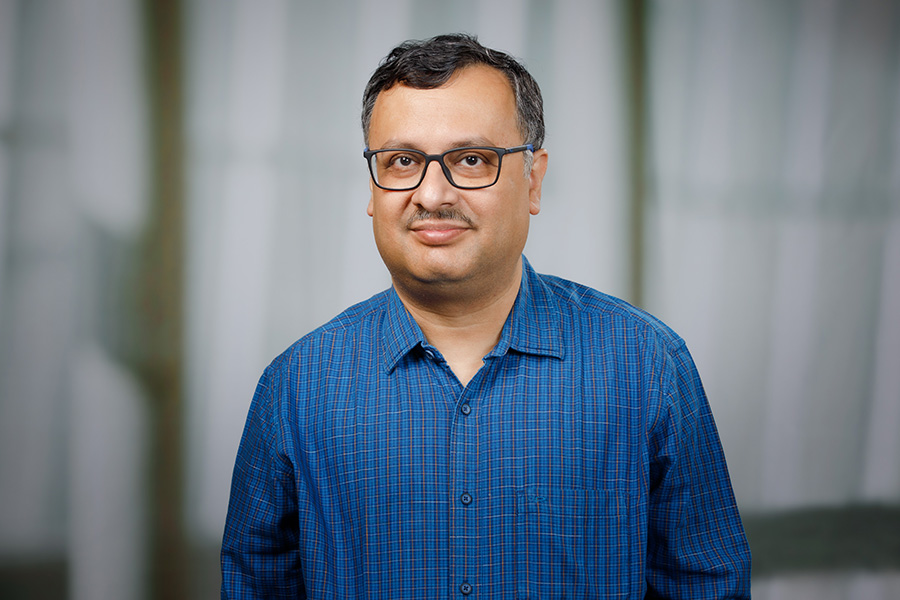
Suvendra Bhattacharyya, MSc, PhD
Education
- PhD in Life Sciences, Indian Institute of Chemical Biology, Jadavpur University, Kolkata, India 2004
- MSc in Biochemistry with Physics and Mathematics, Presidency College, University of Calcutta , India, 1996
2023 JC Bose Fellowship Award, Science and Engineering Research Board
2021 Sun Pharma Award in Medical Sciences, Basic Research
2021 Elected Fellow of the Indian National Science Academy, New Delhi (INSA)
2019 Members of the Joint Science Education Panel of Indian Academy of Sciences,
2018 Khosla Science Award, IIT Roorkee
2017 CDRI Award for Excellence in Drug Research by CSIR-CDRI Lucknow
2017 Members of the Senate of Academy of Scientific and Innovative Research (AcSIR), India
2017 Elected Fellow of the National Academy of Sciences India (NASI)
2017 Elected fellow of the Indian Academy of Sciences, Bangalore (IAS)
2016 Shanti Swarup Bhatnagar Prize in Biological Sciences 2016 by CSIR, Govt. of India (Highest Science award for Scientist working in India)
2016 National Bioscience Award for Career Development by Dept. of Biotechnology, Government of India
2016 Elected Fellow of the West Bengal Academy of Science and Technology, India
2016 Prof B K Bachhawat Memorial Travel Award
2016 Elected Member of the Guha Research Conference, India
2015 Swarna Jayanti Fellowship of Dept of Science and Technology, Govt. of India
2015 NASI-Scopus Young Scientist Award from NASI, India and Scopus, India
2004 AAAS/Science Young Scientist Award given for best PhD work at global level l by AAAS/Science, USA
2004 INSA Young Scientist Award (Highest Science Award for researcher working in India below 32 years)
1998 All India First Rank in GATE 1998 examination in Life Sciences
- Chakraborty S, Bandyopadhyay D, Mukherjee K#, Bhattacharyya S#. (2026). miRNA Sensor HuR Compartmentalizes Ago2-Uncoupled miRNAs to Lipid Droplets to Buffer miRNA Activity in Mammalian Cells. FASEB J. 2026 40(11):e71926. PMID: 42205075. #co-corresponding authors.
- Banerjee S, Hom Choudhury S, Chatterjee S, Hu G, Mukherjee K#, Bhattacharyya SN#. (2026) HuR-driven reversible mitochondrial shuttling buffers cytosolic miRNA levels in hepatic cells. J Biol Chem. 302(4):111255. PMID: 41655692; PMCID: PMC12996657. .#co-corresponding authors.
- Ray, S. Roychowdhury, S. and Chakrabarty, Y., Banerjee, S., Hobbs, A., Chattopadhyay, K., Mukherjee, K., and Bhattacharyya, S.N.(2025) HuR Prevents Amyloid Beta Induced Phase Separation of miRNA-Bound Ago2 to RNA Processing Bodies. Structure (cell press); 33(4):753-770.e5. (Cover Article)
- Hom Choudhury, S., Bhattacharjee, S., Mukherjee, K., Bhattacharyya, S.N. (2024) Human antigen R transfers miRNA to Syntaxin 5 to Synergize miRNA Export from Activated Macrophages. J Biol Chem. J Biol Chem. 2024 300(4):107170.
- Ghosh, S., Hom Choudhury, S., Mukherjee, K., Bhattacharyya, S.N. (2024) HuR-miRNA complex activates RAS GTPase RalA to facilitate endosome targeting and extracellular export of miRNAs. J Biol Chem. 300(3):105750.
- Chatterjee, , Mukherjee, I., Bhattacharjee, S., Bose, M., Chakrabarti, S. #, and Bhattacharyya, S.N. #, (2022) Target-Dependent Coordinated Biogenesis of secondary microRNAs by miR-146a balances macrophage activation processes. Mol Cell Biol. Mar 21:e0045221. #co-corresponding authors.
- Das, , Basu, S., Bandyopadhyay, D., Mukherjee, K., Dutta, D., Chakrabarti, S., Adak, M., Jana, S., Bose, S., Swarnakar, S., Chakrabarti, P. and Bhattacharyya, S. N. $ (2021) Inhibition of Extracellular Vesicle-Associated MMP2 Abrogates Intercellular Transfer of Hepatic miR-122 to Tissue Macrophages and Curtails Liver Inflammation. iScience 12(24) 103428
- De, D., and Bhattacharyya, S. N$. (2021) Amyloid Beta oligomers prevents Lysosomal targeting of miRNP to stop its recycling and target repression in glial cells. J Cell Sci. 134(11) 258360. (Cover Article)
- De, D., Mukherjee, I., Guha, S., Paidi, R. K., Chakrabarti, S., Biswas, S. C., and Bhattacharyya, S. (2021) Rheb-mTOR Activation Rescues Amyloid Beta-Induced Cognitive Impairment and Memory Function by Restoring miR-146 Activity in Glial Cells. Molecular Therapy-Nucleic Acids. (24) 868-887. (Cover Article)
- Ghoshal, B., Bertrand, E., and Bhattacharyya, S. N . (2021) Non-canonical argonaute loading of extracellular vesicle-derived exogenous single-stranded miRNA in recipient cells. J Cell Sci. 134(9) jcs253914
- Goswami A, Mukherjee K, Mazumder A, Ganguly S, Mukherjee I, Chakrabarti S, RoyS, Sundar S, Chattopadhyay K, Bhattacharyya SN. (2020) MicroRNA exporter HuR clears the internalized pathogens by promoting pro-inflammatory response in infected macrophages. EMBO Mol Med. Feb 7:e11011.
- Mukherjee, , Ghoshal, B., Ghosh, S., Chakrabarti, Y., Swetha, S., Das, S. and Bhattacharyya, S.N. (2016). Reversible HuR-microRNA binding controls extracellular export of miR-122 & augments stress response. EMBO Reports, 17:1184-1203. (F100 Prime Article).
- Bose, and Bhattacharyya, S.N. (2016). Target-dependent biogenesis of cognate miRNAs in mammalian cells. Nature Communications,7:12200.
- Mazumder, A., Bose, M., Chakraborti, A., Chakrabarti, S. and Bhattacharyya, S.N.(2013). A transient reversal of miRNA-mediated repression controls macrophage EMBO Reports, 14, 1008-1016.
- Ghosh, , Bose, M., Roy, S., Bhattacharyya, S.N. (2013). Leishmania donovani Targets Dicer1to Downregulate miR-122, Lower Serum Cholesterol, and Facilitate Murine Liver Infection. Cell Host a nd Microbe (Cell Press), 13, 277-288.
- Bhattacharyya, N., Habermacher, R., Martine, U., Closs, E.I., & Filipowicz, W., (2006).Relief of microRNA-mediated translational repression in human cells subjected to stress. Cell, 125, 1111-1124.
- Pillai, R.S., Bhattacharyya, S.N., Artus, C.G., Zoller, T., Cougot, N., Basyuk, E., Bertrand, E. & Filipowicz , (2005). Inhibition of translational initiation by let-7 microRNA in human cells. Science, 309, 573-1576