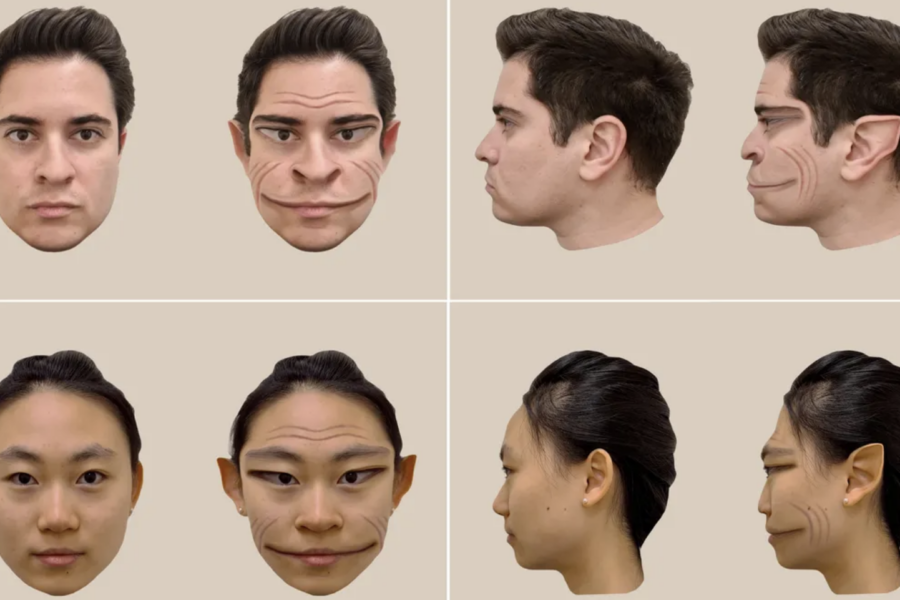
Smithsonian For the first time, scientists have recreated what one patient suffering from prosopometamorphopsia, or PMO, sees when he looks at faces.
One winter morning roughly three years ago, Victor Sharrah woke up and spotted his roommate walking to the bathroom. However, when Sharrah looked at his roommate’s face, he was startled to see that the man’s facial features had stretched to look like “something out of a Star Trek movie, like a demon face,” he tells the London Times’ Kaya Burgess. The corners of his mouth and eyes were pulled back, his ears were pointy and he had deep grooves in his forehead.
Nothing had actually changed about his roommate’s face—but something had shifted drastically in the way Sharrah perceived it. He was, understandably, terrified. The same thing happened when he looked at other people’s faces, too.
“I tried to explain to my roommate what I was seeing, and he thought I was nuts,” Sharrah tells CNN’s Sandee LaMotte. “Imagine waking up one morning and suddenly everybody in the world looks like a creature in a horror movie.”
Sharrah, who is now 59 and lives in Clarksville, Tennessee, was later diagnosed with prosopometamorphopsia, or PMO, an extremely rare neurological disorder that causes human faces to appear distorted. Fewer than 100 cases have been reported since 1904, and many doctors have never heard of it.
Fair Use Notice
UNMC Global Center for Health Security staff curate publicly available news and information for educational and informational purposes. Brief excerpts of published articles may be displayed under principles of Fair Use, with credit and links provided to the source publications. All copyrights remain the property of their respective owners.