Gregory W. Bennett, DMD
Interim Executive Associate Dean, UNMC College of Dentistry
Associate Professor, Department of Adult Restorative Dentistry
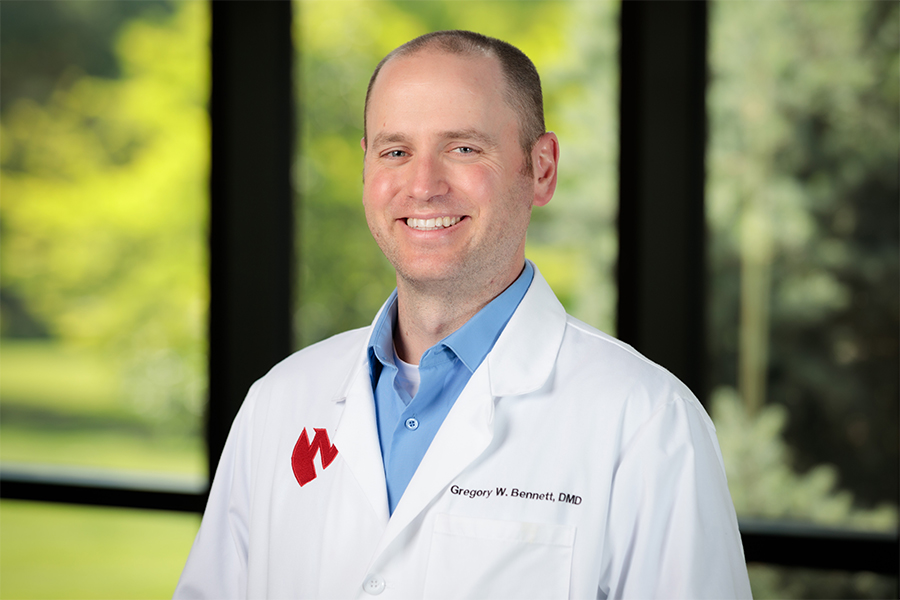
Gregory W. Bennett, DMD, is an associate professor and interim executive associate dean at the UNMC College Of Dentistry. He is originally from the West Coast and earned his Doctor of Dental Medicine degree in 2010 from the Oregon Health and Sciences University School of Dentistry and followed on with a General Practice Residency at the Naval Hospital Camp Pendleton.
Dr. Bennett served in the US Navy as a Dental Corps officer for over five years with time spent in California, Mississippi, Kuwait, Afghanistan and Hawaii. Dr. Bennett left the Navy in 2015 and began teaching at the UNMC College of Dentistry and practicing in a technology focused private practice in Lincoln, Nebraska. Dr Bennett also performs research on dental technology with a focus on 3D printing.
- DMD: Oregon Health and Sciences University School of Dentistry, 2010
- Certificate: General Practice Residency, Naval Hospital Camp Pendleton, 2011
- Emerging applications in digital dentistry
- 3D Printing in dentistry, 3D printed denture materials
- Strategies to confer microbial resistance to 3D printed dental prostheses
- Bennett G, Beatty MW, Simetich B. Evaluation of Printability, Color Difference, Translucency, and Surface Roughness over Time in a 3D-Printed TiO2-Containing Denture Base Resin: A Pilot Study. Materials. 2025; 18(15):3683. https://doi.org/10.3390/ma18153683
- Bennett GW. Multi-material polyjet printing for more lifelike endodontic practice teeth. J Dent Educ. 2023;87 Suppl 3:1852-1853. doi:10.1002/jdd.13223.
- Bennett GW. 3D printed trial dentures to reinforce prosthodontic concepts. J Dent Educ. 2021;85 Suppl 3:2032-2033
- Bennett GW, DiGiovanni T. Effect of wall thickness of 3D-printed models on resisting deformation from thermal forming in-office aligners. Clin Exp Dent Res. 2024 Feb;10(1):e827. doi: 10.1002/cre2.827