Morning Ag Study suggests transmission is not limited to direct contact with contaminated milk. The H5N1 strain of highly pathogenic avian influenza H5N1 has been detected in over 700 herds of dairy cows in California, the largest dairy-producing state in the U.S. A study published May 5th in the open-access journal PLOS Biology led by Seema S. Lakdawala at Emory University School of Medicine, U.S. and Jason Lombard at Colorado State University, U.S. suggests that avian influenza (H5N1) is transmitted through multiple, previously unknown sources and that some H5N1 positive cows do not show clinical signs of infection.
Credit Seema Lakdawala and colleagues
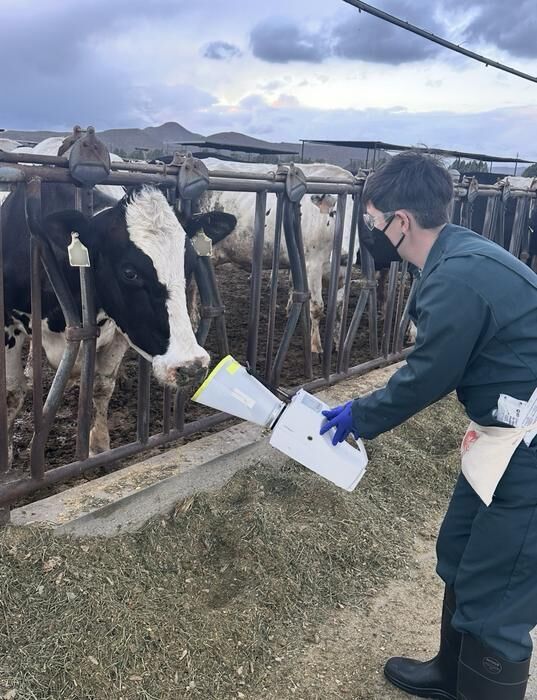
H5N1 may spread on dairy farms through direct contact with unpasteurized milk, such as via contaminated milking equipment. However, the full picture of how the virus can be spread on farms with infected cows is unclear. In order to better understand transmission routes of avian flu on dairy farms, researchers took air, farm wastewater, and milk samples on fourteen dairy farms testing positive for H5N1 across two different California regions between October 2024 and January 2025. They tested all samples for the presence of virus and performed genome sequencing on detected virus to identify any genetic variants and mutations.
The researchers detected airborne virus from the exhaled breath of infected cows and in the dairy parlor, identified the presence of virus in the wastewater, and found a high prevalence of cows who tested positive for H5N1 despite being asymptomatic. The extensive environmental contamination of infected dairy farms suggests a higher risk of viral spread from cows to humans and other animals. However, future studies are needed to validate these results as longitudinal sampling of individual cows was limited to only fourteen animals. Sampling across a larger sample of farms over a longer time period is also needed to support the findings.
Fair Use Notice
UNMC Global Center for Health Security staff curate publicly available news and information for educational and informational purposes. Brief excerpts of published articles may be displayed under principles of Fair Use, with credit and links provided to the source publications. All copyrights remain the property of their respective owners.