Shining a Spotlight on Jami Monico
 Academy Member Since 2021
Assistant Professor, Department of Obstetrics and Gynecology
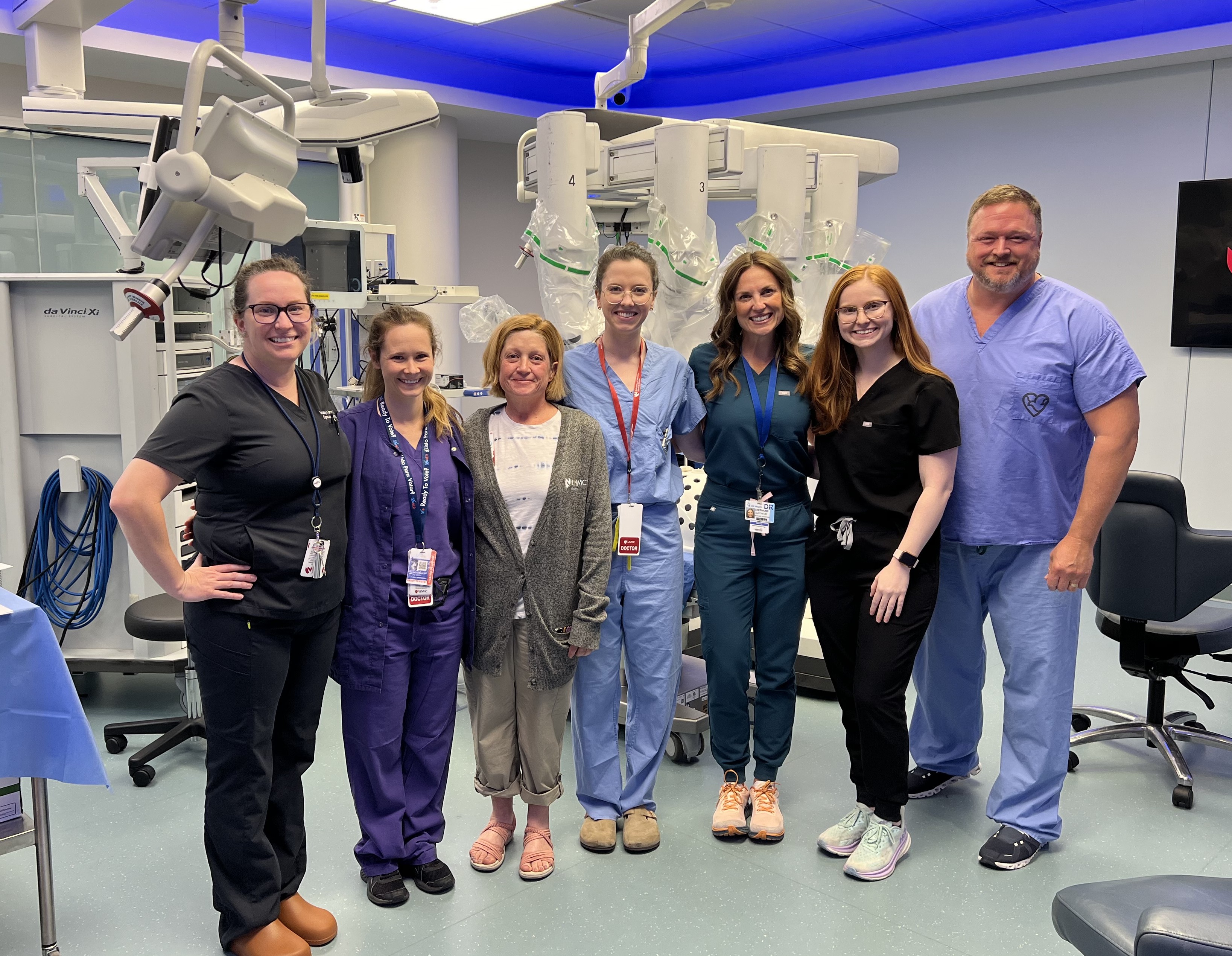
(Pictured here with colleagues during a robotic surgery simulation - third from the left)
Bio
What do you do at UNMC?
I specialize in instructional design and educational innovation, creating engaging, learner-centered materials for medical education. I lead and support simulation-based education initiatives, designing immersive experiences that enhance clinical skills and decision-making. A key part of my work includes developing low-cost, high-fidelity task trainers, often using silicone and 3D printing techniques, to support hands-on learning. I contribute to both undergraduate (UME) and graduate medical education (GME), collaborating with faculty, residents, and students across the continuum of training. My scholarly work focuses on advancing simulation and medical education practices, with regular dissemination through posters, presentations, and national conferences. Collectively, my role integrates creativity, technology, and evidence-based education to improve learner outcomes and patient care.
Tell us about your educational research interests and teaching role.
My educational research focuses on advancing simulation-based learning, task trainer development, and innovative instructional design in medical education. I am particularly interested in creating accessible, high-impact learning experiences that improve clinical skill acquisition and learner confidence. In my teaching role, I collaborate with faculty and lead simulation-based education for learners across the continuum, including a simulation course with the College of Allied Health Professions. I support curriculum design, facilitate simulation activities, and contribute to learner assessment in both UME and GME.
What is one of your favorite/memorable teaching moments?
One of my most memorable teaching moments was designing a reflective assignment for the simulation course based on Benner’s Novice to Expert framework. Learners read and applied the model to assess their own stage of development and identify goals for growth. The assignment encouraged thoughtful self-reflection and professional identity formation, which resonated strongly with participants. Many learners shared that it helped them better understand their progress and next steps in a meaningful way. It was highly regarded in course feedback and sparked rich discussion during debriefing. Seeing learners make those connections was especially rewarding and reinforced the value of integrating theory into practice.
What do you see as the biggest benefit to being a member of the IAE?
The biggest benefit of being a member of IAE is the strong sense of community among educators who are passionate about teaching and learning. Through ongoing conversations and repeated interactions, I’ve built meaningful connections with colleagues from a variety of disciplines. These relationships foster collaboration, idea sharing, and mutual support. IAE also provides continual learning opportunities that keep me engaged and growing as an educator. Over time, the organization has come to feel less like a professional group and more like a supportive, inspiring family.
When you were a kid, what did you want to be when you "grew up" and why?
As a child, I wanted to become a neurosurgeon—specifically focused on brain surgery—because I was fascinated by the complexity of the human body. I’ve always been driven to “fix” things and enjoyed working with intricate details, from building model cars to solving complex problems. That curiosity and creativity have stayed with me over time. While my career path evolved, those same interests ultimately led me to medical education. I feel fortunate to have a role where I can combine creativity, problem-solving, and a passion for healthcare. Contributing to the education of future health care professionals is both meaningful and rewarding.
Back to Member Spotlight page