Curriculum
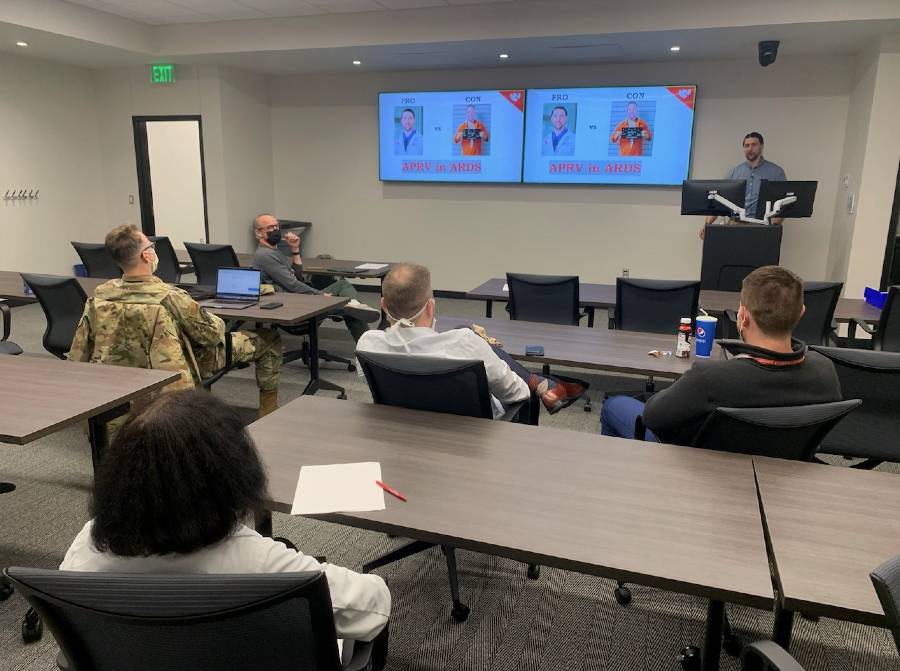
The Pulmonary and Critical Care Fellowship is a three-year program that trains our fellows for successful careers.
Education is an important part of training and there is a schedule of core curriculum lectures, board review sessions, pro:con debates on clinical topics between dyads of fellows and faculty members, journal clubs, quality improvement (revised M&M) and research conferences. Simulations, didactics and resident and student teaching on clinical services are all part of the curriculum.
Our division is responsible for teaching foundational sciences to pre-clinical medical students and there are numerous small group knowledge and clinical skills sessions for fellows to facilitate as part of that course.
Fellows desiring a post-graduate certificate in clinical education may apply for the two-year Health Educators and Academic Leaders, which will require additional work outside the scope of the fellowship program.
At the completion of the three-year fellowship program, trainees are eligible to sit for Pulmonary Disease and Critical Care Medicine boards. Our five-year, first-time taker pass rate for both boards is 100 percent.
Most of our graduates have gone on to private practice but all have retained a desire to be involved in resident and student teaching based in part on their educational experience.
The mix of clinical experiences and didactics provided in this program provides excellent training for the subspecialist in Pulmonary and Critical Care Medicine.
- Orientation – Approximately 30 lectures/discussion sessions covering topics from Pulmonary Physiology and Ventilator Management to Clinic Billing to Interpretation of diagnostic studies.
- COPD – Nine lectures/discussion sessions
- Cystic Fibrosis – Five lectures/discussion sessions
- Asthma – Seven lectures/discussion sessions
- Pleural Disease – Four lectures/discussion sessions
- Cancer Evaluation and Management – Six lectures/discussion sessions
- Lung Injury – Seven lectures/discussion sessions
- Interstitial Lung Disease – Six lectures/discussion sessions
- Lung Transplantation – Six lectures/discussion sessions
- Multisystem Interactions – Five lectures/discussion sessions
- Pulmonary Vascular Disease – Eight lectures/discussion sessions
- Pulmonary Infections – 10 lectures/discussion sessions
- Sleep Medicine – Seven lectures/discussion sessions
- NeuroCritical Care – Seven lectures/discussion sessions
- Miscellaneous Pulmonary Topics – Six lectures/discussion sessions
- Miscellaneous Critical Care Topics – 16 lectures/discussion sessions
Two-Week Rotations
Required rotations in pulmonary medicine include inpatient and outpatient consults, procedures, cystic fibrosis, sleep medicine and lung transplant. Required clinical rotations in critical care medicine include two medical ICU teams, CVICU, NeuroCritical Care Unit and Surgical Critical Care. Electives are chosen six months in advance and range from Pulmonary Hypertension and Right Heart Catheterization to Long-term Acute Care and Allergy to Thoracic Surgery.