Pathologists, who are often referred to as the doctor’s doctor, play a critical role in diagnosing patients. That point was driven home by two challenging cases that came to UNMC in the last year.
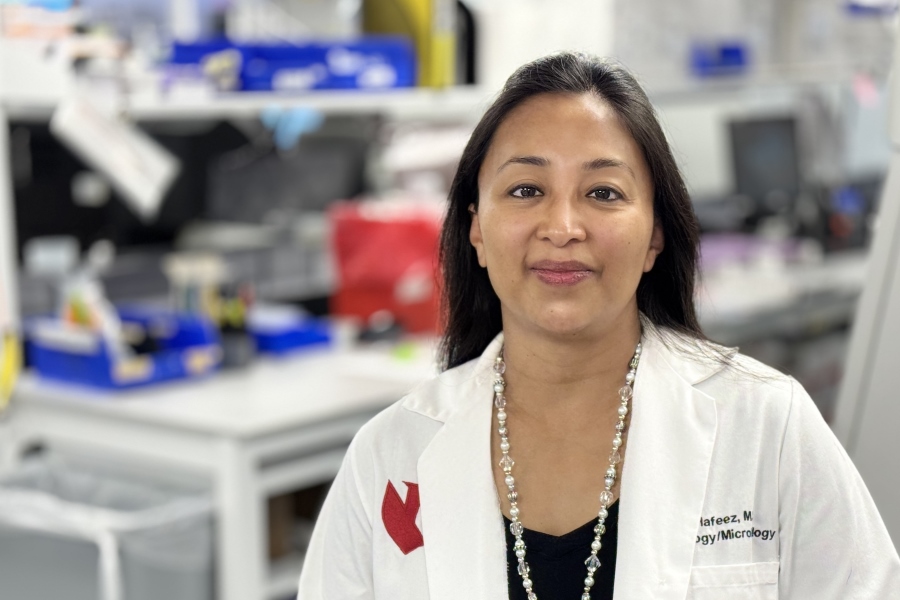
Last December, a patient came to Nebraska Medicine with a fever and other symptoms that didn’t yield a clear answer. Clinicians ordered tests and sent peripheral blood to the core lab. Safina Hafeez, MD, an assistant professor (hematopathologist) in UNMC’s Department of Pathology, Microbiology and Immunology, said she remembers it well.
“Our tech is very, very good. They looked very carefully, and it was Christina Frey who flagged it. She said I see parasites; it looks like histoplasma. So, I looked at it and confirmed that OK, it looks like a histoplasma, which may look very similar to other fungal organisms.” Dr. Hafeez called the clinician to communicate the findings and recommended a serology test, which supported the diagnosis and allowed doctors to administer antifungal medication.
Histoplasmas are associated with decaying bat and bird droppings, common among immunocompromised individuals, Dr. Hafeez said, perhaps somebody on chemotherapy or other immunosuppressive therapy.
“It’s not rare, but it’s important to pick it up at the right time.” Making things more difficult was that the parasite could be seen in only a few cells in the blood smear. “If it was in a tissue, for example in the lung and they get a biopsy, then you might see a lot more histoplasma, but in peripheral blood, when it’s in a few cells, it can be tough. It would have been very easy to miss,” she said.
The vital role that pathologists play can sometimes go unnoticed, she said, because they are working behind the scenes. “But we do play a very important role in patient care.”
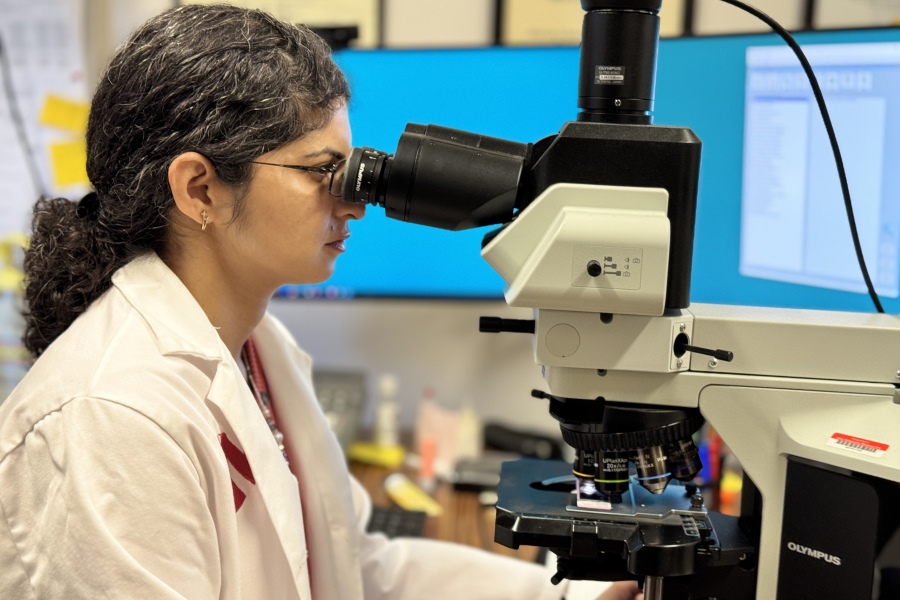
Pathologists were presented with another puzzling case in March. A young woman came to the ER with fever, abdominal pain, vomiting, and nausea. “So they were going through all of those things, thinking of some infectious things, was it meningitis or sepsis, so many tests were ordered, including CBC and peripheral blood smear,” said Neha Gupta, MBBS, an assistant professor in the department and medical director of hematology and bone marrow at the core laboratory, Nebraska Medicine. A technologist in the core lab, Zankhana Amin, examined the peripheral blood smear and noticed something unusual.
“She saw some organisms, things that none of us had seen. And then of course the resident got involved, and the resident called me,” Dr. Gupta said. “We looked at the images together. I said this looks like some spirochete organisms. It’s a broad group of microorganisms, with a typical spiral shape. I said this is something like that.”
“They were so light in color, might appear as artifacts, and one might miss them. I really appreciate the core lab tech, Zankhana, who first noticed them and the other core lab technologists as they were reviewing it so diligently. This is very rare. This is one of those cases that comes on your CAP proficiency test or is asked in exams, but you might not see them again.” Dr. Gupta said she discussed it with the microbiology lab team. “One of the fellows, Scott Stevenson, came to see the slide, and we looked at the slides again. I don’t remember how many people I ended up reviewing and showing these microorganisms to. After many microbiology and molecular tests for various infectious organisms came back as negative, the microbiology team had the answer that this was one of the rare Borrelia species.”
The patient was started on antibiotics that night and responded well to the treatment. She said, “I would say if we hadn’t caught it on the peripheral blood smear, it would have been very difficult to find it since it doesn’t appear frequently in other tissues.”
“It’s not a commonly occurring infection, so nobody would think of sending a specific test” Dr. Gupta said. “This wouldn’t have been on anyone’s radar. It takes hard work, experience and expertise to look further, beyond the routine things. We and the clinical care team first want to rule out the common etiologies. But when it is the rarest of the rare things, it’s not even on their or our checklist. So, it is the diligence of the people who recognized it, the team including medical laboratory technologists and scientists, we pathologists, residents and fellows who all work closely with the clinical staff. I can add this case to my portfolio of things I have seen here. It was a learning moment for us, and it’s going to stay with us for a long, long time.”