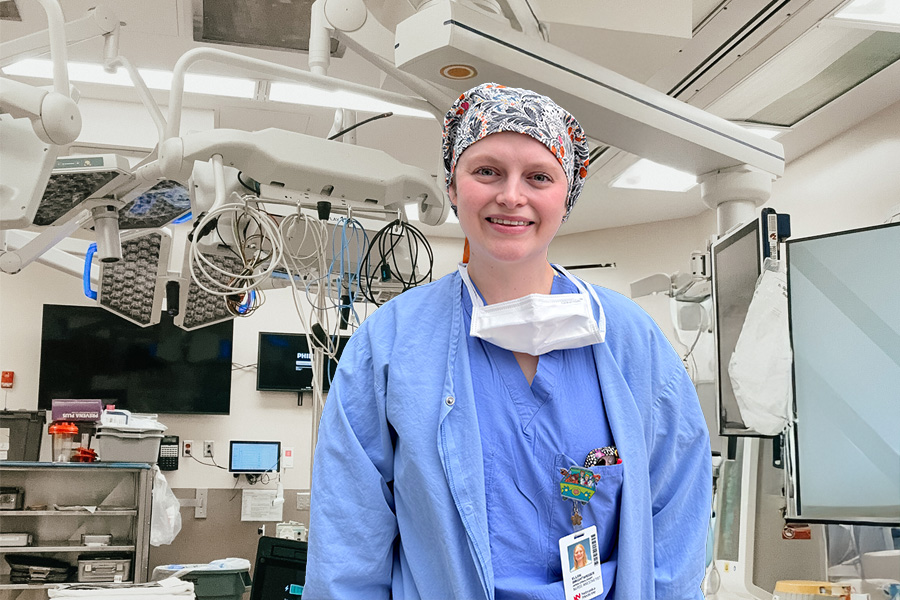
For Ellen Brightweiser, CRNA, anesthesia care is personal.
As a child, Brightweiser underwent multiple surgeries, many at Nebraska Medicine. During one of those procedures, Jeff Bedoya, CRNA, took the time to care not only for her, but for her anxious parents as well. The experience left a lasting impression.
“I could tell how nervous my parents were,” Brightweiser said. “The way he explained things and made us feel safe stuck with me. I knew that was something I wanted to do for other people.”
Today, Brightweiser works alongside Bedoya in the UNMC Department of Anesthesiology, a full-circle moment she describes as both humbling and motivating.
Brightweiser always knew she wanted a career in health care. Coming from a family of health professionals, she just wasn’t sure what role fit best until those early patient experiences clarified her path.
“I never really considered anything else after that,” she said. “I fell in love with the idea of being the person who helps patients feel calm and safe during what can be a really scary day.”
She earned her undergraduate nursing degree from Clarkson College in 2017 and began working in the cardiovascular intensive care unit, gaining the critical care experience required for nurse anesthesia programs. When she entered CRNA school in 2020, it coincided with the onset of the COVID-19 pandemic.
“It was a challenging time to be in health care, but it reinforced that this was the right field for me,” she said.
When it came time to choose where to practice, Brightweiser said the culture at the med center stood out.
“It felt like people genuinely cared about who you were as a person, not just filling a schedule,” she said. “That mattered to me.”
Brightweiser practices across multiple settings, including the main campus, Bellevue Medical Center and on the obstetric anesthesia team. The variety is one of the things she enjoys most.
“No two days look the same,” she said. “You’re constantly learning, adjusting, and working with different teams.”
But regardless of the setting, her approach to care remains consistent.
“A lot of the time, patients are asleep when we’re doing our job,” she said. “That makes those first few minutes especially important. I want them to feel like they’re more than just a patient in a bed.”
She sees anesthesia care as both highly technical and deeply human.
“When I walk into a patient’s room, they’re not just a name on a chart,” Brightweiser said. “For those hours, they’re my responsibility. I think about their family, the people waiting for them, and how I would want someone to care for my own loved ones.”
Since beginning practice, Brightweiser says her role hasn’t changed as much as her confidence and communication skills.
“Learning how to clearly ask for what you need and communicate in high-pressure situations takes time,” she said. “It’s something I’m still working on.”
She credits her colleagues for creating an environment where asking for help is encouraged.
“There is always someone willing to step in,” she said. “That teamwork is one of the best parts of working here.”
Outside of patient care, Brightweiser is passionate about service. She organizes volunteer opportunities at a local food bank, an effort she began as a way to reconnect with community service after completing her education.
“In this job, you don’t always get to see long-term outcomes,” she said. “Volunteering lets you see the immediate impact you can have, even in just a couple of hours.”
She also finds balance through gardening with her family, reading and unwinding with video games, activities she says help her recharge.
For Brightweiser, CRNA Week is about visibility, positivity and recognition for a demanding field.
“Health care can feel very transactional right now,” she said. “This week is a reminder of the meaningful work happening every day and the people behind it.”
She hopes patients and colleagues alike come away with a deeper understanding of the role CRNAs play.
“We’re here to provide care that’s safe, calming and compassionate,” Brightweiser said. “When I walk into a room, I want patients to know that someone truly cares about them.”