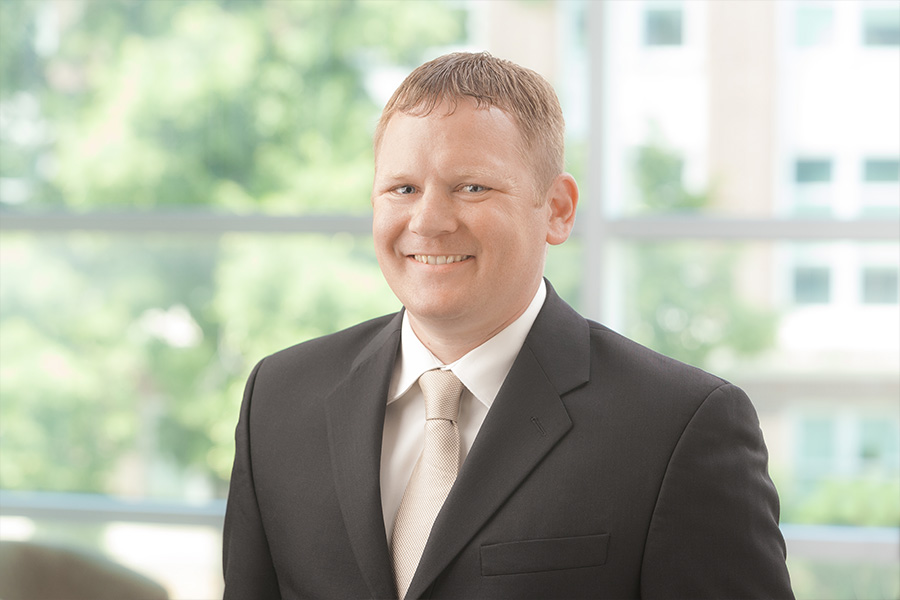
For Shaun Thompson, MD, critical care anesthesiology has always been rooted in a central purpose: helping patients navigate recovery during their most fragile moments and return to their lives.
Dr. Thompson’s interest in critical care began in medical school during intensive care unit rotations, where he was drawn to both the technical complexity of the specialty and its direct, measurable impact on outcomes.
“I enjoyed the procedures and the technology we use to sustain life,” Dr. Thompson said. “And I was fascinated by the opportunity to take someone who is critically ill and help them recover.”
As he progressed through anesthesiology training, Dr. Thompson said he recognized how closely perioperative care and critical care medicine intersect.
“The fundamentals are straightforward,” he said. “You support circulation and ventilation, and patients can be stabilized. I felt that every ICU rotation made me a better anesthesiologist.”
Dr. Thompson has now been appointed critical care anesthesiology division chief and will transition into the role on March 1.
Dr. Thompson brings extensive leadership experience to the position, including serving as critical care anesthesiology fellowship director and medical director for extracorporeal membrane oxygenation (ECMO) at Nebraska Medicine. His leadership in the ECLS program coincided with the COVID-19 pandemic, a period that required rapid adaptation and complex decision-making.
“COVID forced us to pivot quickly,” Dr. Thompson said. “We had to develop criteria for who would be appropriate for ECMO when space and resources were constrained and when it was not yet clear how the therapy would affect outcomes in the short or long term.”
Dr. Thompson said those early decisions were among the most challenging aspects of the work, particularly as the team worked to balance urgency with responsible stewardship of a highly resource-intensive therapy. Over time, he said, the program continued to expand and now ranks among the nation’s busiest ECMO programs.
“It has been rewarding to see the program grow and thrive,” he said, crediting physician and surgical leadership as well as the nursing and coordinator teams who have helped sustain program operations and performance.
As fellowship director, Dr. Thompson oversaw continued growth and national recruitment for the critical care anesthesiology training program. During his tenure, the program expanded from two fellows per year to as many as four or five.
“Part of the role is ensuring fellows stay on track clinically and academically so they graduate prepared to practice safely and competently,” he said.
Dr. Thompson said UNMC’s critical care anesthesiology fellowship remains competitive, in part because of its hands-on training approach and breadth of clinical exposure.
UNMC fellows receive extensive experience in ultrasound and echocardiography, Thompson said, along with high-volume exposure to mechanical circulatory support, including ECMO.
“Our fellows leave prepared to use these tools confidently in practice,” he said. “And we have had strong outcomes over many years, including board performance.”
As the critical care anesthesiology division continues to expand its clinical operations, Dr. Thompson said his early priorities as division chief will focus on access to care and team capacity, particularly for patients referred from hospitals across Nebraska and Iowa.
“We are a major referral center,” he said. “It is not uncommon for patients to wait to be transferred. Improving access so we can help patients sooner is a key goal.”
Dr. Thompson said meeting demand will require infrastructure and staffing growth, including additional beds, nursing support and expansion of the critical care team.
“It will require more physicians and more advanced practice providers so we can maintain the high-quality care we deliver while increasing the number of patients we can support,” he said. Adding that continued system growth, including the future hospital expansion, will further shape clinical needs and opportunities.
Dr. Thompson said he sees significant opportunities for continued innovation in mechanical circulatory support, including ECMO and emerging approaches such as extracorporeal CPR (ECPR).
“There is still a great deal we do not know,” he said. “And there are meaningful opportunities to expand what we can do for patients who are critically ill.”
Thompson said he values the division’s collegial culture and its strong collaboration across specialties.
“It takes a multidisciplinary team to care for these patients,” he said. “Within our group, there is strong camaraderie. People are willing to step in for one another, and we work well with our colleagues across the hospital.”
He described his leadership style as accessible and supportive, shaped in part by mentorship from colleagues, including outgoing division chief, Daniel Johnson, MD, department chair Andrew Patterson, MD, PhD, and former chair Steven Lisco, MD.
Dr. Johnson, who is moving into the role of executive vice chair of the department, said Dr. Thompson is a skilled and effective leader. “I’m excited for Dr. Thompson to take on the role of critical care division chief,” Dr. Johnson said. “He’s always been an exceptional member of the team and I’m excited to support him in this new leadership role.”
Outside of medicine, he spends time with family, has taken up running and is training for his first marathon. He is also an avid sports fan and follows Formula One racing.
As he transitions into the division chief role, Dr. Thompson said he remains focused on building on the division’s strong foundation and continuing its growth.
“I am humbled to be entrusted with this opportunity,” he said. “This has always been a team effort, and it will continue to be. I am looking forward to the work ahead.”