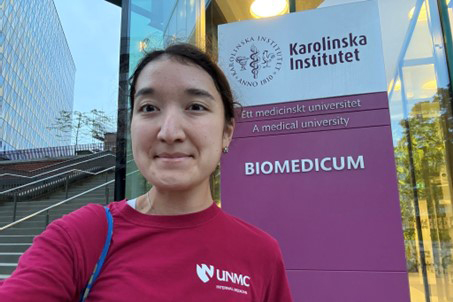
Nozima Aripova, a fourth-year medical student in UNMC’s MD-PhD Scholars Program, recently completed a two-month external rotation at the Karolinska Institute, a translational research lab in Stockholm, Sweden.
The MD-PhD program provides training in both medicine and research, preparing students to become physician-scientists who address a patient’s medical struggles while also pursuing research that may define the mechanism of the patient’s disease.
Aripova’s rotation in Sweden built on research she completed during her PhD training under the mentorship of Ted Mikuls, MD, and Geoffrey Thiele, PhD, both professors in the UNMC Division of Rheumatology and Immunology.
Dr. Mikuls said the rheumatology division has had a longstanding interest in the role of protein modifications driving autoimmunity and inflammation in rheumatic diseases and rheumatoid arthritis, in particular, and that Aripova recently played a major role in advancing those efforts.
“Nozima’s work is really the first to establish that malondialdehyde-acetaldehyde (MAA) and citrulline adducts on proteins, both occurring naturally in the context of inflammation, act in concert to ‘turn on’ inflammatory cells in patients with RA,” he said. “These cells in turn create a crosstalk with fibroblasts in both joints and lungs in the context of RA and mediate fibrosis. This represents an important advance, as it provides novel insight into how these protein changes that are abundant in RA lead to tissue dysfunction both in the joint and lung in many of our RA patients.”
Aripova, who completed her PhD training in 2023 and is now finishing her fourth year of medical school, said her research efforts with the rheumatology division drove the topic of her thesis.
“Antibodies to MAA have been elevated in patients with RA and rheumatoid arthritis-associated interstitial lung disease,” she said. “My thesis involved work on how MAA affects cellular communication between macrophages and fibroblasts, specifically activation of pro-inflammatory and pro-fibrotic pathways.”
Dr. Mikuls said the research findings are important because the protein changes can potentially be prevented with therapies that bind precursor molecules and prevent adduct formation, so they hope their research will lead to treatments for RA and RA-ILD.
“In the lab, we have demonstrated that MAA and citrulline – two biomarkers in RA – affect pro-inflammatory and pro-fibrotic pathways and communication between macrophages and fibroblasts,” Aripova said. “If we can inhibit MAA formation or target molecules that exacerbate those pro-inflammatory and pro-fibrotic pathways, then those can potentially serve as future therapeutic targets in RA and RA-ILD.”
Dr. Mikuls said research focused on MAA in RA is relatively new since the UNMC Division of Rheumatology and Immunology was the first to make related observations in 2015.
“There are only a few research groups internationally with a focus in this area,” he said. “One of those groups has been the laboratory at the Karolinska Institute in Stockholm, led by Caroline Grönwall and Vivianne Malmström. In recent studies, their group has isolated monoclonal B cells that target MAA, and they have shown that autoantibodies targeting MAA activate macrophages, among many other elegant findings.”
When Aripova expressed interest in gaining more laboratory experience, Dr. Mikuls said that he and Dr. Thiele immediately thought of the Karolinska lab.
Aripova said her external research rotation to Sweden in September and October was “the best opportunity.”
“The goal was to learn as much as I can while also moving our projects forward,” she said. “I also wanted to learn new techniques and methodology, and going to the lab at Karolinska gave me that opportunity. All the students and faculty members were supportive, and I hope that this collaboration will continue to grow.”
Bryant England, MD, PhD, interim chief of the UNMC Division of Rheumatology and Immunology, said they plan to continue the work that Aripova began with the Karolinska Institute.
“During the time Nozima was a member of their lab, she conducted exciting studies to forge a new international collaboration evaluating the role of post-translational protein modifications in rheumatoid arthritis pathogenesis,” he said. “While she has completed her external rotation, the collaborative research continues.”
Aripova is now applying to residency programs, and she said her ideal career goals are modeled after her UNMC mentors.
“I want to be a physician scientist; exactly what Drs. Ted Mikuls and Bryant England do,” she said. “Have a lab, have a clinic and also be at an academic medical center. I aspire to be a rheumatologist.”