Health care providers are expected to follow the code of “Do no harm.” During World War II, the medical community was faced with what happens when those who are trained to heal are weaponized on a massive scale to go against that code.
While doctors under the Nazi regime committed atrocities, the American medical community, like much of the United States, remained mostly silent due to a multitude of factors.
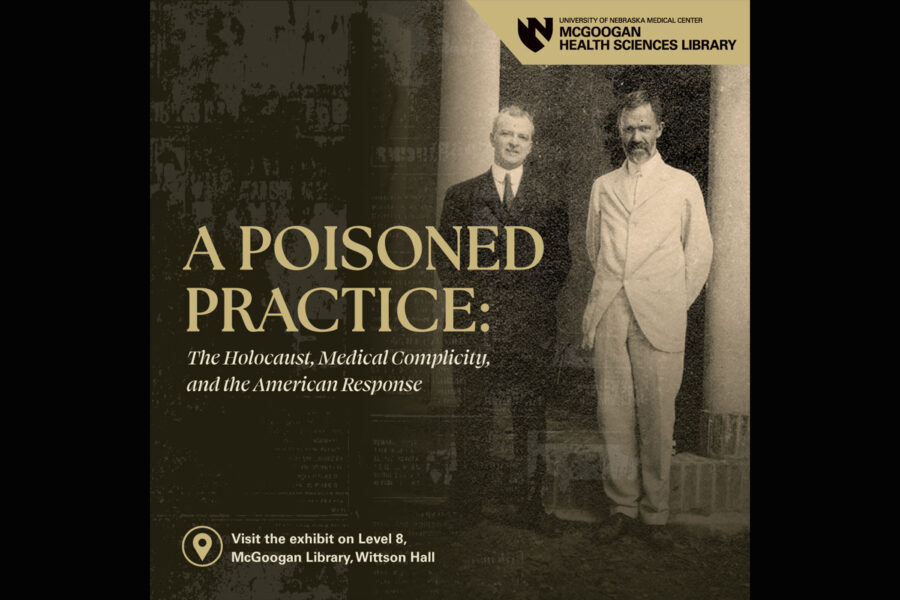
A new exhibit at the McGoogan Health Sciences Library, “A Poisoned Practice,” explores those factors through the lens of the American eugenics movement and in the news available to the Omaha medical community about the Holocaust during World War II. The exhibit also touches on the medical ethics implications of the Holocaust with the creation of the Nuremberg Code.
“A Poisoned Practice” is presented in partnership with the Calvin T. Ryan Library at the University of Nebraska at Kearney as a part of a grant-funded traveling exhibition program from the United States Holocaust Memorial Museum and the American Library Association. The McGoogan Library exhibit runs through June 15.
Find this exhibit on Level 8 of the McGoogan Health Sciences Library in Wittson Hall or see the exhibit online.
Feb. 17 panel discussion
On Feb. 17, the McGoogan Library will hold a panel discussion titled “From Eugenics to Ethics: Lessons for Today’s Medical Community” to discuss the themes behind the exhibited “A Poisoned Practice.”
This panel will explore the troubling legacy of eugenics in medicine and its enduring impact on health care ethics.
Matthew Wynia, MD, and Patricia Heberer-Rice, PhD, will discuss how misguided “science” once justified harm and how those historical practices influenced the medical education, policy and the ethical frameworks that guide contemporary care.
The discussion will highlight lessons for today’s clinicians and researchers, emphasizing the importance of equity, autonomy and justice in medical decision-making.
Dr. Wynia is a professor of medicine and of public health at the University of Colorado, where he directs the CU Center for Bioethics and Humanities. Focusing on issues related to the social roles of health professionals, he is a clinician-researcher and leader in bioethics with a history of exploring some of the most contentious ethical issues in health care. His training is in internal medicine, infectious diseases, public health and health services research.
Dr. Heberer-Rice joined the United States Holocaust Memorial and Museum in 1994 and is now the museum’s senior historian. She serves as a specialist on medical crimes and eugenics policies in Nazi Germany, educates groups inside and outside the museum, and she vets a wide range of museum content for historical accuracy, including the Holocaust Encyclopedia.
Darby Kurtz, special collections curator for the McGoogan Library, will moderate the panel, with introductions provided by Mark Celinscak, executive director of the Fried Academy.
This presentation is provided in partnership with Sam and Frances Fried Holocaust and Genocide Academy at the University of Nebraska at Omaha and the Calvin T. Ryan Library at the University of Nebraska at Kearney, the host of “Americans and the Holocaust: A Traveling Exhibition for Libraries” made possible by the United States Holocaust Memorial Museum and the American Library Association.