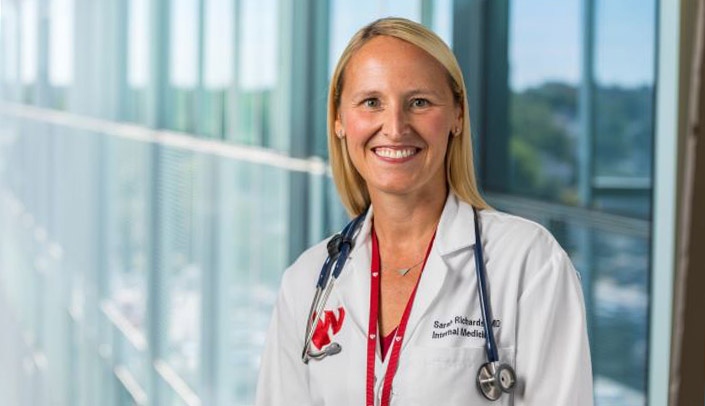
Sarah Richards, MD, associate professor in the UNMC Division of Hospital Medicine, is doing research to explore why hospitalist burnout is exceptionally low at UNMC.
Dr. Richards, who is also the senior medical director of clinician experience for Nebraska Medicine, said that burnout remains one of the most pressing challenges in modern healthcare, with particularly high rates reported among hospitalists nationwide. Her research cites a 2024 Medscape survey that found 47% of male hospitalists and 52% of females reported experiencing burnout.
“This trend is troubling because it impacts physician well-being, patient care quality, safety and experience, and workforce retention,” Dr. Richard said.
However, her research found that hospitalists at UNMC defy that trend. UNMC survey data reveals hospitalist burnout rates ranging from just 2% to 13% since 2021, with data from spring 2025 showing a remarkable 0% burnout rate among hospital medicine providers.
“This finding is not only encouraging; it’s almost unheard of in today’s healthcare environment,” Dr. Richards said. “The result invites a deeper exploration into what factors may be protecting this group, and what lessons might be replicated elsewhere in the system.”
Chad Vokoun, MD, chief of the UNMC Division of Hospital Medicine, said Dr. Richards’s work is important.
“Frequently seeing how we can improve our processes and organization is critical,” he said. “I think this project can shine a light on one program that has been successful at creating a positive environment to take great care of patients, teach at a high level and take care of each other.”
Dr. Richards and fellow researchers Morgan Fink, Jana Wardian, PhD, and Maggie Thompson, reviewed five years of institutional well-being survey data and national literature. Compared with all physicians at UNMC, they found that UNMC hospitalists reported significantly lower frequency of systemic stressors that are strongly associated with burnout. Those stressors include staffing shortages, workflow inefficiencies, documentation burden, excessive workload and team culture concerns.
“The only areas where hospitalists reported higher stress than other physicians was in patient care demands and abuse from patients and their families,” Dr. Richards said. “We think this reflects the inherent intensity of a hospitalist’s clinical roles.”
Dr. Vokoun said the hospital medicine division has thrived, in part, because of organization support, personalized scheduling and a team culture.
“We have developed a great culture of flexibility and taking care of each other,” Dr. Vokoun said. “I am often amazed at how we look to help each other to make everyone’s day the best that it can be.”
Dr. Richards said her team plans to conduct semi-structured interviews with hospitalists to better understand how local culture, leadership and organizational practices contribute to well-being. They also want to identify replicable system-level interventions that can support physicians across all divisions, not just in hospital medicine.
“To meaningfully reduce burnout, we must look beyond individual wellness strategies and focus on organizational drivers like leadership, culture, flexibility, workload design and appreciation,” Dr. Richards said. “UNMC’s hospitalist team is a compelling case study in what’s possible.”
The physician well-being survey will now be distributed annually in October. A smaller “micro-pulse survey” sent this spring will help Dr. Richards’s team quickly assess burnout, trust in leadership and safety culture.