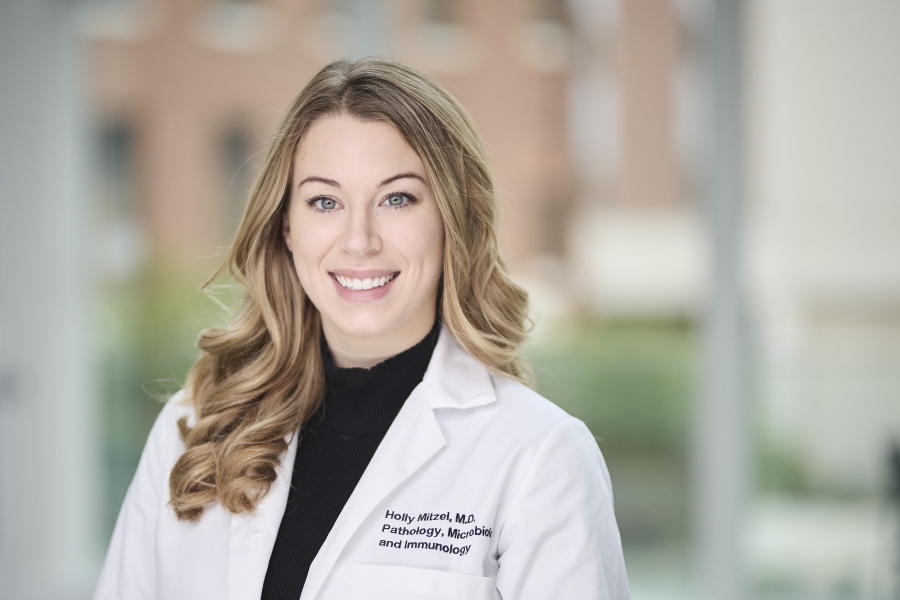
A pathology resident is studying the role of aberrant T-lymphocytes in lymphocyte-rich thymomas and how they may correlate with clinical outcomes.
Thymomas are rare epithelial tumors of the anterior mediastinum. “They aren’t studied too often and they’re fairly rare tumors,” said Holly Mitzel, MD. They arise from thymic epithelial cells and are classified by the World Health Organization into types A, AB, B1, B2, and B3, based on histologic morphology and the relative proportion of lymphocytes to epithelial tumor cells.
Among these, type B and AB thymomas are notable for their T-lymphocytic infiltrates (lymphocyte-rich), suggesting that the local immune microenvironment may play a critical role in tumor biology, progression, and patient outcomes.
This project aims to characterize aberrant T-lymphocyte (thymocyte) populations in types B and AB thymomas using immunohistochemical techniques and to correlate these findings with clinical outcomes. By systematically analyzing markers of T-cell subsets and immune regulation, this study will provide insight into the immune microenvironment of thymomas and its relationship to tumor behavior.
“To our knowledge, few studies have comprehensively evaluated T-cell phenotypes in thymomas with long-term follow-up data,” Dr. Mitzel said. “The results have the potential to identify prognostic biomarkers, refine risk stratification, and guide future research into the role of immune dysregulation in thymic epithelial tumors.” She said that ultimately, this project may help bridge the gap between histopathologic diagnosis and clinical management, improving patient care and informing future studies that incorporate molecular or targeted approaches.
“We have done a database search for thymoma cases from the early 2000s up until very recently,” she said, coming up with about 50 cases. “We found nine of them to be fairly aggressive, either in the form of recurrence or they were metastatic at the time of resection.”
Tissue sections will be prepared by the Tissue Sciences Facility, and unstained slides will be obtained for immunohistochemical staining. “That’s where we are, waiting for stains to come back,” she said. Stained slides will be scored by Dr. Mitzel and her mentor, Dr. Pranav Renavikar, an assistant professor in the department, and possibly by a few other UNMC pathologists.
Her study is made possible by the department’s Research Grant Awards. The awards provide up to $10,000 in research funding for residents and fellows. The aim of the program is to advance the experience and mentorship in clinical and translational research. If Dr. Mitzel wasn’t already aware of the RGA funding, her mentor was—Dr. Renavikar was one of the first recipients, when he was a surgical pathology resident in 2024.
“He’s the most patient, kind mentor,” she said. “He is good at breaking it down, even if you don’t have a ton of experience with research, of here’s how we’re going to get from point A to point B.”
Dr. Renavikar said: “Many studies have linked thymoma development to immune dysregulation within the thymic environment. It is less known if the local immune cells directly affect aggressiveness and long-term behavior of thymomas. This project hopes to answer some of these questions. Dr. Mitzel is a diligent and creative fit to lead this job.”
Dr. Mitzel, a North Dakota native, earned her bachelor’s and medical degrees from the University of North Dakota in Grand Forks. She started her residency at UNMC in 2024. After completing her training, she would like to work in a smaller community or private-practice setting. “I would like to go back to North Dakota someday. I’m trying to be pretty open minded about where my career could take me, but the dream is to end up back home,” she said.