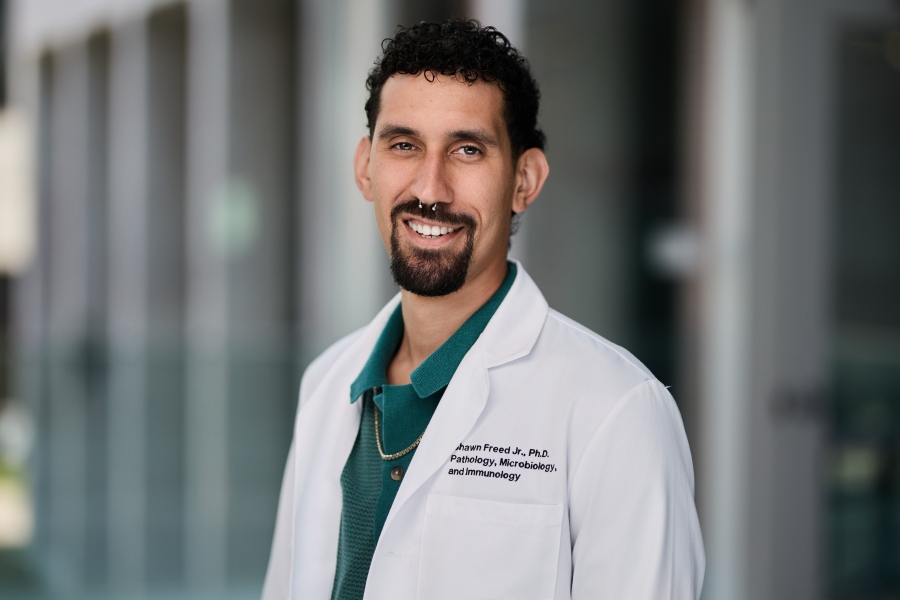
Shawn Freed, PhD, a clinical microbiology fellow in UNMC’s Department of Pathology, Microbiology and Immunology, is studying whole-genome sequencing as a way to more quickly confirm healthcare-associated infections.
Without quick intervention, outbreaks can negatively affect patient care and be incredibly costly to deal with, he said, requiring extensive antibiotic treatment, extended hospital stays and further complications. The cost of these outbreaks has been estimated to be as high as $45 billion in the United States alone, Dr. Freed said.
Researchers at the University of Massachusetts Memorial Medical Center and the University of Pittsburgh Medical Center Presbyterian Hospital got promising results from short-read whole-genome sequencing and machine learning of the electronic health record to identify outbreaks. Dr. Freed said UNMC researchers are exploring the use of long-read sequencing, which is cheaper and also more capable of detecting plasmids.
UNMC is well-positioned to do this research, he said. “We have amazing resources here, really well-connected staff to both basic science researchers, public health and a lot of interconnectedness with our infectious disease specialists. We’re looking at these typically multidrug-resistant Gram-negative pathogens, or those that have acquired some sort of resistance mechanism.”
Dr. Freed’s study is made possible by the department’s Research Grant Awards, created in 2024. The awards provide up to $10,000 in research funding for residents and fellows. The aim of this program is to advance the experience and mentorship in clinical and translational research.
In this study, 60 clinical isolates obtained from Nebraska Medicine patients that stayed in the hospital longer than two days were submitted for sequencing. The idea is that if the isolates didn’t show up until three days or more after the patient was admitted, that suggests they didn’t come to the hospital with the infection, he said. Working with Chunyi Zhou, MD, PhD, (ABMM), a former clinical microbiology fellow and now a senior scientist in clinical microbiology at UNMC, “we’ve sequenced 40 Gram-negative isolates already,” he said. “And then this summer, we identified a potential second risk group in vancomycin-resistant Enterocuccus, so we have since sequenced 15 of those as well.”
Now they’re working on phylogenetic analysis to determine relatedness and to detect potential genomic and plasmid outbreaks. Sequencing statistics will be used to determine genome completeness, he said, and compare the quality genomes between short- and long-read sequencing methods. They will also assess the ability of sequencing to detect antimicrobial resistance markers.
Dr. Tess Karre, director of the Clinical Microbiology fellowship program, said: “Shawn has been deeply engaged in every stage of this project and has shown tremendous intellectual curiosity throughout the process. His commitment to applying new technologies to meaningful clinical problems has been impressive to watch.”
Dr. Freed grew up in the Omaha metro area, graduating from Bellevue East High School. He earned his BS in science at Bellevue University, his PhD in medical microbiology and immunology from Creighton University and was a public health laboratory fellow at UNMC before beginning his two-year clinical microbiology fellowship in the department in July 2025. Ultimately, his goal is to lead a clinical microbiology lab. “I’d like to be at an academic medical center, where I could still be conducting research like this,” he said.