A new mother enrolled in a research study returned to the hospital having seizures after giving birth. Her blood pressure had climbed dangerously high. She had developed postpartum preeclampsia and no one had caught it.
She wanted to know why no one had been monitoring her blood pressure after she went home.
That question stayed with Sajid Shahul, MD, who led the study and is now a professor in the UNMC Department of Anesthesiology and associate dean for clinical research in the UNMC College of Medicine. He realized her crisis could have been prevented.
“Most people assume the danger of childbirth ends in the delivery room,” Dr. Shahul said. “It doesn’t. Most pregnancy-related deaths occur after delivery, many of them due to cardiovascular disease.” Among the leading cardiovascular causes are hypertensive disorders of pregnancy, including preeclampsia. When high blood pressure persists undetected after delivery, it can lead to stroke, heart failure and death.
Among the leading cardiovascular causes are hypertensive disorders of pregnancy, including preeclampsia. When high blood pressure persists undetected after delivery, it can lead to stroke, heart failure, and death.
African American women die and suffer severe complications after childbirth at three to four times the rate of other women, Dr. Shahul said. Many who had preeclampsia during pregnancy still have dangerously high blood pressure in the weeks and months after giving birth and don’t know it.
To bridge this gap, Sarosh Rana, MD, chair of the UNMC Department of Obstetrics and Gynecology, created the STAMPP Hypertension program. It provides six weeks of remote monitoring with community health worker support to all patients who deliver at Nebraska Medicine with high blood pressure in pregnancy.
“We have very high rates of follow-up through this program for immediate postpartum care,” said Rebecca Rimsza, MD, director of the STAMPP program, “but not beyond that.”
Guidelines call for long-term follow-up with a primary care doctor or cardiologist. But in earlier research, Dr. Shahul and colleagues found that only 19 percent of postpartum women actually received that recommended care.
“If we fix the blood pressure during the postpartum period, our hope is that we can reduce severe maternal morbidity and mortality,” Dr. Shahul said.
PRIME CARE is a five-year clinical trial funded by a $3.8 million grant from the National Heart, Lung, and Blood Institute at the National Institutes of Health. It will enroll 404 African American women in Nebraska and track their blood pressure for a full year after delivery — far longer than the standard six-week postpartum window.
The trial picks up where STAMPP Hypertension leaves off. After the six-week postpartum period, participants enter PRIME CARE and are randomly assigned to one of two groups.
One group receives guideline-directed routine care from a primary care doctor — the current standard. The other receives what the team calls Collaborative Care: telehealth-assisted remote monitoring of blood pressure and support from a community health worker.
When readings cross a set threshold, cardiologist Chrissy Dunbar, MD, steps in. When a mother struggles to keep up with monitoring, a community health worker calls to find out why. The equipment may be confusing, a newborn may leave little time for self-care, or she may need help with transportation.
“They understand what social support actually means: education, social, transportation, everything,” Dr. Shahul said.
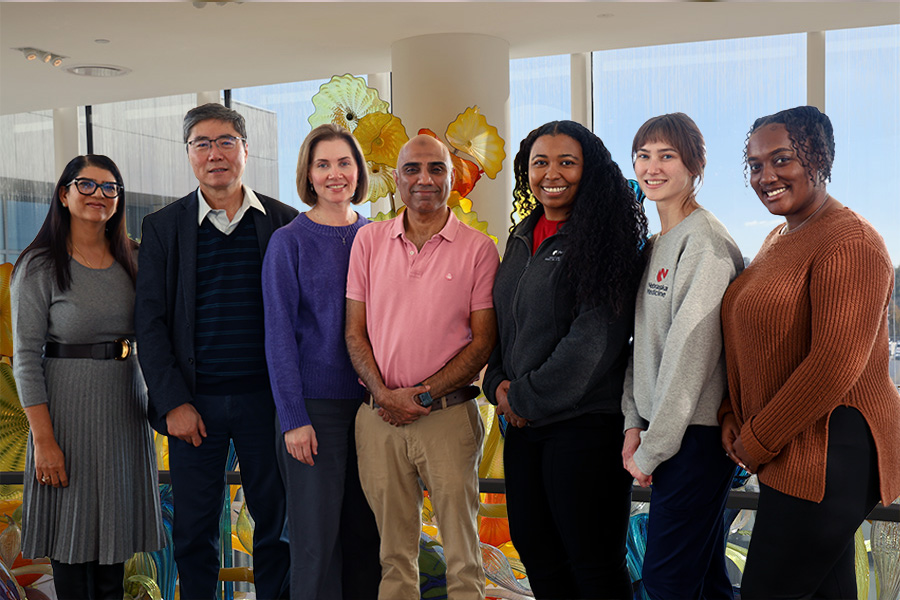
The trial’s two community health workers, Tessa Feeney and Destiny Cole, have completed four advanced training modules on severe maternal morbidity and mortality, and the team hopes to share the modules across the state.
Success has a number: blood pressure below 130/80 at one year, the American Heart Association threshold. If the approach works, Dr. Shahul said, it could shape national postpartum guidelines and help rural Nebraskans who live far from specialists.
“Remote patient monitoring becomes a very viable pathway for an early intervention program,” Dr. Shahul said.
Dr. Shahul urges new mothers and their families to report any new chest pain, shortness of breath, leg swelling, or dizziness to a doctor immediately — even weeks or months after delivery.
“Much of postpartum maternal morbidity and mortality can be prevented. We need to support our moms,” Dr. Shahul said.