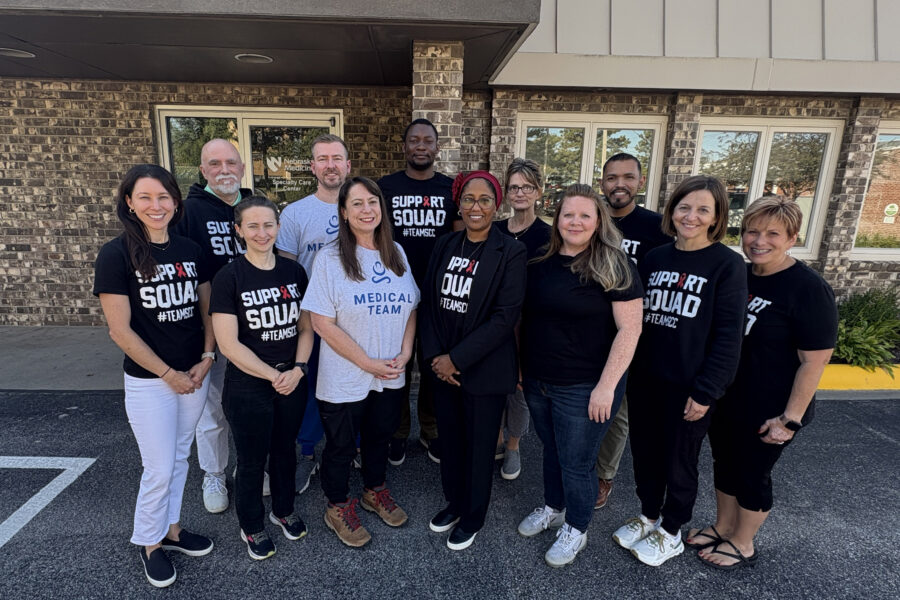
True to its mission to transform lives, UNMC soon will provide more health care to the unhoused in Omaha, building on an already robust collaboration with HEAL Omaha, a local non-profit.
A new $1.4 million grant from the Health Resource and Services Administration will enable UNMC’s Specialty Care Center-HEAL Omaha team to provide more health care to the unhoused in Omaha.
The Specialty Care Center team has received $1.4 million grant to serve as a demonstration site for a HRSA program documenting the efficacy of “street medicine” intervention for people with HIV who are unsheltered, said Nada Fadul, MD, the principal investigator on the grant.
The grant makes the UNMC-HEAL Omaha team part of a HRSA “special project of national significance,” one of only 11 sites in the country exploring how to best implement the street medicine model for people who have HIV.
“We’re going to have collaborators across the country, who are doing this in different ways and sharing methodology,” said Dr. Fadul, a professor in UNMC’s Division of Infectious Diseases. “This will enable us to build a system that’s solid, based on evidence, and also sustainable for the future.
“We are very excited about this opportunity and what it offers for UNMC and the Omaha population.”
The UNMC-HEAL Omaha collaboration has been ongoing for about a year, Dr. Fadul said.
When people who are unsheltered and have HIV are identified, on-the-spot services can include telehealth counseling and labs. An SCC community health worker and social worker often join HEAL Omaha on street rounds, as well as a nurse practitioner providing telehealth. There also are a growing number of UNMC student volunteers involved.
Melissa Neuenfeldt, director of operations for HEAL Omaha, said the news validates the work of the three-year-old nonprofit.
“It signifies confidence in the methods we’re using,” she said. “It’s a national recognition, so it puts a spotlight on the work that we’re doing, and it signifies to our peers across the country that we’re doing something special here.”
Street medicine is not a new concept, Neuenfeldt said, adding that she has been practicing it – as a registered nurse — in some form for a decade.
“Street medicine exists in over 200 cities worldwide,” she said. “Bringing care directly to the people who are living without housing is not a new concept, and it happens in cities all over the place. What’s unique is that we are doing this in what I consider to be the biggest small town in America. We all know each other, and so we have strong collaborative relationships, and that is a significant advantage when it comes to working across sectors.”
Jordan Rhyner, a medical student, had done volunteer street medicine work in Boston during the COVID-19 pandemic before coming to medical school. He was excited to get involved in a similar program in Omaha.
“I wanted to find ways to help the community and get involved, and working with unsheltered folks was a good way to give back and care for my community,” he said.
Medical student Olivia Youngblood worked in case management for the Community Alliance in Omaha, and she found that volunteering with HEAL increased opportunities for patient interaction.
“It’s been really special to work with HEAL, specifically because you can build bonds, and it’s just great practice for us to get more patient interaction in general for medicine.”
The team has built a good relationship with the unsheltered people they serve, Dr. Fadul said.
“In the past, people may not have disclosed their HIV status,” Dr. Fadul said. “But now, people also know our team members. They feel more comfortable telling them if they have HIV, their treatment history and that they want to get back on medication.”
Rhyner and Youngblood are two of the three co-presidents of a new street medicine student interest group at UNMC.
Dr. Fadul said there are several exciting elements to the new grant.
“At the Specialty Care Center, we have around 5% of our patients or about 70 patients at any given time who are unstably housed,” she said. “Having this grant will allow us to provide services for them, and that’s a wonderful thing. And the other exciting part is being part of this large national network that is going to be working toward the same goal.”
The grant also will enable future growth for the program, said HEAL Omaha CEO Dalton Nelsen, MD, who also is assistant professor in the UNMC Department of Emergency Medicine.
“This opens the doors for a lot of other funding and collaborative opportunities within UNMC and other hospital systems in town. It is a huge step for our organization,” he said.
Rhyner and Youngblood also are excited about the opportunities.
“Providing medicine to our unsheltered neighbors is a unique difficulty in medicine,” Youngblood said, pointing to the barriers for consistency of care. “HIV is so difficult to treat, especially without consistent care … and then you add homelessness on top of that. So, it’s a subspecialty that needs a lot of help, because it’s already difficult enough to take care of both of those populations.”
Rhyner said an advantage of the ‘backpack medicine’ aspect of the HEAL-UNMC approach is its flexibility. “We can find people all over the city.
“Viewing everyone with dignity and respect, treating everyone like we want to be treated, is part of my philosophy as a medical student,” Rhyner said. “All medical students will encounter unsheltered patients, no matter what field they’re in, so it’s good practice to understand the determinants of health and how to approach difficult situations.”