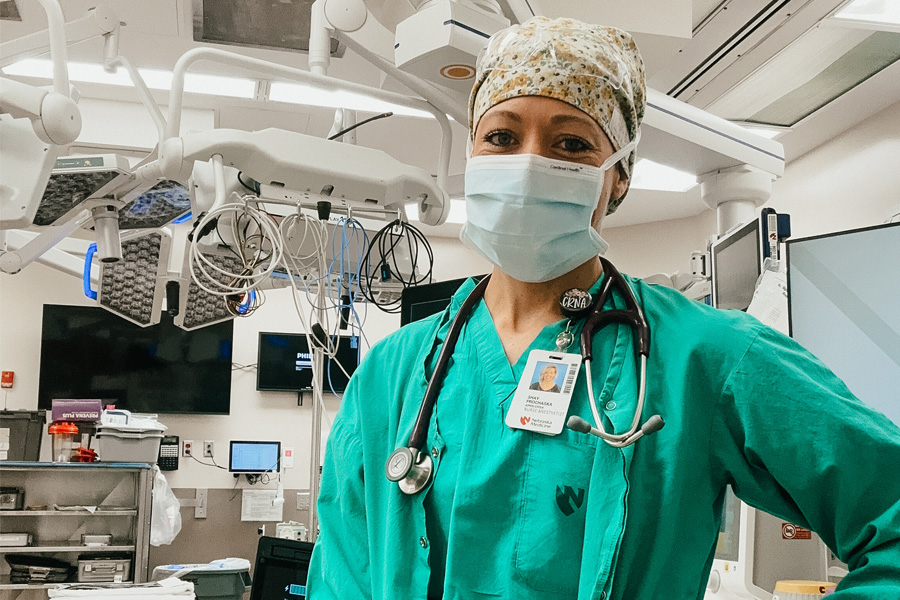
For Shay Prochaska, CRNA, nursing was never a question — it was always the plan.
“Growing up, I knew nursing would be my career path,” she said. “My mom is a nurse, and watching her work really shaped that for me.”
It wasn’t until nursing school that Prochaska discovered nurse anesthesia. At the time, she said, it felt like a lofty goal, but it was one that stayed with her.
“Once I learned about nurse anesthesia, it became something I aspired to,” she said. “I could see myself in that role.”
Prochaska began her nursing education at Clarkson College, balancing full-time coursework with full-time work as a patient care technician on the solid organ transplant unit at Nebraska Medicine. She later transitioned to Bellevue Medical Center shortly after it opened.
After earning her BSN, she worked as a medical-surgical RN at Bellevue before moving into the cardiovascular intensive care unit at Nebraska Medicine. Initially, she planned to spend one year in critical care before applying to CRNA school. That plan changed.
“I fell in love with the CVICU,” Prochaska said. “The complexity of the patients and the level of critical thinking required really energized me.”
After three years in the CVICU and with encouragement from her leadership team, she applied to Clarkson College’s nurse anesthesia program and was accepted.
Today, Prochaska brings that critical care mindset into every anesthetic she delivers. What she values most about her role is the ability to provide individualized, patient-centered care during some of life’s most vulnerable moments.
“I want to be a source of calm and reassurance,” she said. “That’s something I take a lot of pride in.”
She describes herself as composed and steady, even in intense situations, qualities that serve her well in anesthesia care.
“I may have a quiet demeanor, but I’m not afraid to speak up,” she said. “I’ll always advocate for my patient and stand up for what’s right.”
That advocacy, paired with compassion and vigilance, defines how she practices.
Prochaska has been practicing as a CRNA for three years. While the responsibilities of the role remain consistent, she says her growth has been significant.
“Each day brings opportunities to learn,” she said. “My clinical judgment, confidence and efficiency have all grown with experience.”
She describes anesthesia as fascinating but unpredictable — a balance that keeps her engaged.
“You have to be ready to think critically and respond quickly when things change,” she said. “That challenge is part of what makes the work meaningful.”
When explaining her role to those unfamiliar with anesthesia practice, Prochaska keeps it simple and patient-focused.
“I tell people that I’m responsible for keeping patients safely asleep and comfortable during procedures,” she said. “I’m continuously monitoring vital signs so the surgical team can do their work safely.”
For nurses or students considering the profession, her advice is enthusiastic and honest.
“It’s the coolest career around,” she said. “It’s demanding but incredibly rewarding. The level of care you’re able to provide makes it all worth it.”
Outside of work, Prochaska recharges by spending time with her husband and three children. Much of the winter revolves around travel hockey for their youngest — a commitment the family fully embraces.
She and her husband also enjoy attending live music events whenever they can.
“Music really energizes me,” she said. “It’s one of the best ways I reset.”
A Pablo Picasso quote reflects how she approaches both work and life:
“The meaning of life is to find your gift. The purpose of life is to give it away.”
For Prochaska, CRNA Week is an opportunity to recognize the dedication and impact of nurse anesthetists.
“It honors the vital role CRNAs play in patient care and safety,” she said. “CRNAs provide expert care and calm reassurance for every patient, every time.”