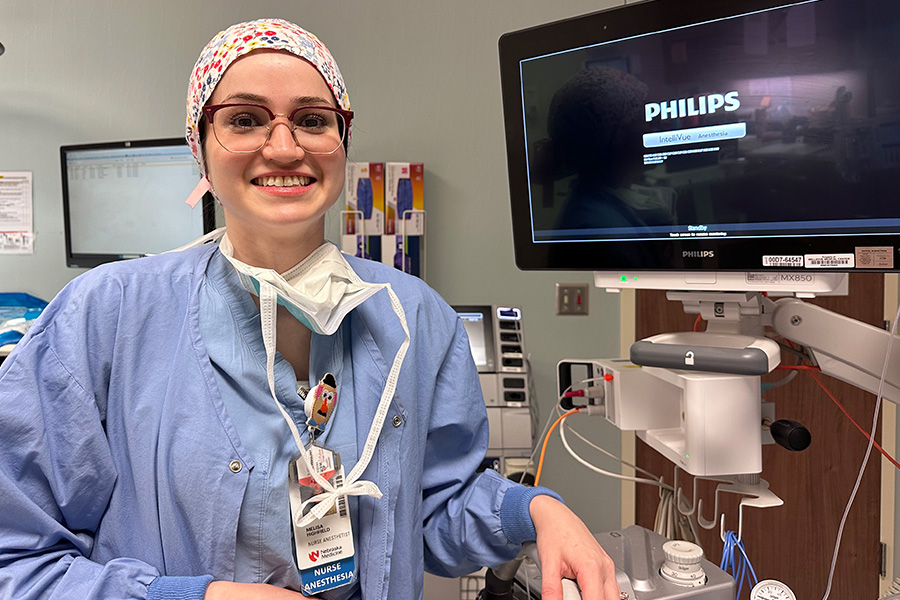
For Melisa Highfield, CRNA, the path to nurse anesthesia started with a moment of clarity.
As an undergraduate nursing student, Highfield had the opportunity to shadow several CRNAs. She remembers leaving that experience both impressed and inspired.
“The CRNAs I shadowed were enthusiastic and welcoming,” she said. “They took the time to explain what they were doing and encouraged me to consider the profession. That really stuck with me.”
Those early shadowing experiences, first as a student and later as a registered nurse, helped solidify her decision to pursue nurse anesthesia.
From the beginning, Highfield knew she wanted a role that allowed her to work directly with patients and make a meaningful difference in outcomes. Nurse anesthesia felt like a natural fit.
“I wanted to be hands-on and have a positive impact on patient care,” she said. “Seeing CRNAs who were passionate about their work made me realize this was the direction I wanted to go.”
Highfield earned her Bachelor of Science in nursing from Methodist College and began her career at Saint Elizabeth’s progressive care unit. After a year, she transitioned to the cardiovascular intensive care unit at Nebraska Medicine, where she cared for complex, critically ill patients.
After gaining experience in the CVICU, she applied to Bryan College of Health Sciences and was accepted into the doctor of nurse anesthesia practice program. She completed most of her clinical training at Nebraska Medicine.
“What drew me in was the variety,” Highfield said. “The wide range of cases and the complexity of the patients kept me engaged and constantly learning.”
Today, Highfield’s schedule varies from week to week. Some days, she provides anesthesia care to healthy patients in outpatient surgery centers. Other days, she works at the main campus, caring for patients with more complex medical needs.
“That variety is one of the things I enjoy most,” she said. “No two days are the same.”
Her favorite part of being a CRNA is the collaborative environment of the operating room.
“You’re constantly working alongside surgeons, nurses, anesthesia colleagues and support staff,” she said. “When communication is clear and everyone is on the same page, it makes a huge difference for patient care.”
That same complexity, however, can also be the biggest challenge.
“Delivering anesthesia to complex patients requires constant vigilance and adaptability,” Highfield said.
Since starting her career at the UNMC Department of Anesthesiology, Highfield says one of the most rewarding aspects has been working with students.
“I’ve really enjoyed precepting SRNAs,” she said. “In the future, I’d love to take on a more active role in coordinating their clinical experiences.”
She sees teaching as a way to give back to the profession that welcomed her early on.
“Having people who took the time to teach and encourage me made a difference,” she said. “I want to be that person for someone else.”
Highfield knows that many people don’t fully understand what CRNAs do. When she explains her role, she keeps it straightforward.
“CRNAs provide anesthesia services that ensure patient safety and comfort,” she said. “We review medical records, develop individualized anesthetic plans and care for patients across the lifespan, from pediatrics to geriatrics.”
She said that CRNAs are involved in a wide range of cases, including neurologic, transplant and obstetric procedures, and play a key role before, during and after surgery.
For nurses or students curious about anesthesia, Highfield’s advice is simple.
“Shadow a CRNA,” she said. “There’s no better way to understand what we do.”
She stays current through educational meetings, departmental resources and ongoing collaboration with colleagues and students. And when she’s not at work, she finds balance through travel, reading and woodworking. Recently, she completed a set of custom upper kitchen cabinets, a project she describes as both challenging and rewarding.
A guiding phrase she returns to often is “roll with the punches.”
“This profession can be challenging,” Highfield said. “Not everything goes according to plan, and learning to adapt builds resilience.”
For Highfield, CRNA Week is about recognition and pride.
“It highlights the important role CRNAs play in the operating room,” she said. “It’s also a chance to recognize the incredible people I get to work with every day.”
Her message to patients and the community is one of reassurance.
“The anesthesia department at UNMC is extraordinary,” Highfield said. “Patient safety is always the priority, and the outcomes speak for themselves. You’re truly in good hands.”