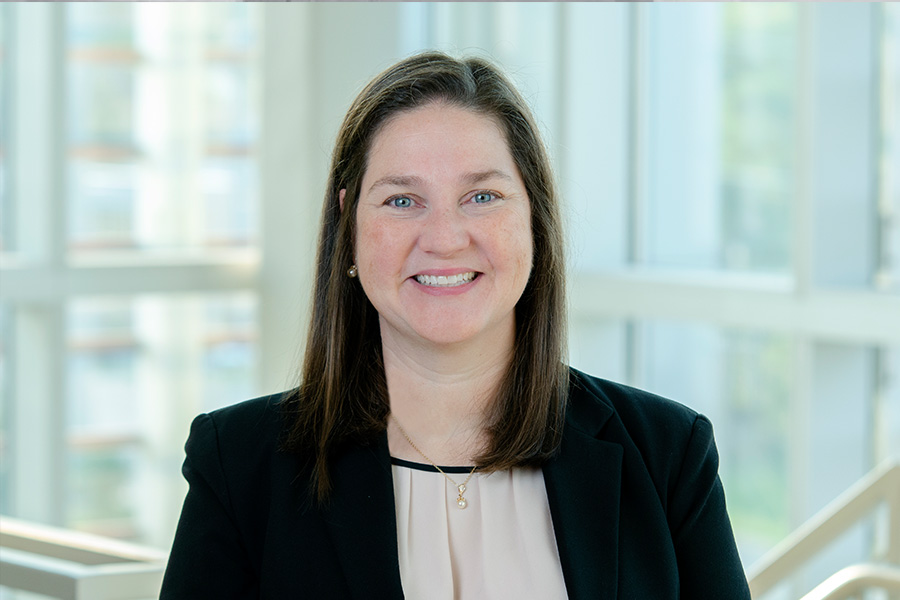
Shelley Iverson, DO, has built her career around caring for some of the most critically ill patients, those whose hearts or lungs need time, support and sometimes the help of technology to heal.
Now, she will lead that work across UNMC and Nebraska Medicine.
Dr. Iverson, an assistant professor and critical care anesthesiologist in the UNMC Department of Anesthesiology since 2022, has been named medical director for extracorporeal life services (ECLS.) In this role, she will help coordinate care for patients requiring advanced mechanical circulatory support, including extracorporeal membrane oxygenation (ECMO.)
Dr. Iverson describes ECLS as a bridge, providing time for recovery or for additional treatment such as transplant or long-term assist devices.
As medical director, Dr. Iverson’s role will involve coordinating the complex systems required to safely deliver that care. That includes working closely with perfusion teams, responsible for operating the devices, collaborating with nursing staff and coordinating care with cardiothoracic surgeons and other specialists involved in mechanical circulatory support.
Dr. Iverson said one of her priorities will be advancing the ECMO program within the Extracorporeal Life Support Organization, the international body that recognizes ECMO centers for excellence.
Dr. Iverson brings a uniquely broad clinical perspective to the role. She completed anesthesiology residency and anesthesiology critical care fellowship training at UNMC after previously completing an internal medicine residency and pulmonary medicine fellowship in South Carolina. She currently serves as both an attending physician on the cardiothoracic critical care anesthesia intensive care unit service and as an attending anesthesiologist in the operating room.
That winding path, she said, ultimately strengthened her ability to care for critically ill patients.
The care of patients requiring ECLS depends on close coordination across many specialties, something Dr. Iverson sees every day in the ICU.
“When you’re taking care of critically ill patients, a multidisciplinary approach is best,” she said. “Physicians, nurses, respiratory therapists, nutritionists, pharmacists – everyone plays a role in the patient’s wellbeing.”
Shaun Thompson, MD, chief of the critical care anesthesiology division, offered his congratulations. “Congratulations to Dr. Iverson on her appointment as medical director for ECLS at UNMC and Nebraska Medicine,” he said. “Our ECLS program is recognized across Nebraska and the region, and Dr. Iverson’s leadership will help us continue strengthening the care we provide for some of the most critically ill patients.”
In addition to expanding patient care, Dr. Iverson said education will remain a central focus of the program. She plans to develop a structured ECMO curriculum that includes didactic instruction and simulation training for fellows across multiple critical care specialties.
“Strong educational programs help attract top trainees and faculty,” she said. “When you have a robust education program, strong clinical exposure and a collaborative environment, that makes a medical center attractive.”
She also sees opportunities to strengthen collaboration across the region, noting that Nebraska Medicine frequently receives the most complex cases from surrounding states.
“All roads lead to Nebraska Medicine,” Dr. Iverson said. “We see the sickest of the sick, meaning our trainees gain experience caring for critically ill patients while working alongside teams that collaborate closely to deliver the best care possible.”
For Dr. Iverson, success in her new role comes down to continuing that tradition.
“Success is delivering excellent patient care,” she said.
Dr. Thompson said Dr. Iverson’s focus on expanding education and collaboration will further elevate the program. “Her efforts to grow our educational programming and strengthen collaboration with cardiothoracic surgery, heart failure and interventional cardiology will help us continue advancing a program that many centers already look to for guidance.”