
The University of Nebraska Foundation was established on June 3, 1936, with one purpose: to raise private support to strengthen the University of Nebraska.
That purpose has guided the foundation over the past nine decades, advancing students, faculty, research and facilities across the University of Nebraska System.
What started with a small group of committed leaders and a handful of gifts has grown into one of the nation’s leading university foundations. From the beginning, this work has been defined by University of Nebraska Foundation Trustees — volunteer leaders and advocates who believed in what the university could become and chose to invest in it.
Established during the Great Depression
The University of Nebraska Foundation, which is celebrating its 90th anniversary, was created with the encouragement of Chancellor Edgar A. Burnett, who led the University of Nebraska through the Great Depression. As state appropriations declined, campus buildings were condemned, and enrollment decreased, Burnett began a campaign to solicit private support to sustain a level of academic excellence not possible through state funding alone.
In the 1930s and 1940s, through the Great Depression and World War II, donors’ commitment to the University of Nebraska endured. The foundation’s first gift was a $1,000 contribution to support the construction of a student activity building — today the student union on the University of Nebraska–Lincoln’s City Campus. That was followed by a $3,000 gift for public health research on the bacteriology of milk. In 1937, the foundation received the first gift of company stock to create the university’s longest-running scholarship, the Cornish Scholarship, which is now being awarded for the 89th year.
Clifford M. Hardin, who served as chancellor from 1954-1969, observed that, as the struggle for financial support grows, the difference between mediocrity and distinction would depend in large measure on the strength of outside support. In the late 1960s, the foundation’s scope expanded alongside the university itself. Following the University of Nebraska’s merger with the University of Omaha, the foundation assumed responsibility for private support across a unified university system.
First comprehensive campaign
In 1977, the first comprehensive, universitywide campaign was launched. By its conclusion in 1980, the Nebraska Campaign had raised $51 million — more than double its goal. The Lied Center for Performing Arts at UNL and Durham Science Center at the University of Nebraska at Omaha were just two of the results of this campaign.
The 1990s and 2000s marked a period of transformation. Philanthropy resulted in the creation the Lied Transplant Center and the Durham Research Center towers on the UNMC and Nebraska Medicine campus; the J.D. Edwards Honors Program (today known as the Jeffrey S. Raikes School of Computer Science and Management), the Mary Riepma Ross Media Arts Center and the International Quilt Museum, all at UNL; and the Peter Kiewit Institute and the Walter Scott, Jr. Scott Scholars program at UNO. The College of Public Health at UNMC was created with the support of private funds.
In 1993, the Kearney State Foundation merged with the University of Nebraska Foundation after Kearney State College joined the university system, further strengthening a unified approach to private support. Shortly thereafter, a gift allowed for enhancements on the Kearney campus and the construction of the Ron and Carol Cope Fountain.
Recent years
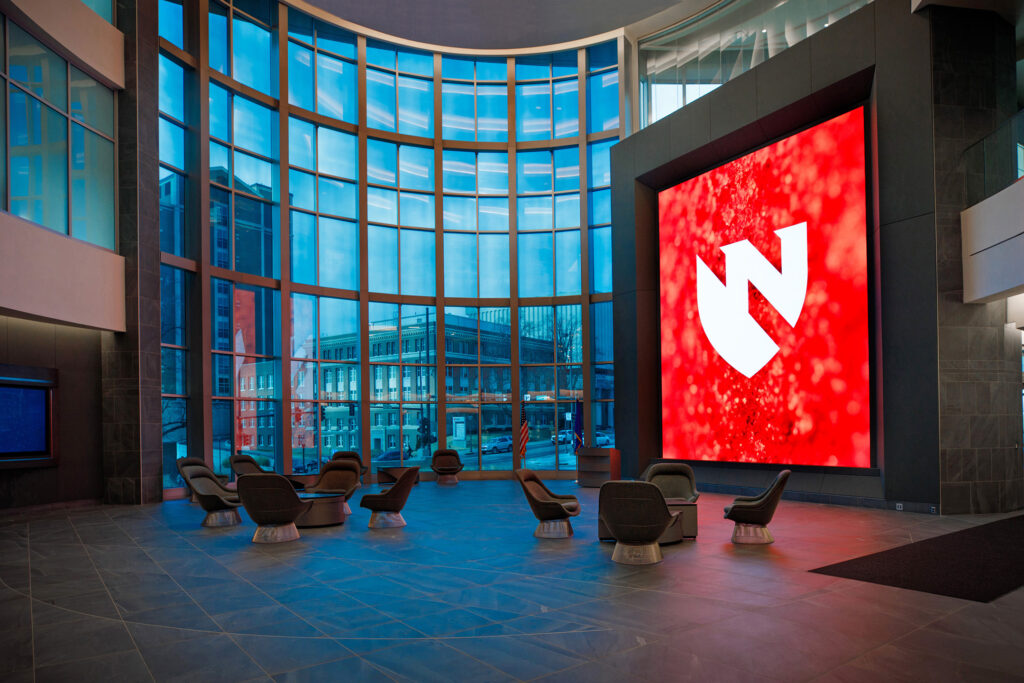
In more recent years, philanthropic support for the University of Nebraska has continued to expand both opportunities and impact. Numerous major facility projects have been constructed or are planned, including the Biomechanics Research Building and phase two and three expansions, Barbara Weitz Community Engagement Center and Mammel Hall at UNO; Michael F. Sorrell Center for Health Science Education, Fred & Pamela Buffett Cancer Center and Dr. Edwin G. & Dorothy Balbach Davis Global Center on the UNMC and Nebraska Medicine campus; the Johnny Carson Center for Emerging Media Arts, Howard L. Hawks Hall and Kiewit Hall at UNL; the Douglas A. Kristensen Rural Health Education Complex at the University of Nebraska at Kearney; and the recently approved renovation of the Student Success and Activity Center at the Nebraska College of Technical Agriculture in Curtis, Nebraska.
Throughout the foundation’s history, donors have invested in the success of University of Nebraska students. Philanthropy supports scholarships and academic programs across disciplines, ensuring that more students in Nebraska and beyond can pursue their dream of higher education. Support for faculty and research remains a top priority.
Today, the foundation manages assets of more than $3.9 billion, an endowment ranked in the top 25 among public universities and more than 11,000 donor funds. In fiscal year 2025, annual fundraising exceeded $400 million for the first time. And a fourth comprehensive campaign, Only in Nebraska: A Campaign for Our University’s Future, is underway, with a goal to raise $3 billion from 150,000 generous benefactors.
For 90 years, the foundation’s story has been defined by people who chose to invest in the University of Nebraska and the future it represents. From its earliest days, each generation has helped expand what’s possible. Only in Nebraska.