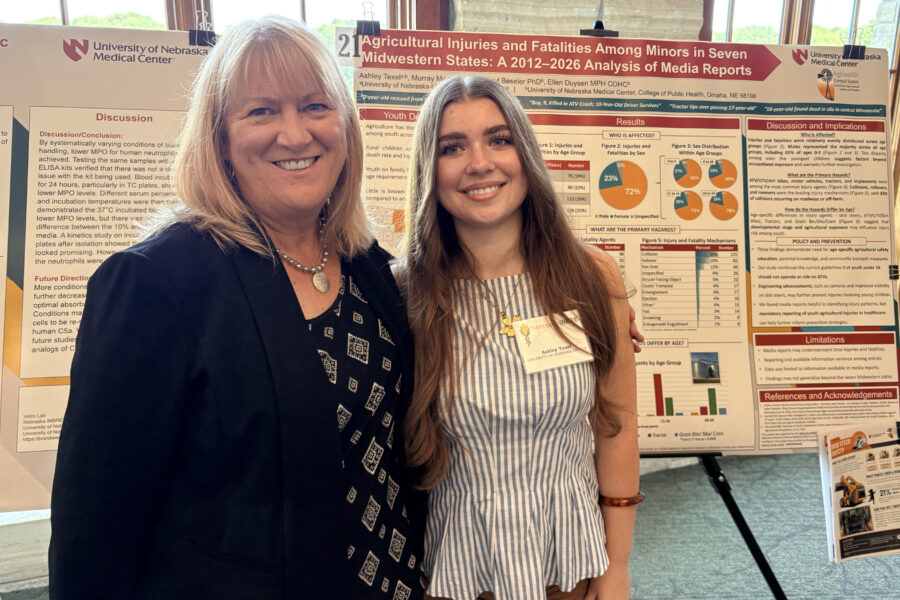
Ellen Duysen was on her way to Minnesota, to present at a large agriculture event.
But first, the research assistant professor at the Central States Center for Agricultural Safety and Health (CS-CASH) at UNMC headed in the opposite direction: to Nebraska City and the NE-INBRE Conference, to cheer on University of Nebraska-Lincoln rising senior Ashley Texel.
Texel had spent her time at INBRE working with Duysen, who had never hosted an INBRE scholar before, on agricultural safety research.
“Oh my gosh, I’m impressed,” Duysen said. She was a few steps behind a group of mentor and student judges who were quizzing Texel on her research, a survey of child mortality due to agricultural equipment such ATVs and tractors.
“Ashley came from a wet lab, a biochemistry background,” Duysen said. “She brought her expertise into a setting where we could employ all her skills and explore agricultural safety and health.”
Texel, whose mother is a nurse, said that although she loves the science she does as a UNL biochemistry major, she saw INBRE as a chance to explore public health research.
“More people who go into public health with a strong background in science and how laboratory settings function would be really helpful,” Texel said. “I’m working on developing a plethora of knowledge and becoming more well-rounded when it comes to understanding public health.”
As she considers her graduate school path, Texel said the INBRE experience was helpful.
“I wanted to see what a public health study would look like,” she said. “I’m on the fence about getting a PhD in public health or biochemistry. And this summer helped me understand what public health research looks like — and then, what does that outreach look like? It’s been a really good experience.”
Texel created the database of agricultural injuries and fatalities from seven Midwest states for children younger than 19 by looking not only at state and CS-CASH figures but tracking media mentions. Once she created and analyzed the database, she created an informational handout, including information on skid steer deaths, a category she’d never heard of before the research project.
“I expected ATVs to be a large number of injuries, but I didn’t expect it to be as disproportionate as it was,” she said. “I hadn’t even known what skid steers were.”
Skid steers, which turn by skidding their fixed wheels, can have a big blind spot, which may be why Texel’s research showed they are particularly deadly for younger children, who are smaller and less easy for the driver to see.
It is Texel’s information on skid steers, Duysen said, that will be appearing on the CS-CASH website.
“She set up a unique database, did analysis with one of our statisticians and then formed some important conclusions. And then, to talk about translation from data to educational resource, she created a flyer that will be on the CS-CASH website.”
Duysen also said she’d be happy to do research with future INBRE students.
“This is a wonderful program,” Duysen said.
At the 2026 INBRE Research Conference, Texel received an honorable mention in the faculty poster judging and also was selected for one of three poster awards voted on by students.”
“I was incredibly honored to receive both recognitions, especially for a project that meant so much to me,” she said.