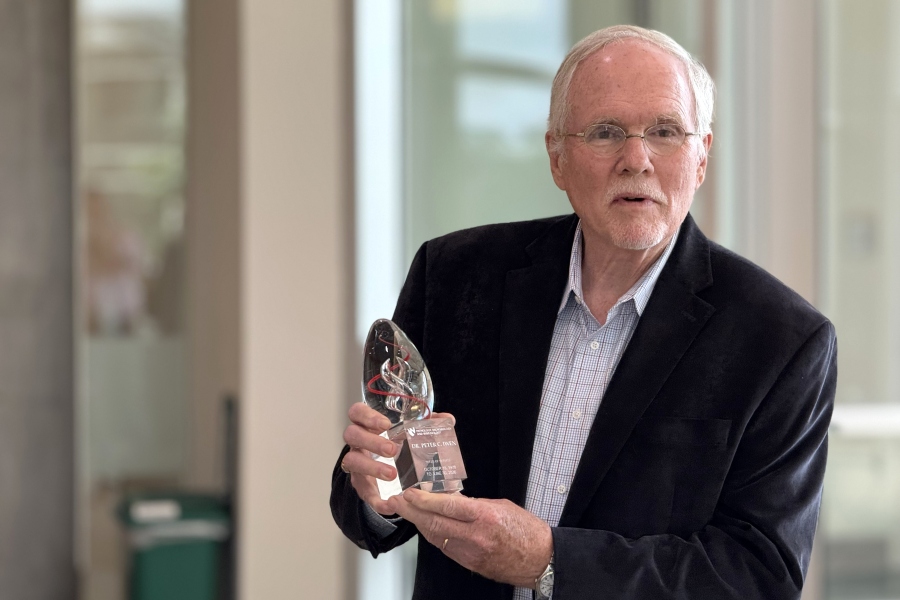
Dr. Peter Iwen can look back on many accomplishments in his 48-year career at UNMC. He’s also leaving with a sense of gratitude for the people who played a big part in his journey.
“I had many opportunities, which occurred because of people providing encouragement to me,” he said. “Dr. Norman Miller, who was co-chairman of what was then called the Department of Medical Microbiology, hired me as a research scientist in October 1978. He took a chance on me since I had recently graduated from undergraduate college and had no laboratory experience. Dr. Harry McFadden was chair of the department at that time and was also medical director for the Clinical Microbiology Laboratory at what was called University Hospital. Between the two of them, they encouraged me to continue my education and introduced me to the benefit of the tuition reimbursement program. So I got my master’s degree through that.”
In mid-1986, the department merged with the Department of Pathology and Laboratory Medicine. Dr. David Purtilo was chairman of this new merged department of Pathology and Microbiology following the retirement of Dr. McFadden. Dr. Purtilo encouraged Dr. Iwen to teach microbiology labs and made him an instructor within this new merged department. Dr. Purtilo unfortunately passed away shortly thereafter, and Dr. Samuel Cohen stepped in as chair. He brought in Dr. Steven Hinrichs as a new faculty member for his expertise in virology, and he subsequently became medical director for Nebraska Medicine’s clinical microbiology lab. Both felt Dr. Iwen’s research would make for a good PhD dissertation, and they encouraged Dr. Iwen to pursue his PhD, again using the tuition reimbursement program.
Dr. Mark Rupp was his PhD advisor. “He was interested in my work with invasive fungal diagnostics. He opened up the door for my interest in infectious diseases to apply the clinical patient care side with laboratory diagnostics. He encouraged me to join the hospital infection control committee. So again, opportunities were available for me to move forward in my career.”
Dr. Iwen is also appreciative of Emily McCutchen, who’s succeeding him as director of the Nebraska Public Health Laboratory, and for the entire NPHL staff. “They’re what make the laboratory function. Although I direct the laboratory, they are the ones that do the work. They’re very competent individuals.”
That makes stepping away from the laboratory easier. “There are so many new things that are happening all at once in the laboratory sciences. I’m at an age now where keeping up with these changes is getting to be a challenge. I feel the laboratory is in a good position to move into the future. So I think it’s time. These young laboratory scientists are prepared to move NPHL into the future.”
Dr. Iwen said he got the most satisfaction out of seeing people be successful. “A lot of people I’ve worked with have gone on to other positions and have been very successful. Also, being appreciated by your colleagues as a person of integrity and valued for my knowledge of clinical microbiology were important to me.
“I’d also like to be remembered for being supportive of my staff,” he said. “I’ve tried to make sure the staff is adequately compensated for what they do, for instance, and that they had opportunities to participate in programs to advance their careers. If you don’t get somebody to go to bat for you, sometimes things don’t happen. Finally, multiple staff members have been encouraged to continue their education while still working and supporting their families.
“And leaving here knowing that NPHL is better than when I started, and it’s going to move in the right direction makes retiring easier. I believe the lab is going to be better yet after I leave. New blood will do that. This is important to me. I’ve been working at that; Emily has been working hard during this transition time, and I feel she’s the right person to direct and keep the laboratory moving forward.”
Dr. Iwen said he plans to spend more time with his family. “A couple of my children and their families are here in Omaha. My daughter lives in Germany with a couple of our grandchildren, and I have a son and his wife who live in Fort Collins, Colorado. My wife and I enjoy traveling to national parks, so that’s something that we’re healthy enough to still do that. We have a shared lake cabin up in Minnesota that we like to go to and just hang out. Other retirees have told me not to make big plans early in retirement, to just sit back, take your time to define the new you, and that’s where I’m at now. But I’m not going to completely leave my professional interests in microbiology, as I’m still going to be involved here as an emeritus professor. This is not goodbye; I’ll see you later.”
Career highlights
- Taught microbiology topics to a variety of students (graduate, medical, nursing, pharmacy, and physician assistant), residents, and directed a postdoctoral microbiology training fellowship
- Author on over 170 peer-reviewed publications, 191 abstracts, and 15 book chapters
- Primary investigator on over $65 million in contractual arrangements with the Nebraska Department of Public Health to support the Nebraska Public Health Laboratory
- Co-author in the identification of two new bacterial species (Mycobacterium nebraskense and Mycobacterium talmonii) and one new fungal species (Philosimplex caninus)
- September 2001, provided research for and published one of the first review articles describing the use of the internal transcribed spacer regions as molecular targets for the identification of fungi, which subsequently became recognized as a bar code for fungal identification (PhD dissertation)
- October 2001, coordinated environmental anthrax testing at NPHL during the Amerithrax biothreat incident
- January 2002, hired as the first campus biosafety officer and coordinator for the high-level containment laboratories
- June 2002, appointed the first campus responsible official (RO) for the newly developed Select Agent (Biothreat) Program
- September 2014, directed the NPHL as the only state or jurisdictional public health laboratory in the U.S. to provide laboratory support for the identification and care of Ebola virus-infected patients admitted to the Patient Care Biocontainment Unit
- April 2020, developed a group testing (pooling) protocol used to diagnose patients with suspected COVID-19 when a shortage of test reagents occurred that subsequently became a national standard for other labs
- March 2026, managed a team from the Association of Public Health Laboratories Biosafety and Biosecurity Committee in the development of national standards to advise clinical and public health labs on how to safely handle specimens that might contain a high-consequence pathogen
- May 2026, directed the NPHL in the development of the first CLIA-approved rtPCR assay in the U.S. for the detection of the Andes strain of hantavirus to support diagnostic testing for travelers admitted to the National Quarantine Unit