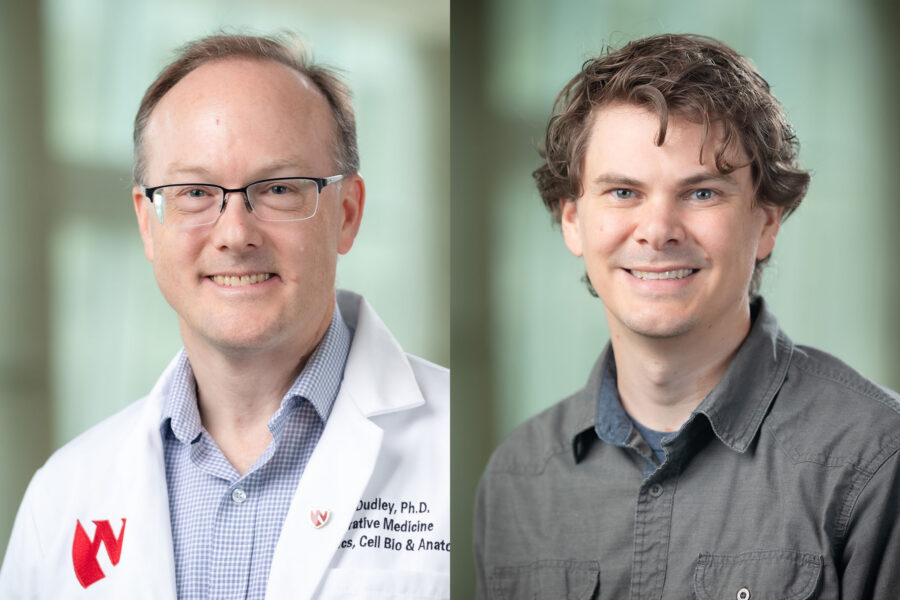
Jordan Rowley, PhD, and Andrew Dudley, PhD, faculty members from the UNMC Department of Genetics, Cell Biology and Anatomy, have been awarded a five-year, $3.3 million T32 grant from the National Institute of General Medical Sciences to establish a new training program to support computational science.
The grant is the result of 16 years of building a bioinformatics program in the department and campuswide, said Vimla Band, PhD, department chair.
“The goal of any T32 program is to provide unique experiences that enhance the training of individual scientists,” Dr. Dudley said.
The program, DECODE (Developing Experts in Computation, ‘Omics and Data Exploration) will use computation as the framework to train students in computer and AI tools to enhance productivity and allow the budding investigators to focus on critical thinking and creativity.
Co-principal investigator Dr. Rowley said DECODE is the first T32 program at UNMC to be open to first- and second-year graduate students – the federal programs are more often geared to third- and fourth-year students.
“DECODE is designed to jumpstart graduate education and promote self-efficacy and independent learning,” Dr. Rowley said. “While technical proficiency is often a focus of training, it’s vitally more important to be intellectually proficient.”
To ensure trainees are prepared for the future, the training will emphasize the application and ethical use of AI tools for coding, data analysis and visualization, and preparation of research reports.
“Five years ago, if we talked about computation, we’d be talking about a heavy focus on learning computer programming languages,” Dr. Dudley said. “In the last two years, generative AI has completely flipped that model. Researchers have switched from coding their own software individually to relying — in an ethical manner — on generative AI to do some of the heavy lifting for the coding and data analysis.”
But the program is not only about computational skills and AI.
Dr. Rowley said that the cross-training is meant to erase a divide that has long shaped graduate education. “Students no longer have to define themselves as either a bioinformatician or a bench scientist,” Dr. Rowley said. “We enable bench scientists to bring real computational skills to their own experiments, and for computational students to understand where the data comes from and what that means for the analysis.”
“The students simultaneously will learn how to manage projects, how to lead, how to teach,” Dr. Dudley said. “We integrate this training into a student-led team project rather than breaking it apart into individual courses.”
Although students will only be in the program for two years, the principal investigators expect to see success metrics that will continue throughout their pre- and post-doctoral careers.
“We expect these students to graduate with more papers and to have better job prospects, honestly,” Dr. Rowley said. “We want to ensure that, when they graduate, they’ll have a paper from their DECODE experience, as well as their own research papers and manuscripts, which includes greater expectations that they publish in high tier-journals.”
“We also want to see our trainees giving more national presentations, receiving more external fellowships, and stepping into leadership positions on campus and in national organizations,” Dr. Dudley said. “In terms of metrics, what we’re really tracking is: Does being in the program for those two years have an impact as they continue their academic and professional careers?”
“This T32 will help campuswide collaboration to build training for our next generations of scientists in merging bioinformatics and artificial intelligence with biology for healthcare related discoveries—diagnosis, prognosis and therapy of human diseases, such as cancer, addiction, neurological disorders to name a few,” Dr. Band said.
Laying the groundwork
Dr. Band pointed to Babu Guda, PhD, the first bioinformatics faculty hire in the UNMC Department of Genetics, Cell Biology and Anatomy, as laying the foundation for bioinformatics training at UNMC.
“Dr. Guda helped develop several didactic and online courses and two current graduate programs — Biomedical Informatics (BMI) and Bioinformatics and Systems Biology (BISB),” Dr. Band said. “These efforts have laid the groundwork for the current DECODE program. Dr. Guda and subsequently other faculty members, such as Drs. Dudley and Rowley, Sandipan Brahma, PhD, Gargi Ghosal, PhD, Kyle Hewitt, PhD, Kishor Bhakat, PhD, Subu Ramanathan, PhD, and Shibiao Wan, PhD, helped solidify the program and will continue to provide essential expertise to develop and teach within the program.”
Congratulations!!!
Hearty congratulations! New topic and direction for the benefit and growth of science, the institutional stature, and opportunities for students and faculties…..,
Congratulations!
Yay you! Well done. This sounds great!
Congratulations Drs. Dudley and Rowley!
This is a great contribution to the University!!!!
Many Congratulations.
Congratulations!
Heartiest congratulations! Leading New frontiers for the students 👏
Andy & Jordan – CONGRATULATIONS!
Congratulations to both of you!!