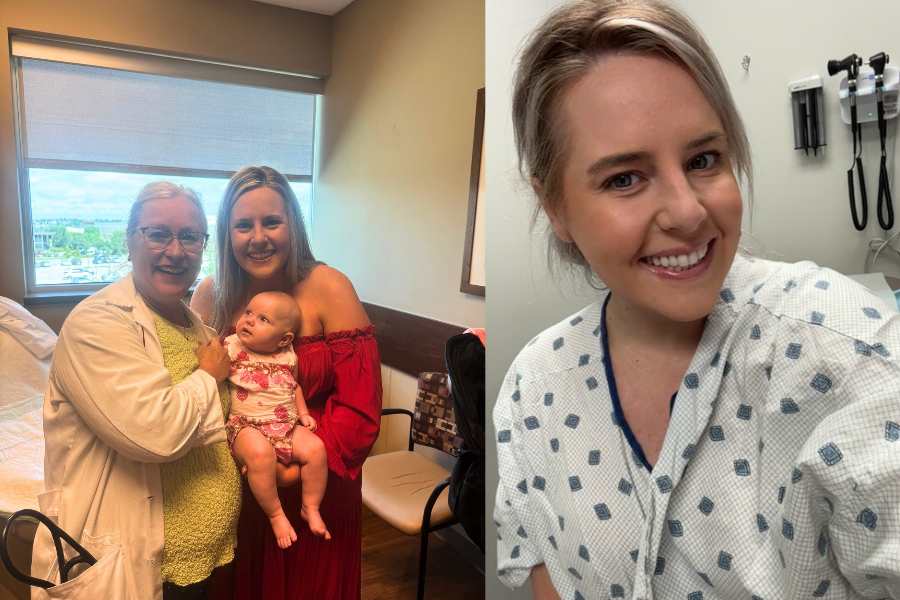
Brandi Kay Muhle said yes to a clinical trial that meant exploring a new way to reduce ovarian cancer risk—one that could potentially delay menopause for women like her.
Brandi is a participant in the SOROCk Trial in Omaha, Nebraska, at the NCI-designated Fred & Pamela Buffett Cancer Center. This is a national study investigating whether removing just the fallopian tubes while delaying removal of the ovaries can reduce the risk of ovarian cancer similarly to removing both the ovaries and fallopian tubes.
For Brandi, this choice was very personal. “I know what it means to live with an inherited cancer risk,” Brandi said. “I lost my mom to breast cancer.”
Brandi found out at 19 that she has a BRCA gene mutation, which raises her risk for some cancers. When she was 22, she had a mastectomy.
“I am a mother to a four-month-old daughter, and I feel strongly about doing everything I can to lower my own risk and help create better options for my daughter and future generations,” she said.
For women with a high-inherited risk of ovarian cancer, one way to lower the risk is to remove both the ovaries and fallopian tubes. However, taking out the ovaries causes immediate surgical menopause.
That was a major consideration for Brandi.
“Going into menopause at 35 really worried me,” she said. “There are many things to think about, like mental health, bone strength, heart health, and other changes in the body. It’s not just about removing the ovaries; it’s a big thing.”
The SOROCk trial is based on a discovery that changed how researchers understand where most high-grade serous ovarian cancers begin.
“We have discovered that the vast majority of ovarian cancers actually start in the fallopian tubes,” said Kerry Rodabaugh, MD, gynecologic oncologist and principal investigator of the SOROCk Trial.
“With this trial, we are also looking at how participants in the study feel about their quality of life with delaying surgical menopause,” said Dr. Rodabaugh.
The SOROCk approach is different from opportunistic salpingectomy, where doctors might remove the fallopian tubes during another surgery, such as a C-section, after childbearing.
In the SOROCk Trial, Dr. Rodabaugh is studying risk-reducing salpingectomy as a strategy for women at high risk of ovarian cancer, often because they have a known genetic mutation.
Ovarian cancer can be particularly difficult to detect early. “Early cancer often does not cause symptoms,” Dr. Rodabaugh said. “When symptoms do occur, they can be nonspecific and are often thought to be related to the gastrointestinal tract.”
“Routine monitoring also does not always detect cancer in the early stage,” Dr. Rodabaugh said. “I have had patients in my practice who had routine exams and ultrasounds with normal results but returned months later with advanced ovarian cancer.”
“It is a difficult cancer to detect at an early stage,” she said.
“For patients like Brandi, that uncertainty makes prevention especially important. But prevention can also come with difficult choices,” said Dr. Rodabaugh. “The possibility of reducing ovarian cancer risk without requiring women to enter surgical menopause immediately is what makes the study important.”
“A total sense of peace of mind,” said Brandi. Being part of the trial has given her something equally important: reassurance about taking steps to reduce her risk.