When Jessica Davies, director of the Panhandle Public Health District, is out and about, mosquitoes are never far from her mind.
“As I’m at Friday night football games and I’m at the county fair, I walk around with my bug spray and I hand it to anybody that’s sitting near me,” she said.
But her concern isn’t just itchy bug bites. According to a recent Nebraska study led by UNMC, the Great Plains, particularly Nebraska, have among the highest cumulative incidence of infection of West Nile virus (WNV) in the U.S.
WNV is a mosquito-borne disease. More precisely, “West Nile is an emerging infectious disease introduced less than 30 years ago in the U.S.,” said David Brett-Major, MD, professor of epidemiology in the UNMC College of Public Health.
Neuroinvasive cases of WNV can lead to “severe manifestations of meningitis, encephalitis and acute flaccid myelitis,” the study said.

Population serosurveys have shown that up to 20% of people in western Nebraska have been exposed to WNV. Nebraska has reported more than 400 human cases to the Centers for Disease Control and Prevention (CDC) over the past four years, and more than 200 of these were classified as “neuroinvasive disease.”
Everyone has at least heard of someone who has been impacted in some way, Davies said.
Even mild cases of WNV can leave people with long-term neurological aftereffects. It’s estimated that only 1 in 10 cases causes people to seek professional healthcare. They may not even know they have WNV.
But people can still be affected by these unreported, subclinical cases.
“We’re only seeing the tip of the iceberg of the total burden” of WNV in western Nebraska, said Jana Broadhurst, MD, PhD, a clinical pathologist, microbiologist and immunologist.
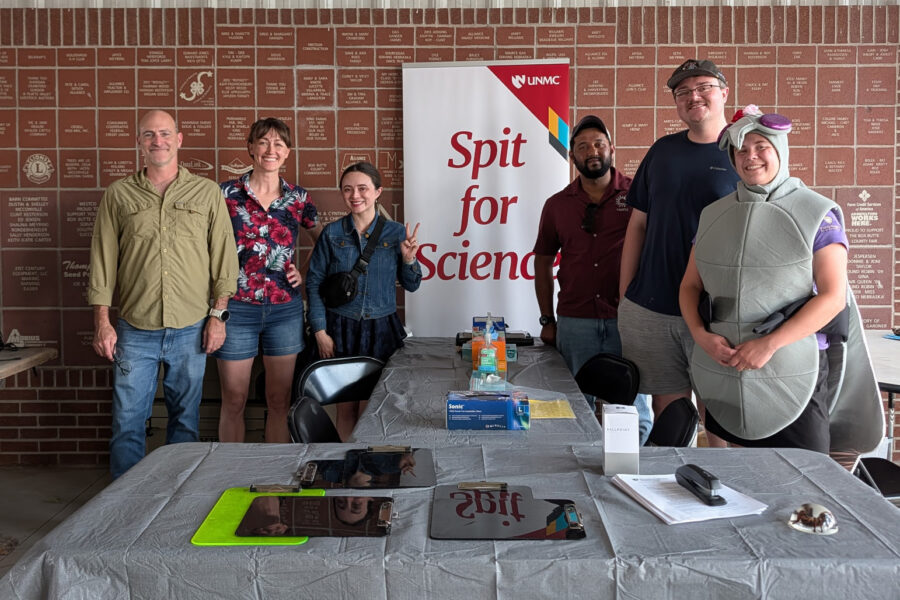
Dr. Broadhurst also is the principal investigator for the study that began collaboration with Panhandle Public Health District and other stakeholders on WNV in western Nebraska. She, Dr. Brett-Major, and Joseph Fauver, PhD, the director of UNMC’s newly established Nebraska Vector-Borne Disease Transmission Dynamic Program, lead UNMC’s efforts to learn more about WNV in Nebraska.
“We are pursuing better understanding of the transmission between birds, mosquitoes, and people, in the context of agriculture,” said Dr. Brett-Major. “It is a complex ecology. There are waves of transmission from year to year. It’s a dynamic problem.”
The scientists’ most recent visit to the Panhandle in August also included University of Nebraska at Kearney ornithologists Letitia Reichart, PhD, and Jacob Cooper, PhD, from UNK’s Department of Biology.
This collaboration has taken the work already being done in the Panhandle to another level.
“As a public health system, we’ve always taken (WNV) very seriously,” Davies said.
But a connection with Central States Center for Agricultural Safety and Health (CS-CASH) led to a connection with UNMC, and pilot funding. And to a chance to conduct collaborative research with the University of Nebraska’s academic health science center – including world experts like Drs. Broadhurst, Brett-Major and Fauver.
Davies said she and western Nebraska community members have found working with the UNMC team a rewarding experience.
“They’ve been very personable, very respectful, very willing to accommodate what makes (research) accessible from our rural perspective,” Davies said.
“They were excited to work with us.”
Why does Nebraska, and especially western Nebraska, have such high incidence of WNV?
“We think these things are very local,” Dr. Brett-Major said. “We are working to find out why this particular mosquito does very well there, in a unique ecology like western Nebraska.
“The Great Plains are unique,” he said. “The way we do agriculture is different. The land is different. The water paths are different.”
Davies said she’s seen enthusiasm in the Panhandle about the UNMC partnership.
“We’re always open to research in our rural communities,” she said. “People want to be part of the solution.”