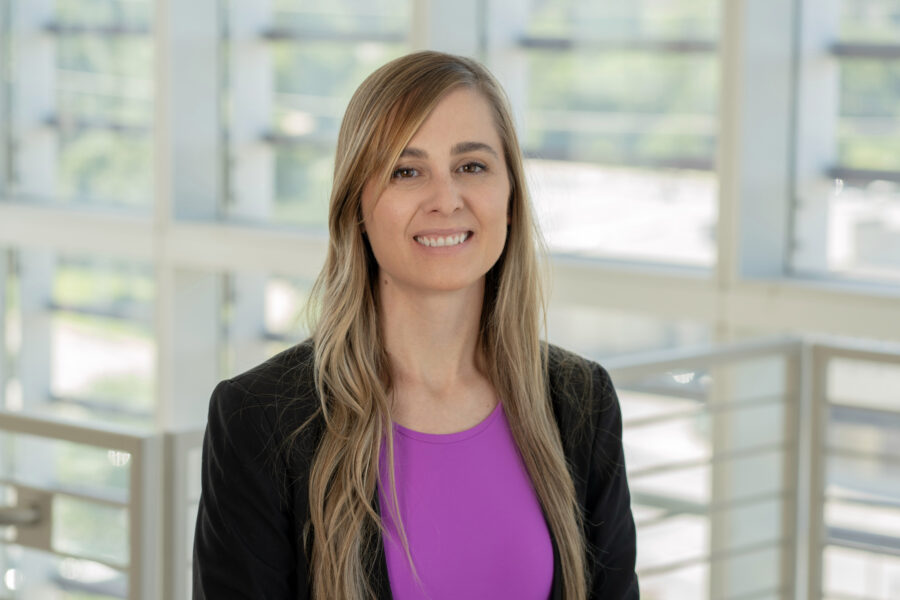
Karmen DeLancey, DNAP, worked as a clinical research coordinator in the UNMC Department of Anesthesiology from 2020 to 2023. She left to become a certified registered nurse anesthetist, and now she’s back, this time in the operating room.
“Anesthesia is a branch of medicine that still has many questions requiring curious minds to ask them,” she said. “There is a lot of gray area. I think this is what draws me to it.”
DeLancey grew up in Murray, Nebraska, and began nursing in 2012, working in the ICU and as a flight nurse. Her path to anesthesia started with a missed intubation.
Picking up extra intubations in an operating room one month, she worked with a CRNA who chose direct laryngoscopy, an approach she had rarely used.
Although she was unable to complete the procedure, the CRNA quickly fixed it, and the patient was fine.
“Here I was, this supposedly ‘very cool’ flight nurse … but I did not feel very cool in that moment,” she said. “But it did make me realize CRNAs are pretty cool, and maybe I’d like to be one someday.”
She credits anesthesiologists Jeffrey Songster, MD, Karsten Bartels, MD, PhD, and Daniel Johnson, MD, whose excitement about education influenced her decision to apply. Dr. Bartels and research nurse coordinator Julie Hoffman wrote recommendations that, she was told in her school interview, stood out.
In 2023, DeLancey entered the Doctor of Nurse Anesthesia Practice program at Bryan College of Health Sciences. After more than a decade as a nurse, being a novice again was humbling — “which is not a bad thing if you embrace it,” she said. Former ICU colleagues who had become CRNAs helped her keep going when things got hard.
From the coordinator’s desk, she saw the documentation. In practice, she was surprised by how much autonomy residents and experienced student nurse anesthetists have.
“It can look like I’m just sitting there, but I’m always thinking,” she said. “I was always taught a really great provider knows and anticipates the risks at any given moment.”
For coordinators or techs considering school, she calls it an individual decision.
“It’s very demanding, and you will likely eat and sleep — don’t mind the pun — anesthesia for three straight years, so having your life in order to make room for that is very important,” she said. “But overall, as challenging as it was, I wouldn’t take any of it back and I highly recommend trying.”
Outside the OR, DeLancey is a musician who owns nine guitars.
“I have this belief we are conditioned to think we are either a creative or scientific brain,” she said. “I like to believe it’s okay to cultivate both.”