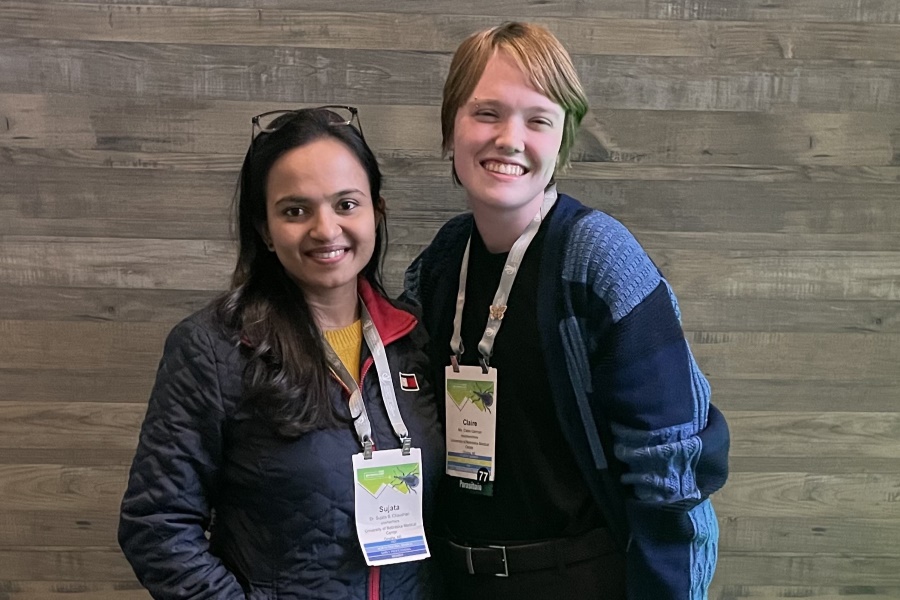
Claire Garman, a second-year PhD student in the Immunology, Pathology and Infectious Disease (IPID) Graduate Program in Dr. Sujata Chaudhari’s lab, won first place in the oral presentation competition at the Entomological Society of America’s (ESA) annual conference last month in Portland, Oregon. Garman presented research on the critical role of chitin biosynthesis in maintaining tick cuticle integrity during engorgement.
“There were more than 1,000 people in the room,” Dr. Chaudhari said. “We sat in the front row, and when they called Claire’s name, I attempted to take a picture, but it ended up blurry because I was literally shaking with excitement.”
“I think I lost hearing for a minute because everybody was yelling,” Garman said.
Dr. Chaudhari noted that the ESA annual meeting is the largest gathering of arthropod science professionals in the world, drawing thousands of researchers, students, and industry leaders each year. The conference serves as a major platform to share new discoveries in vector biology, pest management, ecology, genetics, and emerging technologies, and is a highly competitive venue for student presentations and awards.
“ESA is where major advances in arthropod science are discussed and where collaborations begin,” she said. “It’s an exciting environment because you are standing in front of experts who understand the importance of your work.”
Garman, who presented in the physiology, biochemistry, and toxicology category, said the conference was a valuable opportunity to learn about a wide range of research and to share findings from their lab. “The presentation focused on understanding how chitin metabolism is essential for tick cuticle integrity,” Garman said. “I discussed how the synthesis and deposition of chitin in the expanding tick cuticle during feeding helps maintain structural stability, and how reducing the expression of the chitin synthase gene makes ticks more vulnerable to external stress.”
Dr. Chaudhari explained the broader context of the work, noting that ticks feed for long periods and can ingest large volumes of blood, causing dramatic expansion of their bodies. “During feeding, ticks swell significantly—almost like a balloon,” she said. “Our lab has been investigating the underlying mechanisms that stabilize the expanding tick cuticle against external mechanical stresses encountered during animal grooming. In simple terms: how do ticks not pop during engorgement? Our research shows that chitin in the cuticle helps protect them from mechanical stress, and when chitin is depleted, the cuticle becomes softer, making ticks much easier to ‘pop.’”
She emphasized the importance of advancing tick control strategies, given their role in disease transmission. “In the United States, about 95% of vector-borne disease cases are tick-borne,” she said. “Identifying new biological targets is critical for controlling ticks and reducing disease transmission.”