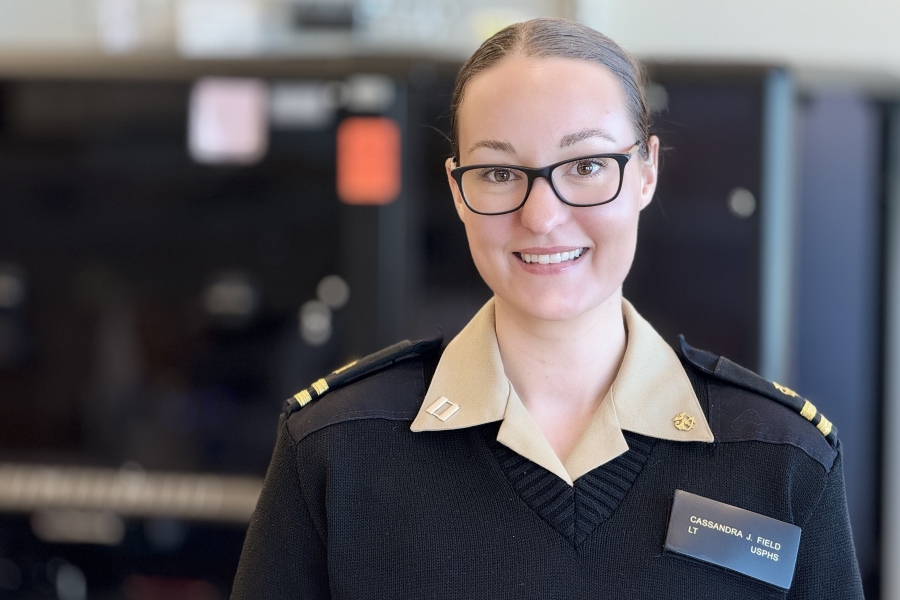
A fellow in the CDC’s Laboratory Leadership Service program said she has learned and grown a great deal during her time with the Nebraska Public Health Laboratory at UNMC.
Dr. Casey Field, who entered the LLS fellowship program in 2024 as a member of the U.S. Public Health Service Commissioned Corps, is over halfway through the two-year postdoctoral service-learning program that combines core public health laboratory (PHL) competency-based training with practical, applied investigations and service.
This fellowship is designed to provide training in the competencies required to lead a PHL or program, to include applied laboratory research, quality management, biosafety, leadership, communication, and bioinformatics. Fellows learn through service and hands-on assignments under mentors and supervisors and complete 10 Core Activities of Learning (CALs) that develop skill and proficiency in each domain. Leadership training and opportunities are woven throughout the training competencies and CAL projects. Fellows conduct applied laboratory research to address a public health or safety-related issue, assess laboratory quality management systems, conduct a laboratory safety risk assessment, give scientific presentations, and write a first-author scientific manuscript for a peer-reviewed journal.
Some LLS fellows are in CDC laboratories, while others may be in a state, local, territorial or tribal laboratory anywhere in the U.S. “We go through a matching process similar to a residency match, where we do 10 interviews with 10 different host sites looking for an LLS fellow. We rate how much we like the host site while the host site ranks how much they like you. The ranking is then placed into a special algorithm, which decides where we end up. For me, the algorithm picked Nebraska, which was great, since Nebraska was my first choice. So the match worked out well.”
Field got her doctorate at Penn State University in molecular, cellular and integrative biosciences. “It’s a long program name, but in reality, my graduate work was in virology,” she said. “Things I focused on during my PhD included high-consequence pathogen (HCP) work, using biosafety-level 3 laboratory containment to include work with the avian influenza virus (H5N1) and with SARS-CoV-2. One reason I ranked Nebraska as my No. 1 pick was because of the Global Health Center and the associations with the Patientcare Biocontainment Unit and the National Quarantine Unit on the UNMC campus. These complemented my interest in infectious diseases and HCPs, that particularly drew me in. While here in training, I’ve had the opportunity to tour those facilities, which was super valuable to me.
“It’s been a really well-rounded experience. I’m fortunate to have Dr. Pete Iwen, Emily McCutchen and Dr. Mike Wiley as mentors. Since I’m on the wastewater team for NPHL, my main supervisor is Mike, and most of my activities take place in Wittson Hall. It has been great to have access to Emily and Pete as well because they are just so knowledgeable – truly powerhouses in the field of public health. That’s been unmatched. I’m so happy that I matched here in Nebraska, because I don’t know if I would have gotten that experience somewhere else.”
Dr. Iwen said: “Casey has been a great addition to our laboratory. She is the first LLS fellow that we have had the opportunity to train, and we have learned much about how the CDC provides training for the next leaders in public health. Additionally, her expertise has been invaluable to the NPHL operations, and we are fortunate to have her as a colleague/trainee in our laboratory!”
Field said she recently had the opportunity to write a continuity of operations plan for NPHL. “They don’t teach you how to do that sort of thing in graduate school. So that’s been brand-new to me, and there’s been a lot of stuff I’ve done here that is outside my wheelhouse. But that has pushed me out of my comfort zone, forced me to try new things, learn something new, and develop new skills, which is really what the fellowship is all about. So I’m definitely grateful to the team here at NPHL for providing those opportunities so I can learn and grow.”
Field said that as someone who trained as an influenza virologist, the opportunity to develop a flu subtyping test for wastewater was definitely in her wheelhouse. NPHL tests wastewater samples from across the state for various pathogens, including the influenza virus. “But the original test only told you whether it’s flu A or flu B,” she said. “Within influenza A there are several different subtypes, or what you might call strains. The two subtypes that most commonly circulate in the population during respiratory season are H1N1, which is derived from the pandemic virus that happened in 2009, and the swine flu virus, as well as H3N2.
“I developed a new assay for the lab that will allow us to further test wastewater samples that are influenza positive. These positive samples are subsequently reflexed to identify the specific subtypes. With this new assay, we can provide more specific results to know which subtype is circulating in the state. This test can also detect the highly pathogenic avian influenza (HPAI) virus (H5N1). As an agricultural area, testing for the HPAI virus is even more important. And maybe I’m biased since I’m a flu person, but I think that’s super timely and valuable for Nebraska.”
Field, from Bethlehem, Pennsylvania, was a biology major as an undergraduate at Lehigh University and soon learned she had a passion for studying infectious diseases. “I think the summer after my first year of undergrad was when Dr. Kent Brantly was brought from Liberia to the United States for treatment during the Ebola virus outbreak. I was home at my parents’ house watching the news footage on TV. The helicopters were flying around, and the medical staff were in their Tyvek suits helping Dr. Brantly into an ambulance. We had plans to go to some family barbecue or something that day and my parents said it’s time to leave, and I said no, I have to stay home, I can’t miss this. That was when I decided OK, this is clearly my thing. And sort of ran with this ever since.”
Field says that when her fellowship is over, she would like to find a PHL position as a quality manager or biosafety officer. The CDC says that over 90% of LLS graduates remain in public health, and the majority accept positions with the CDC. The program doesn’t guarantee employment but offers support to second-year fellows to network, identify available positions, and submit applications.
“They train us to be well prepared to find a job after the fellowship,” she said. “For example, in a few weeks we have what they call ‘interview speed dating.’ They’ll put together a panel of people, where we’ll have just rapid-fire Zoom interviews to get us thinking and on our toes and ready to go with what the interview process will be like. There is also an alumni network that we can reach out to for networking. Ideally, the program is designed so all of us LLS fellows have opportunities to be placed in jobs that support public health.”