When Matthew Lunning, DO, was 19 years old and working as a clinical research assistant at his local Cancer Center in Mason City, Iowa, he needed guidance on how to assist the local oncologist in managing a patient enrolled in a clinical research study. So, he called the physician listed on the front page.
That physician: James Armitage, MD.
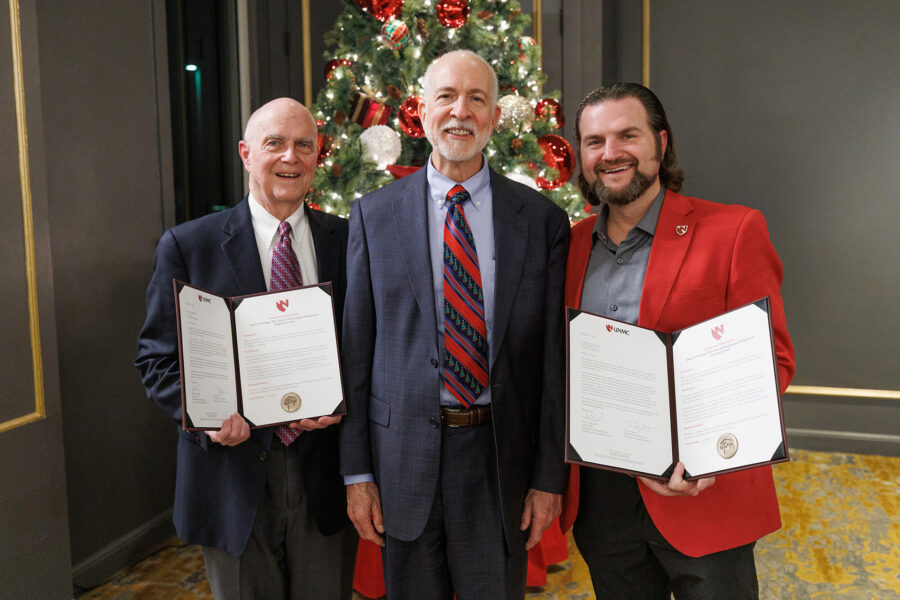
Thursday night, Dr. Lunning, interim chief of the UNMC Division of Hematology and UNMC’s assistant vice chancellor of clinical research, was named the inaugural recipient of the endowed James O. Armitage, MD, Chair in Hematological Malignancies at UNMC, which was created through the generosity of donors.
“To all those who donated to create the James O. Armitage, MD, Chair in Hematological Malignancies, your generosity is an investment in cancer care,” Dr. Armitage said at the event Thursday. “Endowed chairs are among the most powerful recruitment and retention tools that exist in academic medicine. This chair will make it possible to attract and keep a bright, ambitious, curious clinical scientist who will make important observations that lead to curing patients, saving lives. And that is exactly what Dr. Lunning is going to do.”
For Dr. Lunning, the honor is humbling but also fitting. He has known Dr. Armitage for more than 25 years and cites him as the main factor in his decision to pursue a residency at UNMC after graduating from Des Moines University College of Osteopathic Medicine in 2006.
And he still recalls that first phone call.
“We were talking about the patient,” he said. “And when we were finished, Dr. Armitage began asking about me – my aspirations my dreams and how I planned to get there.”
Dr. Armitage’s sincere interest left an indelible mark, Dr. Lunning said. Enough so that when it was time to begin applying to residencies, he specifically applied to UNMC’s Internal Medicine residency program “in the hope of working with Dr. Armitage” – a physician-scientist whom Joann Sweasy, PhD, director of the National Cancer Institute-designated Fred & Pamela Buffett Cancer Center said “has played a foundational role in bringing clinical research to the forefront of patient care” during his four-decade career.
The residency went so well, Dr. Lunning said, that when it was time to leave UNMC for a fellowship, he met with Dr. Armitage and then-chair of internal medicine Lynell Klassen, MD, to “specifically plan to go to a fellowship that would provide me the best opportunity to come back to UNMC to work with Dr. Armitage again.”
The hematology/oncology fellowship was at Memorial Sloan-Kettering Cancer Center in New York, where he eventually became the inaugural chief hematology fellow. But when it was complete, he returned to UNMC to work with Dr. Armitage and to be there as the Fred & Pamela Buffett Cancer Center rose on the medical center campus.
Dr. Lunning called the chair a great honor.
“I have been striving to get to a point in my career where I was worthy of such a chair. And while I feel my career is not complete, this appointment is a springboard, not a step, to a future that will not only help solidify the program, but I hope to take it to another level.”
The personal touch, the unsolicited interest in other people – his patients and peers, certainly, but even a “small-town Iowa boy” with medical dreams – is part of what makes Dr. Armitage not merely a health care and research icon, but the kind of man any young doctor might want to emulate, Dr. Lunning said.
“As I’ve gotten to know Jim, the way he engages people – whether people he knows well or people he meets only in passing – it’s like he’s a soft-spoken ambassador to finding joy in every part of your day. I’ve always tried to become a physician who could be mentioned in the same breath as him.”
He is grateful for the chair, he said, not only for the link to Dr. Armitage, but for the impact it will allow him to have as a researcher, clinician and leader.
“It gives me the opportunity to tell the story of who I believe Dr. Armitage is, to honor his career, and to promote his vision about what it means to be a physician for the patient.”
He drew a parallel between Dr. Armitage and internal medicine pioneer Sir William Osler.
“Although separated by more than a century, both believe that excellence in medicine starts with sincere curiosity about the person behind the illness,” Dr. Lunning said.
In that first phone call, Dr. Armitage’s friendly interest was “an unexpected kindness that has guided every step of my career.
“As I got to know him, I realized that the qualities I read about in Dr. Osler in Aequanimitas — the humility, the humanity, the joy in serving others — were standing right in front of me. Dr. Armitage became, in every sense, my Osler.”
Mark Rupp, MD, interim chair of the UNMC Department of Internal Medicine, called Dr. Lunning a fitting choice for the inaugural chair.
“Dr. Lunning is an internationally recognized clinician-scientist, an expert in the treatment of lymphoma, and he has made recent breakthrough observations through a multi-disciplinary and team approach in the use of CAR-T cell therapy for lupus and multiple sclerosis,” Dr. Rupp said. “Dr. Lunning has contributed significantly to institutional success as well, via his leadership roles in the UNMC Clinical Research Center and at the Fred & Pamela Buffett Cancer Center.
“Receipt of the Armitage chair is a great honor,” said Dr. Rupp, who once described Dr. Armitage as an “exemplary” leader. “It is also a strong vote of confidence in Dr. Lunning and in the expectation that he will continue to be a leader in his field for years to come.”
Bradley Britigan, MD, congratulated Dr. Lunning on the appointment and thanked the donors, including Robert Parnes, MD, who made the first gift toward creating the chair.
“We are confident that Dr. Lunning’s work in this role will be a credit to the pioneering efforts of Dr. Armitage, exactly as the donors intended it should,” Dr. Britigan said.
Congratulations, Dr. Lunning!
So that big party by our CON Holiday party was for you?
I should have stopped over to congratulate you. Well done, sir!
Congratulations on this career achievement, Dr. Lunning! We are so fortunate to have you here at UNMC! Thanks to the visionary donors who recognize the need for such a position and for honoring Dr. Armitage in this way. A special story for a Monday morning!
Congratulations!
Congratulations, Dr. Lunning!
I enjoy the lymphoma tumor board and learn from you and your colleagues every week.
Dr. Lunning has instant likeability and a wealth of knowledge. Patients love him. He will make Dr. Armitage very proud – a perfect choice for this endowed chair.
Congratulations Dr. Lunning! I am glad to see that you doing great things.
Your accomplishments bring honor to your family and all of the people in Mason City who knew you “back when.”
Congrats Dr. Lunning! Well deserved!
This is great news! Congratulations!
Congratulations Dr. Lunning!
Bravo!
What a wonderful story of the power of kind words and interests in others.
Congratulations Dr Lunning!!
Congratulations Dr. Lunning! It’s been great to see your career grow and I am sure Dr. Armitage is very pleased. I wish you continued success.