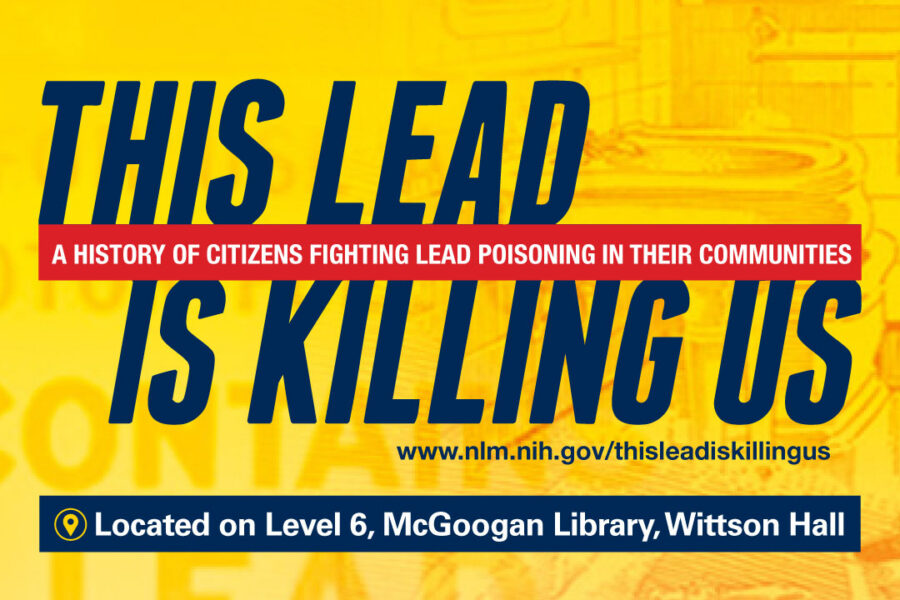
The McGoogan Health Sciences Library will offer the exhibit “This Lead is Killing Us: A History of Citizens Fighting Lead Poisoning in Their Communities” from Feb. 9 through March 21.
The display is on Level 6 of the McGoogan Library, with an online exhibit available.
For more than a century, citizens have confronted lead industries, housing authorities and elected officials to protect their health against the dangers of lead poisoning. When people ingest lead — by breathing contaminated air, drinking contaminated water or accidentally ingesting leaded paint chips — they can become very sick.
Lead poisoning causes neurological problems and sometimes even death. Today, researchers believe that no amount of exposure to lead is safe for children.
Produced by the National Library of Medicine and guest-curated by historian and educator Richard Mizelle Jr., PhD, of the University of Houston, this traveling banner exhibition and companion website explore the story of citizen action taken against an environmental danger.
On March 17, McGoogan Library will hold a discussion on Omaha’s own history with the issue. The talk led by Erin Torell, an associate professor with McGoogan Library and rare book librarian, is titled “Health Sciences History Hour – Omaha’s Medical Detectives: How Drs. Matilda McIntire and Carol Angle Uncovered a Hidden Epidemic of Lead Poisoning.”
It will run from noon to 1 p.m. CDT. Register to attend the virtual discussion at this link.
For decades, Omaha and UNMC physician-scientists Matilda McIntire, MD, and Carol Angle, MD, pioneered and persevered through a decades-long investigation into lead toxicity. They eventually exposed one of the nation’s most significant environmental health crises.
The panel will discuss how Drs. McIntire and Angle connected unexplained pediatric symptoms to emissions from Omaha’s lead smelters, refineries and battery reclamation plants. Their fieldwork revealed dangerous levels of lead in Omaha’s air, soil and homes, especially in Black and low-income neighborhoods situated near the industrial sites.
Their findings resulted in the federal government designating more than 17,000 acres of Omaha as a Superfund site. Their investigative methods and public-health advocacy were crucial in remediating the lead toxicity in Omaha and influencing understanding of lead poisoning.