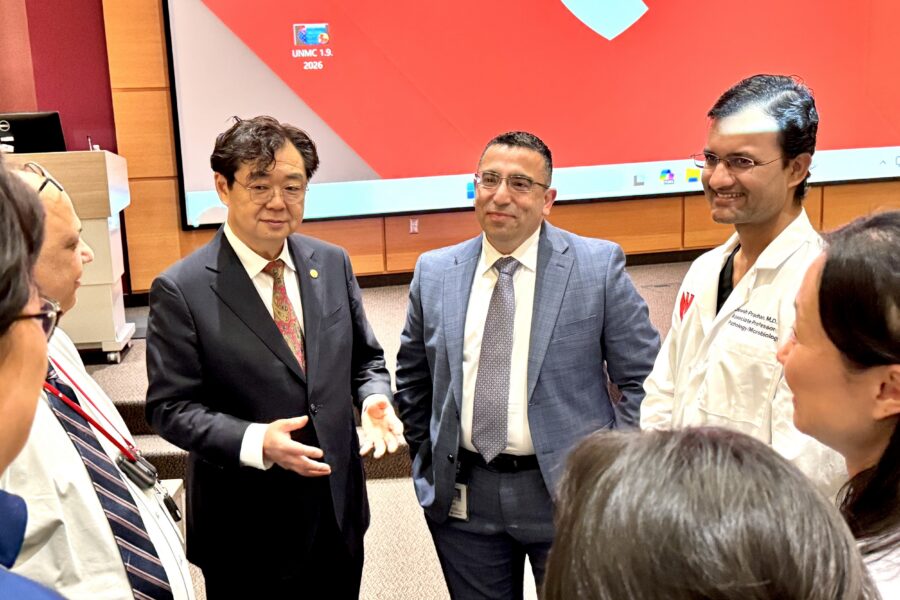
Pathologists face many challenges, but CAP stands ready to help. That was the message from Qihui “Jim” Zhai, MD, FCAP, president of the College of American Pathologists, at a recent speech at UNMC.
Dr. Zhai was a special guest speaker for a noontime event sponsored by the Department of Pathology, Microbiology and Immunology at the Durham Research Center.
As pathologists, “we have an interest, we have a stake, we have a shared vision,” he said. The stakes have never been higher—challenges facing pathologists include a severe shortage of lab staff, tougher regulations for labs and pathologists, and difficulties in applying new technologies.
CAP, the leading organization of board-certified pathologists, was founded more than 70 years ago to foster and advocate excellence in pathology and laboratory medicine. CAP began its inspection and accreditation program in the 1960s. The effort has grown ever since. “Every single day, about 20 labs are undergoing inspection,” he said. There are more than 8,100 CAP-accredited laboratories worldwide.
Dr. Zhai said public outreach is another CAP focus, and he noted that Dr. Ana Yuil-Valdes, an associate professor in the Department of Pathology, Microbiology and Immunology, serves on the CAP Foundation board and has been heavily involved in CAP’s See, Test and Treat program, which provides free breast and cervical cancer screening to women in communities across the country.
Advocacy is another emphasis. Not long after its founding, CAP realized it needed to be an advocate for the profession, and it devotes significant resources to communicating with federal officials about health care and pathology’s key role. Dr. Zhai said an estimated 70% of the information in patients’ electronic medical records is related to pathology and lab medicine. “We’re only as good as the lab,” he said. “Don’t underestimate our value.”
Dr. Zhai noted that Medicare payment rates have failed to keep pace with inflation. While physicians’ practice costs are up nearly 14% since 2020, payment rates have declined, leading to an 18% gap in 2024.
CAP is the second-largest medical organization in the nation, behind only the American Medical Association, counting more than 19,000 members and more than 8,000 labs in the U.S., with hundreds more globally.
“We spend a lot of time, a lot of money to promote, to educate, to advocate,” he said. Dr. Zhai encouraged individual pathologists to lend their voices to this effort as well and reach out to their representatives in Congress. Pathologists may be surprised at how receptive lawmakers are. “They want to listen to you, they need to listen to you, they will listen to you,” he said. The alternative to engagement isn’t pretty. “If you’re not at the table, you’ll be dissected.”
He said CAP also works to help grow the pipeline of pathologists entering the workforce. CAP offers many opportunities for pathology residents to connect and network. “We have educational opportunities for you to shine, to contribute,” he said.
Opportunities for the field include an explosive growth of information and discovery, as well as new technologies in molecular, digital, and AI. Generative AI in cancer pathology is here today, he said, and while AI can enhance efficiency and accuracy, it remains a tool to augment human expertise. “I’m not worried about AI replacing us,” he said. “We need to be smart enough to use AI tools to serve patients.” He said CAP has many resources to help pathologists in using AI.
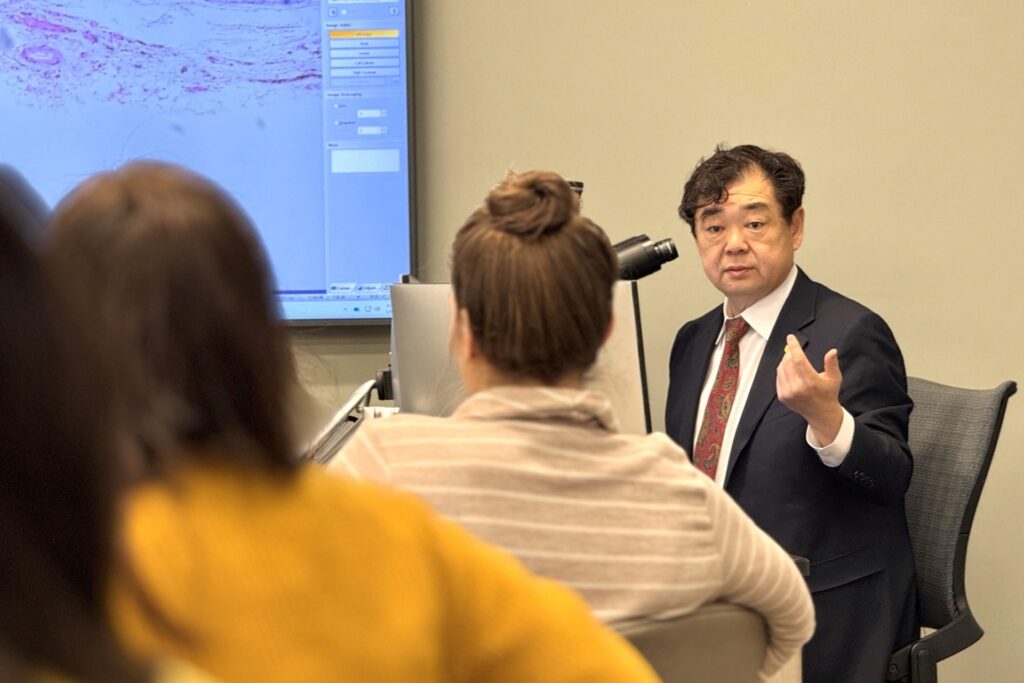
Dr. Zhai’s visit also included a slide session with residents and fellows and meetings with several department faculty members.