The UNMC College of Medicine is establishing a new set of awards to honor exceptional educators in the college with the 2026 Medical Education Awards.
The new annual awards will honor faculty who show exceptional commitment to the education of future health care professionals – with innovation, mentorship, leadership and excellence across all phases of medical education.
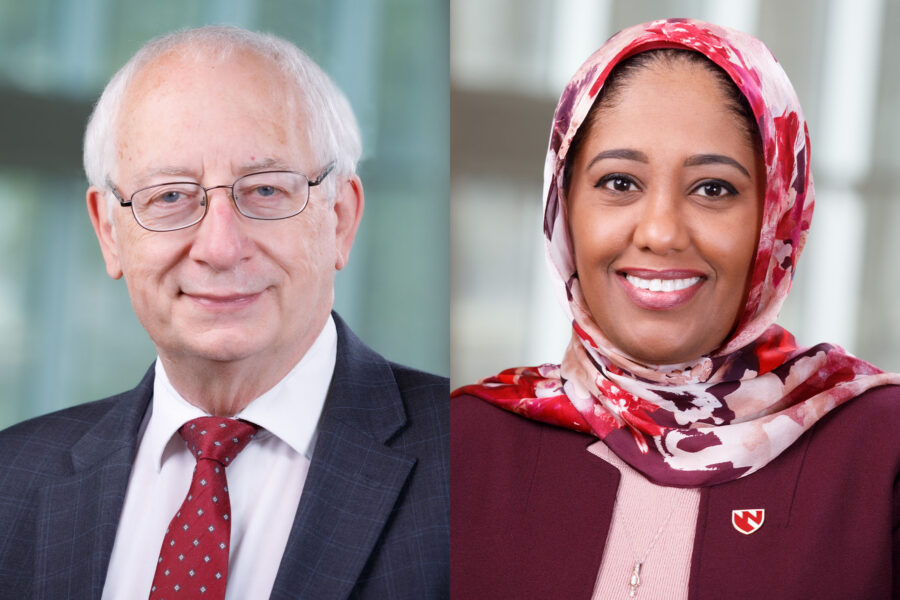
Nada Fadul, MD, the college’s associate dean for faculty affairs and a professor in the college, said the college’s faculty deserve the recognition for the time, effort and passion that they put into teaching UNMC’s medical students and the future generation of health care professionals.
“We know our faculty go above and beyond what’s required to hold the classroom,” Dr. Fadul said. “They make it engaging. They introduce a lot of innovations in the teaching. They mentor our students and support their research and their projects, and we have faculty who have been at the institution for a long time, and they have committed their career to teaching.
“We wanted to do something to recognize all of these domains of faculty.”
The awards were created in collaboration by the college’s Office of Medical Education, the Office of Graduate Medical Education and the Office of Student Affairs. Dr. Fadul thanked the philanthropic support of donors who also made the awards possible.
Dean Brad Britigan, MD, said education is the foundation upon which medical schools were created, and they have assumed several additional missions over the years, most notably research, patient care and community service.
But in the process, Dr. Britigan said, faculty numbers have grown considerably, and the prominence of outstanding educators has diminished.
“These new awards are intended to reverse that trend,” Dr. Britigan said, “and recognize the outstanding and dedicated teachers among our faculty who carry out the critical mission of educating the next generation of physicians while meeting the other demands of their positions.
“My thanks to our donors, whose philanthropic support made the awards possible, and Dr. Fadul for initiating them. I look forward to the announcement of the inaugural recipients of these awards.”
The awards, which are open for nominations, are:
Educator Innovation Awards
- Foundational Science Educator Innovation Award: Eligible for faculty teaching in Phase I. Recognizes faculty who developed innovative curriculum, assessments or technology, demonstrated measurable impact on learner outcomes and/or shared innovations through scholarship or institutional adoption.
- Clinical Educator Innovation Award: Eligible for faculty teaching in Phases II, III or graduate medical education. Recognizes faculty who created impactful innovations in clinical education, demonstrated improved learner skills or patient-centered practice and/or disseminated work through publications or presentations.
Emerging Educator Awards
- Emerging Foundational Science Educator Award: Eligible for an instructor or assistant professor in Phase I. Recognizes educators who demonstrate teaching excellence and engagement, participate in curriculum design or assessment, engage in professional development and receive positive evaluations from learners.
- Emerging Clinical Educator Award: Eligible for an instructor or assistant professor in Phases II–III or graduate medical education. Recognizes educators who demonstrate effective clinical teaching, contributes to clinical curricula or evaluation systems, engages in educational scholarship and/or are recognized as a rising leader.
College of Medicine Distinguished Medical Education Awards
- Distinguished Foundational Science Educator Award: Eligible for faculty with 15 or more years teaching in Phase I or in research. Recognizes faculty with sustained outstanding teaching and mentorship, leadership in curriculum development, educational scholarship or institutional contributions and/or broad recognition for commitment.
- Distinguished Clinical Educator Award: Eligible for faculty with 15 or more years of clinical teaching in Phases II–III or graduate medical education. Recognizes excellence in clinical teaching and mentorship, leadership in program development, institutional or national impact and/or someone who is highly regarded by peers and learners.
Mentorship and coaching
- Mentorship and Coaching Excellence Award: Eligible for faculty who mentor across all phases or research settings. Recognizes faculty who are long-term impactful mentors, guide mentees in career development, demonstrated mentee success and/or are recognized for accessibility and advocacy. Faculty and department leaders are eligible to nominate, and self-nominations are permitted.
So many non-COM faculty support medical education. Some teaching the same content year after year. You might consider in the future an award for those contributors as well.
Thank you, Dr. Beam, for the feedback. We appreciate the efforts of all of our UNMC faculty who participate in the education mission. We hope to be able to recognize their efforts in the future.
To strengthen confidence in the awards, it would be helpful to provide more transparency about the selection committee and review process. Because many educational functions already sit within the same administrative offices, having an external committee would help avoid perceptions of administrative favoritism.
It may also be worth reconsidering self-nominations, as peer or learner nominations better reflect community recognition rather than self-promotion. Clear guidance on how administrators will be evaluated alongside frontline educators would also help ensure the awards highlight those whose teaching impact may otherwise go unrecognized. Just feedback and discussion.
Thank you, Dr. Larsen, for your feedback. The review process includes a comprehensive and objective rubric that aligns with the criteria for each award. The review committee is primarily composed of administrative faculty, with half of its members not directly involved in medical education, along with two independent faculty members. We believe that having educational administrative faculty involved in the first round is important for improving the process in the future. In the coming years, we plan to involve some of the awardees in the review committee.
Self-nomination was included for the same reason: to avoid any perception of administrative favoritism, as many faculty contribute to education but may not be well-known to the administration.
Students are intentionally excluded from this process because they have other prestigious COM awards for which they independently select faculty. We did not want to interfere with that selection process.