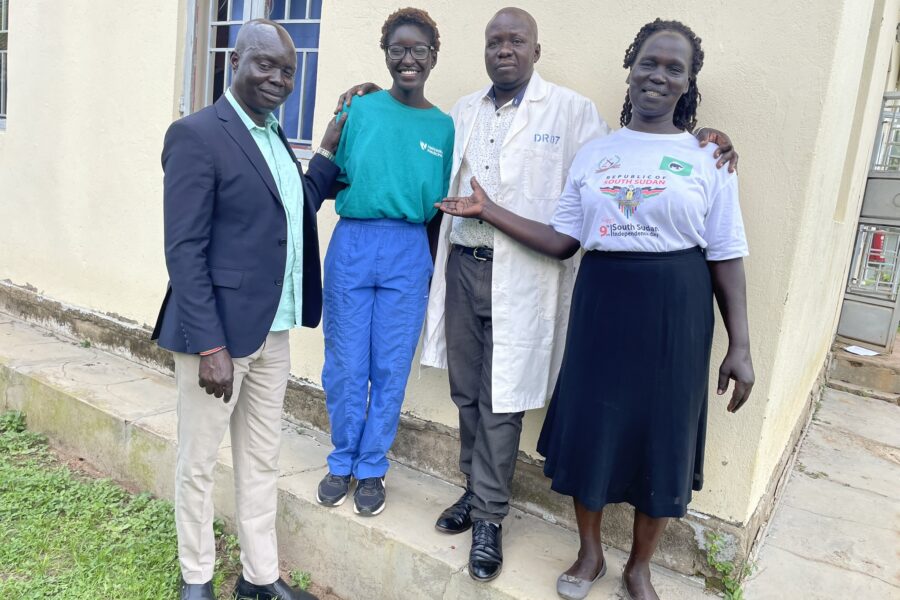
(NOTE: Although Winnie Ladu’s global learning trip was taken in the summer of 2025, the author recently learned about Ladu’s experiences in South Sudan.)
Navigating the “Standard of Crazy”
Winnie Ladu’s journey began on June 6, 2025, and was defined by a series of grueling “firsts.” Accompanied by her father, she traveled from Omaha to Uganda, landing in Kampala. From there, the real challenge began: a 12-hour bus ride toward the South Sudanese border.
The logistics were anything but certain. “There aren’t buses that go straight through to South Sudan,” Ladu explained. After missing a connection at the border, she and her father had to lash their luggage to the back of two motorcycles to cross into the country.
“I thought, ‘This must be as crazy as it gets,’ but that became the standard for the entire trip,” Ladu recalled. “Eventually, I just got used to it. I learned to anticipate the unexpected.”
Data in the Dust: Researching Neonatal Survival
To ground her research, Ladu leveraged her network, connecting with Dr. Joseph Dumba, a South Sudanese physician who helped her coordinate with medical directors in Kajokeji. Her goal was to investigate a somber reality: the factors contributing to neonatal mortality in the region.
Conducting research in a resource-limited setting required a departure from modern digital tools. Ladu’s primary resources were handwritten paper registries—skinny lines of ink documenting every admission, complication, and birth defect from the previous year.
“The nurses would handwrite everything… everything they could fit on a skinny little line,” Ladu said. “To find the corresponding patient files, I had to go to the data archive room—which was essentially a shed filled with boxes and papers.”
Despite the “arduous” nature of the work, Ladu meticulously compiled her findings upon her return to Omaha in July 2025. Her final study, “The Effects of Maternal Malnutrition on Birthing Outcomes: A Retrospective Study on Neonatal Survival in Kajokeji, South Sudan,” offers a rare look at the intersection of nutrition and infant health in the region.
From Dream to Data
“Although it seems daunting, venturing into international research is possible,” Ladu insisted. “My project originally started as an idea that I’d dreamt about. But once I connected with UNMC faculty and Dr. Dumba, we were able to breathe life into my vision. The support that I received from my small idea was what gave me the confidence to take a leap of faith.”
Immersing Ladu within the Kajokeji community offered a unique perspective that could have never been achieved remotely. For Ladu, the work was as much about people as it was about statistics.
“It was exciting knowing that my research could potentially enrich the medical system of South Sudan,” she said. “My research experience was unlike anything I’ve ever done before, but if given the opportunity I would love to do it again!”
Advice for the Global Scholar
Ladu’s experience serves as both a roadmap and a reality check for other medical students considering global health projects.
- Set Realistic Expectations: “It’s not a simple process,” she warned. Research abroad requires flexibility and a high tolerance for logistical hurdles.
- Find a Mentor: Ladu emphasizes finding a support system—like the one she found in Dr. Dumba—to help navigate the complexities of international study.
- Trust Your Instincts: “If you have that inkling that you want to experience another community and contribute your research, go for it,” she said. “You never know unless you try.”
Students who are interested in a global learning experience, should contact Sara Pirtle, programs manager, UNMC Office of Global Engagement.