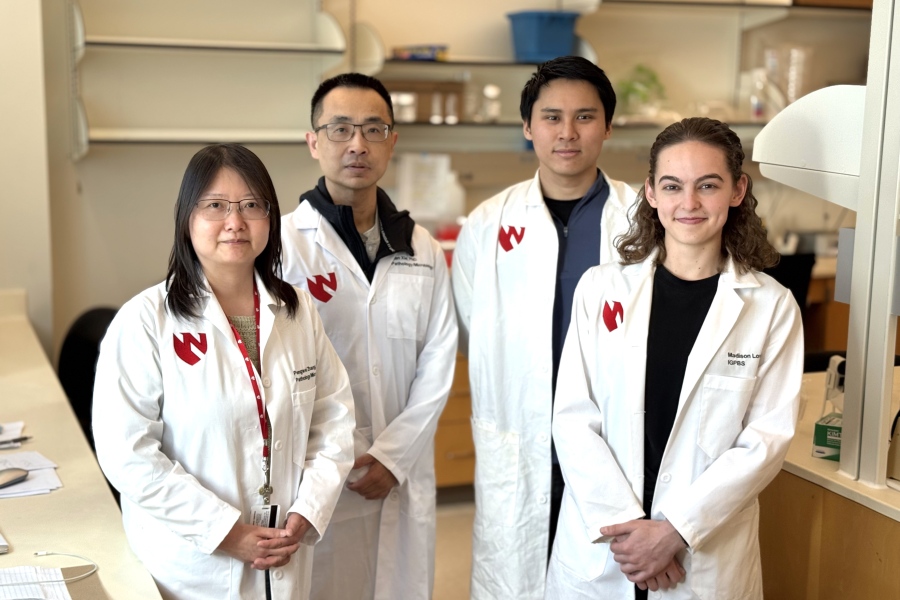
A team of researchers from UNMC’s Department of Pathology, Microbiology, and Immunology has discovered a critical strategy human papillomavirus (HPV) uses to establish infection after entering cells.
The study, recently published in the Proceedings of the National Academy of Sciences (PNAS), a top-tier, prestigious peer-reviewed journal, found that HPV reprograms a host protein to coordinate the transport of virus-containing compartments and their fusion with early endosomes, a step required for successful infection.
“Tumor viruses account for approximately 15% of all human cancers worldwide. Understanding HPV infection is especially important because HPV is one of the major tumor viruses, causes about 5% of human cancers and is the most common sexually transmitted infection in the United States. This new understanding of HPV infection provides fresh opportunities to develop strategies against HPV,” said Pengwei Zhang, PhD, assistant professor in the department, who led the study and mentors Maddie Love, a third-year doctoral student and lead author of the paper.
After entering a cell, many viruses become enclosed in small membrane-bound compartments. For infection to move forward, these compartments must travel in the cell and merge with early endosomes, essential organelles that sort incoming cargo and direct it to subsequent intracellular destinations. This process helps the virus disassemble properly and reach the location needed for later stages of infection and replication.
“How this essential process is achieved has remained poorly understood,” Dr. Zhang said. “We brought together molecular virology, cell biology, live-cell imaging, and single-particle tracking to examine viral entry at a mechanistic level. Our study helps fill this gap by showing that compartment movement and fusion are coordinated during HPV entry.”
“These findings improve our understanding of how viruses exploit the cell’s own fusion and transport machinery to establish infection,” Dr. Zhang said. “This mechanism may also reflect a broader strategy used by other viruses that enter cells through similar pathways. In the future, this knowledge may help guide the development of targeted antiviral approaches.”
Dr. Zhang said the study was truly a team effort. Jian Xie, Ph.D., assistant professor in the department, collaborated with Zhang on the study.
“Viruses have long served as powerful tools for advancing molecular and cellular biology,” said Dr. Xie. “In this study, HPV functions as a genetically tractable and quantitative system, enabling us to gain unique insights into a highly transient and heterogeneous biological environment.”
Richard C. Dang, a doctoral student in bioinformatics and a student of Dr. Xie, is the paper’s second author and contributed to the single-particle tracking analysis. Dr. Zhang said a T32 training grant for the students, NIH funding, and strong backing from the department made the work possible.