When the Trans‑Mississippi & International Exposition opened its gates on June 1, 1898, Omaha transformed 200 acres between Sherman Avenue and 24th Street into a bustling showcase of the American West. Visitors poured in, arriving by a 10‑minute trolley ride from downtown or by two steam railways, prepared to experience the city’s grandest event to date.
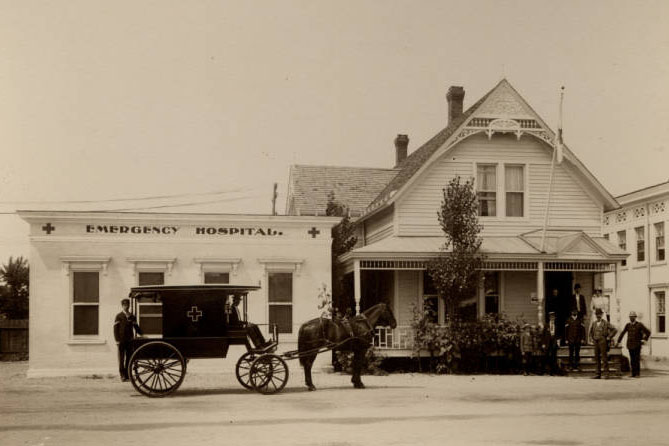
Given the scale of the exposition, organizers anticipated the need for on-site medical care. Among the buildings erected for the fair was a fully equipped emergency hospital, providing an early example of organized emergency care in Omaha. John Wakefield, in his 1903 History of the Trans‑Mississippi & International Exposition, described the hospital as:
“A fine modern cottage, remodeled for the purpose with a wing added for an operating room. It was supplied with a modern ambulance and with complete hospital furnishings and instruments. A corps of physicians and trained nurses were always on duty, ready for instant service.”
Constructing the hospital cost $1,821 and maintaining it throughout the exposition required an additional $4,075.13.
Stuart Avery Campbell, MD, led the hospital’s medical team as the emergency hospital chief of staff, fresh from graduating with honors from the Omaha Medical College, Class of 1898. The college later would become part of UNMC, linking the exposition’s emergency operations to Omaha’s evolving medical institutions and highlighting the emergency hospital as a forerunner to more organized, modern emergency care in the city.
During the exposition’s five‑month run, more than 2.6 million people visited the fair, and 3,095 of them sought care at the emergency hospital. Staff treated an average of 20 patients per day at a cost of just $1.31 per patient.
The most common diagnoses reflected both the environment and the era:
- Enteritis: 633 cases
- Heat exhaustion: 471 cases
- Contusions and lacerations: 330 cases
- Malaria: 217 cases
- Influenza (La Grippe): 49 cases
- Gunpowder wounds: 30 cases
- Electrical burns: Seven cases
- Typhoid fever: Four cases
- Gunshot wounds: Four cases
While many injuries were typical of large construction projects and electrical setups, others resulted from the exposition’s attractions, such as the “Indian Congress,” which was staged to bring together members of major tribes so that fairgoers could witness their daily lives, ceremonies and traditions up close. Exposition leaders promoted it as both an educational showcase of Indigenous cultures and a dramatic attraction that would draw crowds to the fair. Members of the “Indian Congress” staged “sham battles” which led to additional wounds, particularly burns and bruises from paper bullet cartridges or gunpowder.
Another main attraction and source of injury was the traveling circus Hagenbeck’s Trained Animal Show. Carl Hagenbeck advocated open, cage-free animal habitats and for training animals using rewards instead of punishment. Animal performers included lions, tigers, bears and elephants.
Dr. Campbell also recalled treating several animal‑related injuries endured by staff and animal trainers: “A large number of badly lacerated wounds were furnished by the employees and animal trainers at the Hagenbeck show. Our experience in dressing wounds made by lions and leopards was a most interesting one.”
He went on to describe how all such wounds were infected, requiring the team to open, irrigate, cauterize and dress them with moist carbolic dressings. Their success earned Dr. Campbell and his colleague Dr. Strader each a parting gift: a “beautifully mounted lion claw” from the show’s manager.
Capping its six-month run, the exposition closed on Nov. 1, 1898. In 1899, the emergency hospital reopened on the same fairgrounds for the Greater America Exposition, which showcased American military colonialism following the Spanish-American War.
So interesting! Love this!
Wish these buildings still existed! Where is West Midway?
The West Midway was on the north side of the Exposition grounds. Kountze Memorial Park at 20th Street and Florence Blvd. is located on the former Exposition site.
Love the History! So interesting for the time period of a well organized Hospital!
Was Omaha the State Capital at this time of the Exposition, and who was the Governor?
The Legislature voted to move the State Capital to Lincoln in 1867. Silas Alexander Holcomb (1895-1899) served as Governor during the Exposition.
Very interesting!! I love learning about when Omaha hosted the Trans‑Mississippi & International Exposition!
Fascinating! Thanks for writing this.