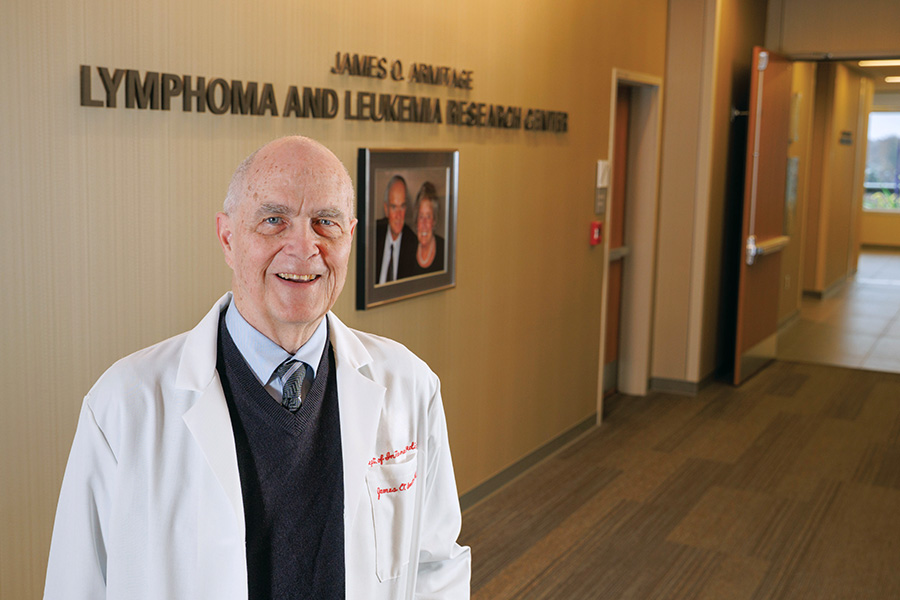
An expert in lymphoma and blood cancers, UNMC’s James Armitage, MD, founded the med center’s world-renowned bone marrow transplant program in 1982. Since then, nearly 7,000 patients have received bone marrow transplants or CAR T-cell therapy at Nebraska Medicine. To his patients, he is best known for extending empathy and hope.
Q. What led you to dedicate your life to fighting cancer?
A: First, I thought I’d do something with animals, but then I decided medicine was exciting and went to UNMC. During medical school, I drew blood and did CBCs (complete blood counts) and UAs (urinalysis) at the Douglas County Hospital. I liked looking at the microscope and seeing blood cells and decided I was going to be a hematologist.
Q. As a 1973 College of Medicine graduate and oncology trailblazer, what stands out when you reflect on your career?
A: I’ve been unimaginably fortunate in my life. I went to the University of Iowa for a fellowship in hematology/oncology, then spent two years in private practice in Omaha. My fellowship boss at the University of Iowa (head of hematology/oncology) asked if I’d come back and start a bone marrow transplant program, which was a peculiar invitation, since I’d not only never done one, but had never seen one. I took the job, visited places doing transplants, made a plan, and we started doing bone marrow transplants seven or eight months later. Lynn Klassen and I ran it for three years and then got recruited by Mike Sorrell to come to Nebraska – Lynn to start rheumatology and I as Mike’s vice chair. Soon after, we launched our transplant program, and I started the lymphoma program. I was Mike’s vice chair for eight years, chairman of medicine for a decade and dean. I’ve had a variety of roles since then, but I’ve always cared for people with lymphoma, which is what I most enjoy.
Q. Patients speak of your humanity, and you often tell them, “I work for you.” What have you learned from them?
A: How courageous people can be and how, sometimes, people can be angry when they’re ill. Working with nurses is a big part of taking care of patients, and I’ve had an amazing series of kind, caring, smart, tough nurses.
Q. What does it mean to have an endowed chair named in your honor?
A: Endowed chairs are among the most powerful recruitment and retention tools in academic medicine. Chairs make it possible to attract and keep bright, ambitious, curious clinical scientists. For me, personally, it was meaningful that the people I both cared for and worked with would do this.
Q. Are you still seeing patients?
A: I still see patients in clinic two days a week and an occasional patient outside the clinic.
Q. You have pet snakes. What fascinates you about them?
A: They’ve been around for millions of years, and they’re the only creature that walks on its ribs, can’t hear and smells with its tongue.
Q. You fought your own cancer battle. What did you learn from the experience?
A: “Chemo fog” is real. I had the most common lymphoma (diffuse large B-cell lymphoma) and don’t remember a lot of that six-month period when I was being treated.