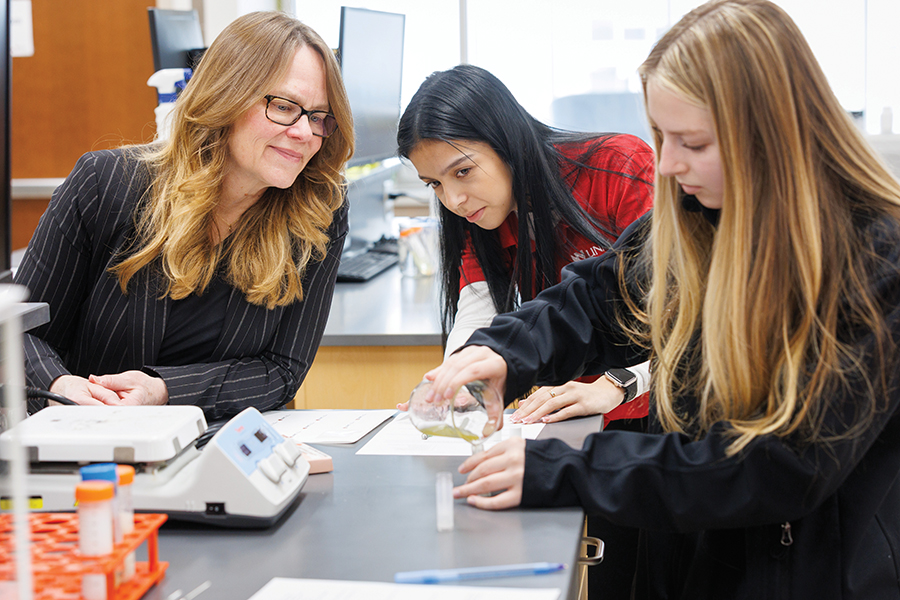
Every weekday afternoon, Taylana Tolbert leaves Bellevue East High School and heads to UNMC, where 20 minutes later she is staring at a Petri dish under the bright fluorescent lights of a research lab.
Around her are students from other high schools, all in matching shirts, ID badges clipped on, looking like they belong.
Because they do.
They’re part of UNMC’s High School Alliance, a program launched in 2010 to give motivated high school students a college-level introduction to the health sciences — and learn about opportunities they might not otherwise have considered.
“We started the first year with 32 students,” said Heidi Kaschke, director of the High School Alliance. “Now, we have almost 100 students, and we’re basically operating on the same budget.”
Nearly 300 juniors and seniors from 25 Omaha-area high schools apply each year for about 100 seats – growth that reflects both demand and trust. But the program’s impact goes far beyond enrollment numbers, Kaschke said.
•••
The High School Alliance was never meant to resemble a traditional high school classroom.
“We’re trying to simulate what it’s going to be like in college, and then in medical school or nursing school, pharmacy school and even graduate school,” Kaschke said. “We’re pretty no-nonsense about that.”
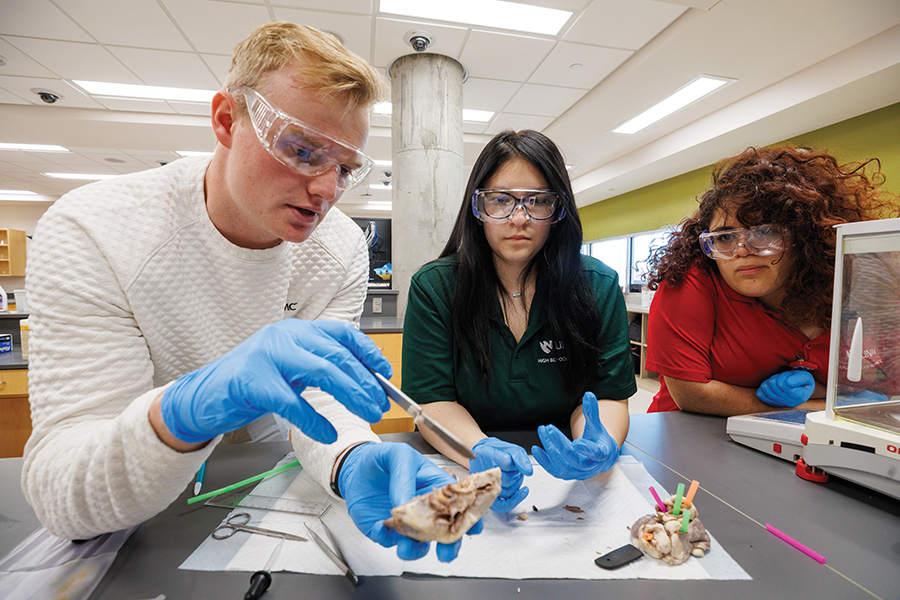
For Millard West High School alum Grace MacLeod, now a second-year UNMC medical student, the difference was immediately apparent.
“In high school, you’re in structured boxes,” MacLeod said. “Here, you have to be responsible for yourself and your schedule. You’re communicating with real doctors, real faculty. Independence and personal growth happen fast.”
The program, she said, helped her understand campus life, professionalism and expectations. “You’re surrounded by people who want to be here, and the energy is contagious.”
That culture is something Jaynie Bird, a certified high school teacher with the program, sees each year. “Students create lifelong friendships here,” Bird said. “They find people who are like them, who have the same mindset, goals and drive.”
The High School Alliance program primarily is funded by a local private foundation. This foundation requires that 35-40% of the participants qualify for reduced fees at their home high schools, ensuring access for students from a wide variety of backgrounds.
“The barrier isn’t academic ability,” Kaschke said. “It’s opportunity.”
•••
One of the program’s defining features is its breadth. Students often arrive with a narrow sense of what health care looks like, Kaschke said, adding these views commonly are shaped by internet searches and pop culture.
“When we interview students, most of the boys tell us they want to be an orthopedic surgeon,” she said. “They look up what makes the most money, and that’s what comes back.” She often hears a different pattern from girls: NICU nurse, pediatric nurse or OB-GYN.
Those ambitions are valid, she said, and needed. “We’re always going to need orthopedic surgeons, and we clearly need more nurses. But our mission is to show them everything.”
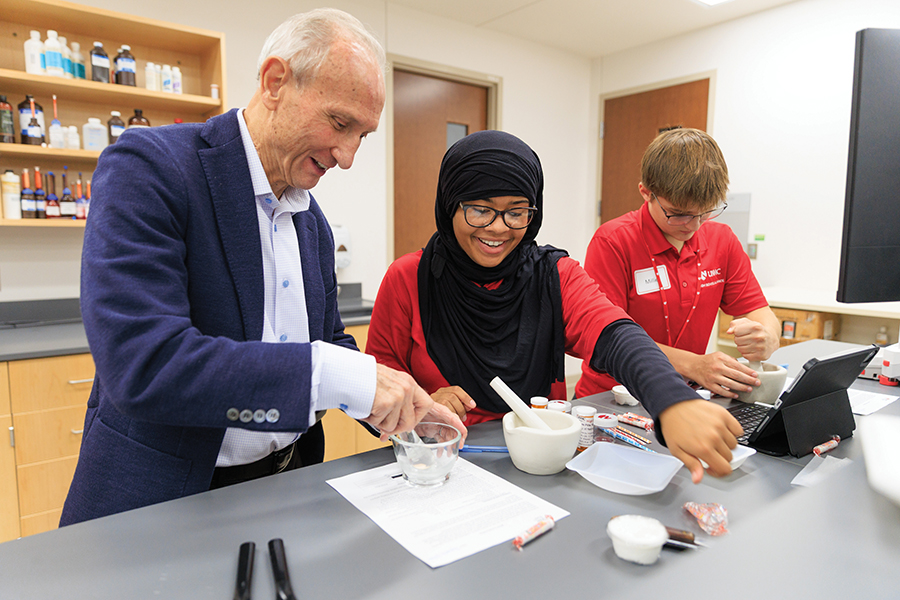
“Everything” includes pathology, microbiology, infectious diseases, pharmacy, public health, research, clinical labs and the behind-the-scenes roles that keep an academic medical center running, from hospital administration to legal and compliance professions.
“Students don’t understand all the possibilities,” Kaschke said.
Alliance students say that variegated exposure is transformative. Once on campus, perspectives can shift quickly.
“I didn’t realize how fast career goals can change,” said Bryan High School student Sarah Mesfin. “This program broadens your horizon.”
Hands-on experiences often spark those changes. For Bellevue East’s Taylana Tolbert, the turning point came in the infectious disease lab. “Once I worked with microorganisms, everything clicked,” she said. “That’s when I realized I want to pursue medicine and research.”
Others had ambition-defining experiences during operating and labor-and-delivery room simulations, inside the cadaver lab or while hearing guest speakers share their stories.
“I came in thinking there were only doctors and nurses,” said Madilynn Winger of Bellevue West. “Then you hear about pathology, public health, research — all these careers you didn’t even know existed.”
•••
Beyond academics, students say the program fosters a powerful sense of belonging.
“I wasn’t sure how we’d be treated as high school students on a graduate-level campus,” said Alyssa Lawrence, a High School Alliance graduate and Omaha Central High School alum who now is continuing her path toward medicine. “But there was never a moment where we felt out of place. We were meant to be here.”
Alumnus Grant Neuverth, a UNMC medical student and Millard North High School alum, agreed. “We weren’t treated like high schoolers. It was a thrill to be at a collegiate institution and be treated like we belonged.”
Students, who spend two hours of every school day on the UNMC campus, also describe overcoming imposter syndrome. “Before this, I thought medicine was for a certain type of person,” Dinan said. “Now, I realize anyone can do this if they care and put in the work.”
When asked to name one unexpected skill gained, students’ responses varied:
- Networking.
- Discipline.
- Optimism.
- Healthy habits.
- Friendship.
For many alumni, the program not only shapes career interests but their life’s direction. “It’s the reason I ended up at UNMC for medical school,” said Neuverth, crediting Kaschke’s mentorship in guiding his path.
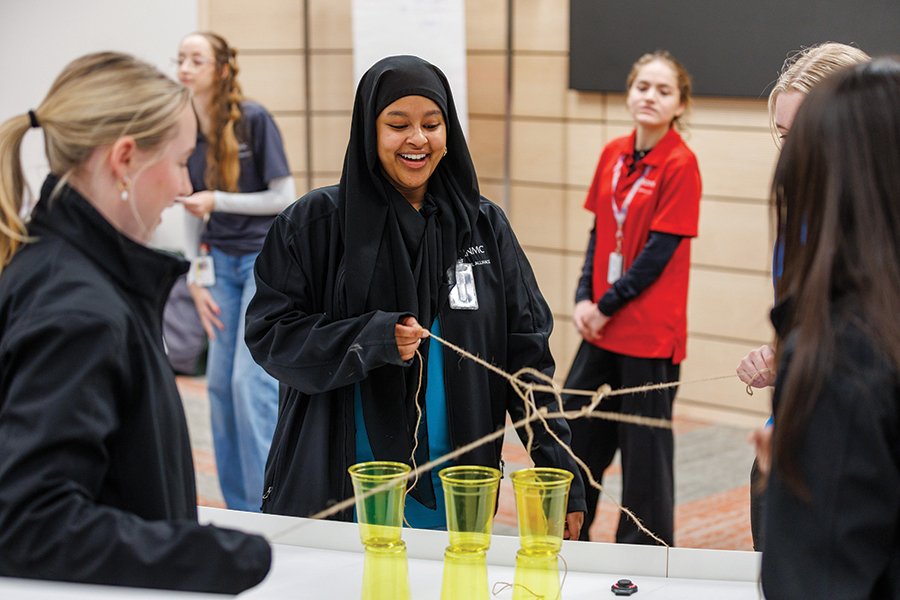
For MacLeod, a public health course proved especially influential. “Before that, I had no idea what public health even was, so it was a light bulb moment.”
She later earned degrees in public health and physiology. She now plans to practice medicine witha strong population-health lens.
The program also helps students realize when medicine isn’t the right fit – something Bird considers a success.
“We absolutely see that as a win,” she said.“They’re figuring things out early.”
Alumni often return to mentor students, including MacLeod, who left Nebraska for her undergraduate degree but applied only to UNMC for medical school. “I had invisible strings connecting me here,” she said. “This program taught me that I belong here. Now I get to help others believe that, too.”
•••
Looking ahead, program leaders are exploring ways to expand summer research opportunities, build middle-school pipelines and strengthen statewide pathways – efforts that could greatly widen the circle of students who benefit from the program. For now, Kaschke measures success by the connections made: an alliance alum returning to speak to current participants, a medical student mentoring a teen with med school dreams or a curious student discovering an unexpected path.
“We don’t get to work with every student who could benefit from the program,” she said. “But for the ones we do reach, we make it count.”
For MacLeod, that rings true.
“This program taught me that I belonged here. And now, every time I see High School Alliance students on campus, I make sure they feel welcome.”
Thank you for capturing our students at their best!