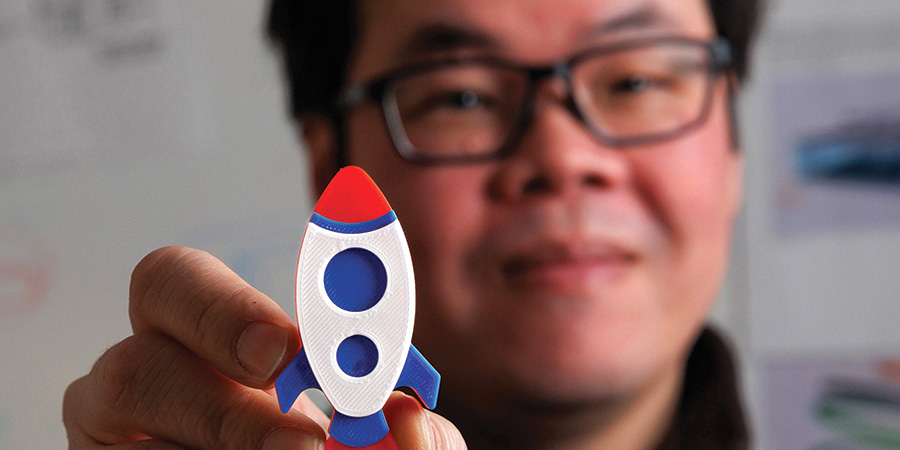
One of UNMC's guiding values is innovation, which the latest issue of UNMC Connect explores. NU remains one of the world's top institutions for earning patents, as reported by the National Academy of Inventors. Here is a look at the Innovators Among Us at UNMC.
Thanh Nguyen, PhD, is UNMC's most prolific inventor, closing in on 100 inventions. Sangamesh Kumbar, PhD, of the UNMC College of Dentistry, demonstrates the power of collaboration, as he reaches out to peers throughout the university system to supercharge innovative capability. Janina Baranowska-Kortylewicz, PhD, and Bethany Lowndes, PhD, represent the strong cohort of creative women inventors at UNMC.
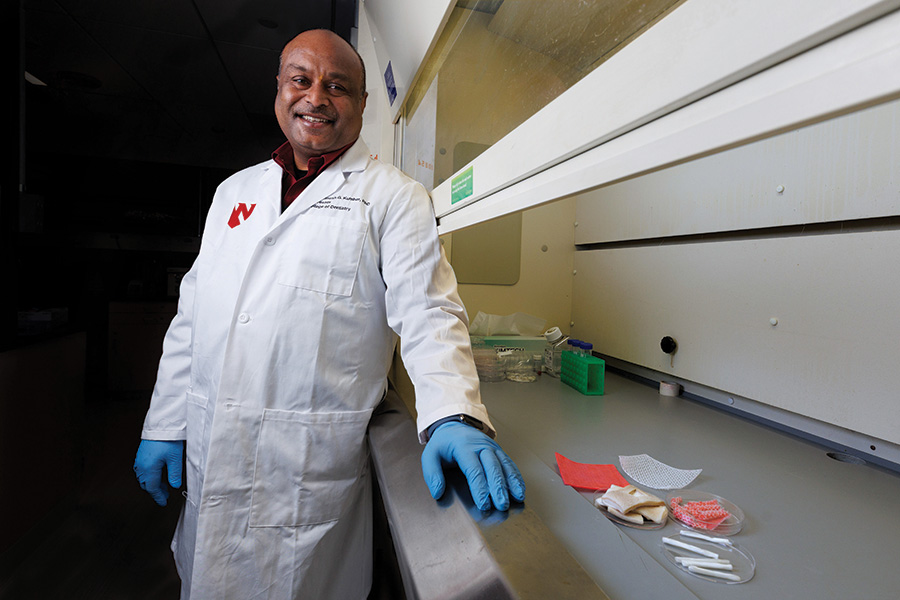
Engineering with simplicity and impact
- Sangamesh Kumbar, PhD
- Associate dean for research, UNMC College of Dentistry
- Joined UNMC: 2025
- Areas of interest: Musculoskeletal tissue healing and regenerative medicine
The question is, how do you come up with a creative way of solving problems that is straightforward, simple and has an impact?
Before finding a solution, the critical step is identifying the problem and defining the problem. There could be 10 different solutions. Always pick the simple and most impactful one.
I had three patents and abandoned them because they were of no practical value. If there is no practical value, your idea lacks importance.
Identifying solutions
I’m an engineer. I do not think like a biologist. Biologists like to understand the mechanism and what regulates biological processes, and expect complications: ‘If this happens, in the downstream that happens.’ In my world, I know there is an engineering solution to every problem. I think like an engineer, and I let the biology play out.
I have a knack for quickly identifying solutions. I do not hesitate. If I can prove my point, I proceed. Innovation is a continuous thinking process. As an innovator, problem identification is the key aspect. There are a lot of problems. Some are important. Some are worth pursuing. Every patent, every idea is not meant to be commercialized just because it is novel.
No end to innovation
There is no end in adding to basic science and exploring new ideas. But at some point, you have to move that basic knowledge into practical value. I borrow stuff that basic scientists have invented or discovered, and I apply an engineering solution.
Ideas are not a linear process. It’s always a circular process. You define the problem, go about it, learn something new, define the inventing strategy. Why is it important? Who is it going to impact?
If I have a new drug that has never been tested before, my route to market – whether it’s wound healing, bone regeneration or nerve regeneration – will have a bigger battle. Drugs that have been tested with humans in multiple clinical trials, where safety and efficacy already have been established, are easy to adapt and repurpose for a different application. You find an innovative way to a new application.
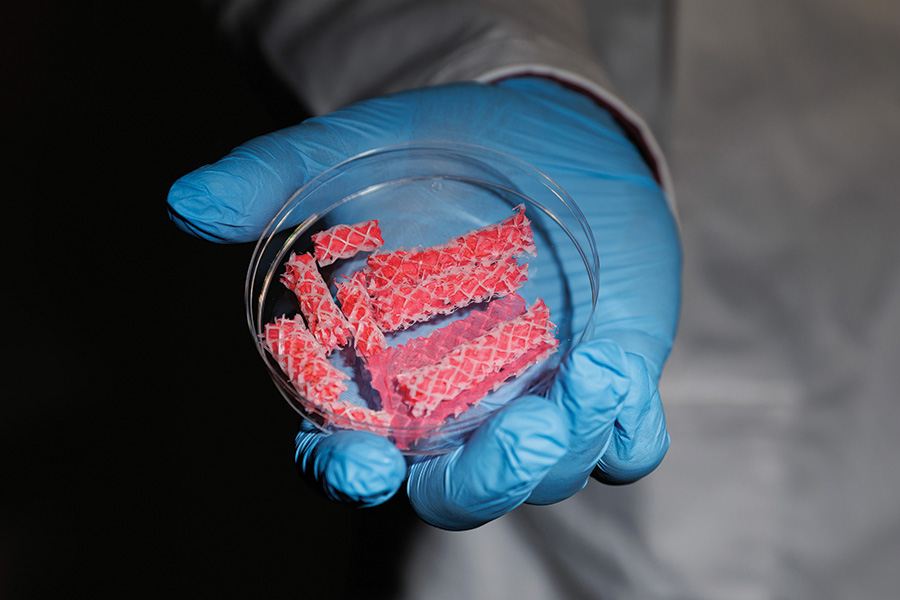
Biodegradable scaffolds prototyped in Dr. Kumbar’s lab help nerves heal and regenerate.
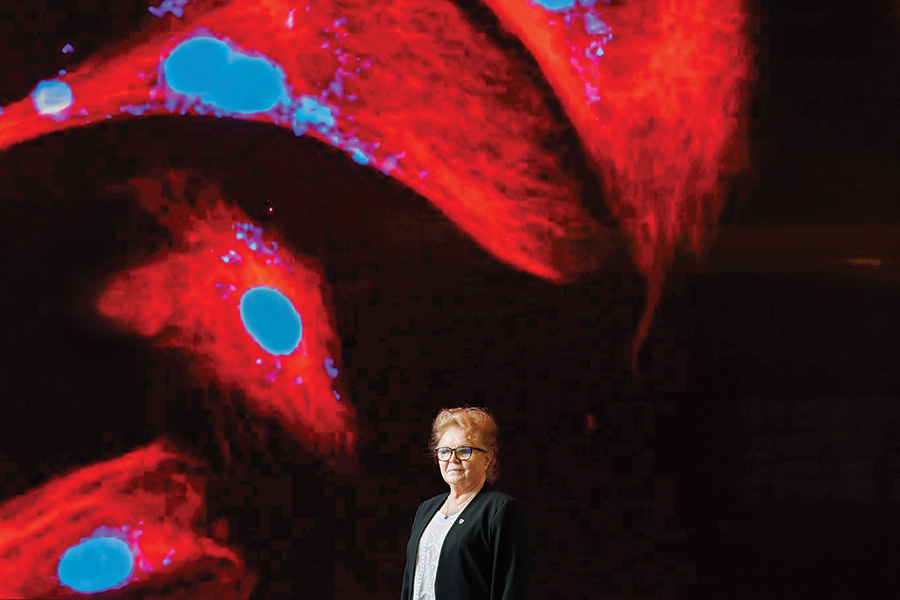
Redefining cancer therapy — without the collateral damage
- Janina Baranowska-Kortylewicz, PhD
- Research professor, UNMC College of Pharmacy
- Joined UNMC: 1993
- Areas of interest: Design, synthesis and evaluation of theranostics
My ideas come from working on cancers that are difficult to treat, where current therapies are limited by toxicity or vulnerability of the patients (young children or immunocompromised patients, for example). I look for ways to treat these aggressive diseases while minimizing harm to the patient.
Problem-solving process
I begin by asking whether a molecular feature of a tumor can function as a druggable marker, one that clearly distinguishes cancer from normal cells. From there, I consider how to design therapeutic agents that not only bind that marker, but also co-target DNA selectively within tumor cells, which enhances efficacy without increasing toxicity to the patient during the treatment process. The process is iterative and mechanism-driven, with constant attention to precision, reversibility and safety.
Challenges faced
I enjoy designing cancer therapies that are biologically informed and clinically practical, with safety built into the design. The greatest challenge is demonstrating that these approaches can remain highly effective while avoiding the collateral damage that traditionally has been accepted as inevitable in cancer therapy.
Innovative portfolio
Many of my inventions focus on making cancer treatments safer and more precise by combining tumor marker targeting with DNA-directed effects. In simple terms, these include:
• Cancer-targeting drugs that allow the treatment to concentrate where it matters most.
• Radiopharmaceutical agents that deliver therapeutic radiation in a temporary, localized manner, limiting exposure to healthy tissues.
• Dual-action therapies that use a tumor marker to guide treatment while also damaging cancer cell DNA in a controlled way, increasing effectiveness without increasing toxicity.
• A promising new agent for the treatment of advanced and metastatic breast cancer that is lethal to cancer cells but has practically no effect on cells from several normal tissues. The common goal: To use the biological differences between cancer and normal cells to create safer treatments.
Making an impact
While the full impact of my inventions will not be realized until these agents are translated into theclinic, I am encouraged by several new agents that appear to be safe and are designed to treat challenging pediatric cancers, such as medulloblastoma and neuroblastoma. For me, the most impactful inventions will be those that provide safe and effective treatment options for children with cancer.
Proud moment
I developed a theranostic agent for advanced prostate cancer that demonstrated sufficient promise for the U.S. Food and Drug Administration to permit an Investigational New Drug application. This invention combines tumor marker targeting with DNA-directed therapeutic effects, allowing the same platform to be used for both imaging and treatment. Reaching this stage is especially meaningful because it reflects not only scientific innovation, but also rigorous attention to safety, manufacturability and clinical relevance, key steps in translating an idea from the laboratory to patients with limited treatment options.
Guiding belief
Understanding where and how to act on cancer cells, through marker targeting and DNA co-targeting, can fundamentally change how even the most difficult cancers are treated.
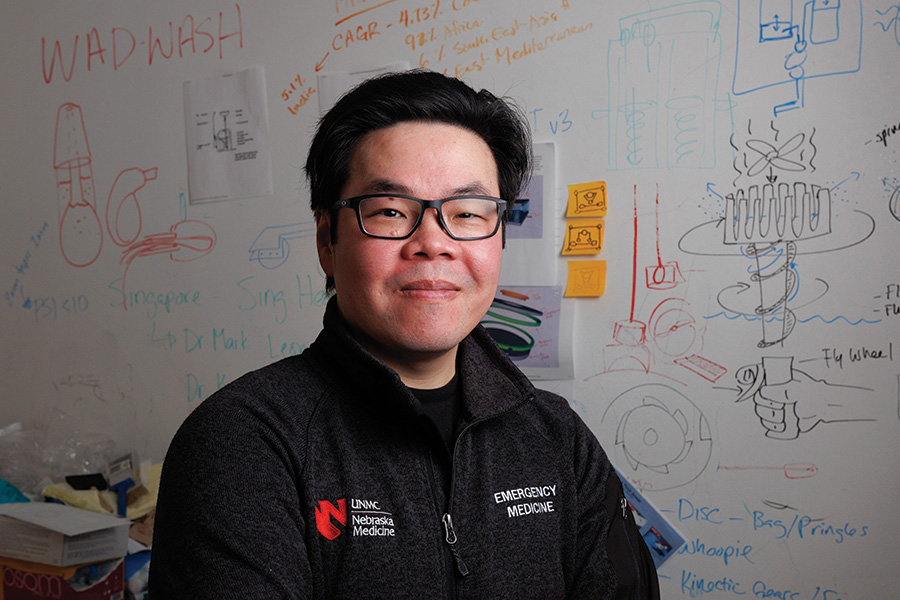
Ideas take flight
- Thanh Nguyen, PhD
- Assistant professor, UNMC Department of Emergency Medicine
- Joined UNMC: 2010
- Areas of interest: Finding the nexus between technology and medicine to improve wellness
When I see a problem, or if I see a solution, even a make-believe solution in a movie, I will walk that concept through in my head and wonder, ‘How does that actually work?’ One example is the lightsaber. Nearly everyone is familiar with the “Star Wars” lightsaber, but how many of us have wondered how it works? A lightsaber is a laser beam, but a laser beam’s light projection is usually infinite. So, if it’s a laser beam, how do they get the beam to terminate into the shape of a sword?
When I do these thought exercises, I go down this rabbit hole; I’ll do literature searches on laser beam technology to see if there are laser beams capable of taking form like a lightsaber. Then I go down another rabbit hole looking at patents.
Reading (patents) is fundamental
I like reading patents. I find it enlightening and motivating to see others’ approach to problem solving. You would imagine that a patent is something that will eventually make it into the real world as something you can tangibly hold and play with, but oftentimes it doesn’t. Nonetheless, when reviewing a patent, you’re given insight into what the inventor was thinking and how they chose to solve the problem. Some people just like to think through concepts. And if they have a concept that is, in their mind, solid enough, they will file for a patent. Unfortunately, many issued patents remain on paper and eventually expire.
But these expired patents are still a treasure trove of ideas that I can, maybe, build upon with concepts of my own.
Ideas first, details later
When we approach problems, we instinctively try to envision a solution that is feasible “right now.” We notice this approach a lot when we work with individuals who are more concrete thinkers, such as our mechanical engineering friends. And sometimes this concrete thinking can be inhibitory during the early phases of ideation, where we’re not too worried about feasibility because we’re just ‘making up stuff.’ I just want to see if you can walk through the ABCs of how it will or can work. I encourage others to not let their “dream solution” be constrained by what we know or have experience with. Instead, let your ideas live in the fantastical. We’ll figure out the details later.
“Love Death + Robots”= inspiration
The RapidSmear is a product we have on the market, and the original concept came to me during one of these “pie-in-the-sky” thought exercises.
There is an anthology series on Netflix that I enjoy, called “Love Death + Robots.” There is an episode where an astronaut crash lands on Mars, and treks from her crash site to a base. As part of her astronaut suit, she wears this electronic gauntlet on her arm. As she’s hiking, injured and alone, through this barren alien landscape, she talks to this gauntlet, asking it to “analyze” her condition. And because it’s a sci-fi show, the gauntlet replies with, “Your endorphins are high,” and advises an injection of morphine. Instead of enjoying the show, I keep thinking, “How is the gauntlet doing that?
How does it know the status of her blood chemistry? Can it also screen for anemia or bleeding since she’s injured?” And, of course, my family is sitting with me, and I’m talking through this out loud. They’re getting annoyed. But I continue to loudly work the problem. Obviously, the gauntlet is analyzing her blood. So, somehow it must be tapping into one of her veins, drawing off a bit of blood and running it every time she asks for an analysis. It’s probably not drawing a lot of blood, because that would drain her; also, the gauntlet is small, so large vials of blood wouldn’t be feasible.
So, what can you do with a little amount of blood that would give you the largest amount of useful data? And that’s when I had a eureka moment. The gauntlet is likely performing a blood smear analysis. In hematology, we take a drop of blood, smear it across a glass slide, and then you can look at it with a microscope and determine hematologic parameters such as red blood cell counts, cellular morphology, potentially screen for infectious diseases, and so much more. I thought, “Wow, a blood smear – to do it in the real world, it takes a whole workstation. So how can I make a device where you can do a quick smear automatically, and it can fit inside a gauntlet or a glove?” I grabbed my iPad and, in the middle of family movie night, started designing it. Eventually I fired up my 3D printer and started prototyping it.
A few months later, we were able to get the design to work. It makes great looking blood smears while being smaller than a cellphone. Now, I just have to come up with a talking gauntlet.
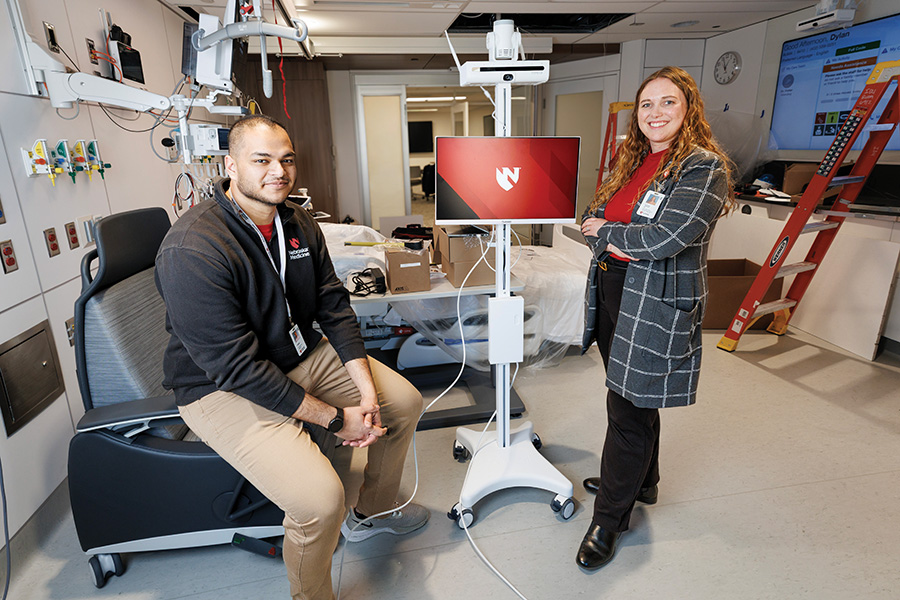
Perspectives = Solutions
- Bethany Lowndes, PhD
- Associate professor, human factors, UNMC Department of Neurological Sciences
- Joined UNMC: 2018
- Area of interest: Developing user-centered design solutions
As a human factors engineer, I am an inventor, ethnographer and collaborative scientist who develops products and systems to help solve problems. I try to understand what users need in the context of their work and, through that, implement solutions that meet everyone’s needs.
Innovation + collaboration = solutions
As a biological systems engineer undergraduate student, I thought I’d be designing medical devices or going on to medical school. Then, I realized I could work across different clinical areas and bridge the gap between what users need and how we can meet those needs through user-centered design solutions. I love working with people to gather their insights and solve problems. It’s fun to see collaborators and users light up when solutions come to life.
Gathering perspectives to problem-solve
I ask lots of questions of the users and people on the front end who are interacting with a problem. Individuals have different perspectives, and each role provides a different view of the problem and potential solution. It’s important to gather these perceptions to really understand the problem and determine if there is more than one problem.
Solving challenges in health
As a faculty member, I’m working with Dr. Beth Beam on user-centered design features of the Beam prototyped PPE helmet, and with Drs. Aaron Yoder, Joseph Siu and Santosh Pitla (UNL) on designing systems to detect fall risk in occupational settings. I’m also an enabler of inventions and help determine how we get final products into workspaces to make an impact on health and health care delivery. My role varies across projects from ensuring teams have resources and connection with users to being an active member of the design team.
I serve as the scientific director of our Innovation Bridge Program connected to the Innovation Design Unit, which supports clinical innovation across Nebraska Medicine and UNMC. Here, we think about the future of health care delivery and how we can use technology and design solutions to help nurses, patients and family members.
As the health systems’ engineering liaison with the Great Plains IDeA-CTR Technology Initiative, I support and initiate collaboration on engineering and technology projects with university colleagues in Lincoln, Omaha and Kearney to address problems and challenges in health care. We help senior capstone students in the University of Nebraska-Lincoln’s College of Engineering and students in UNMC’s Enhanced Medical Education Track evaluate or create inventions.
Driving success
Passion about the problem is better than passion about the solution. At times, you might receive feedback that requires shifting directions on a design solution. Passion about the problem is a key driver of success.
Unplugging after hours
I find balance and inspiration through hobbies that also involve problem-solving. In addition to biking, old house projects and hiking with my family, I do a lot of puzzles and play board games – especially problem-solving games. I can always identify problems and opportunities for things to be better, but since I can’t fix everything, I tell myself: “That problem does exist, but it is not my problem to own.’’
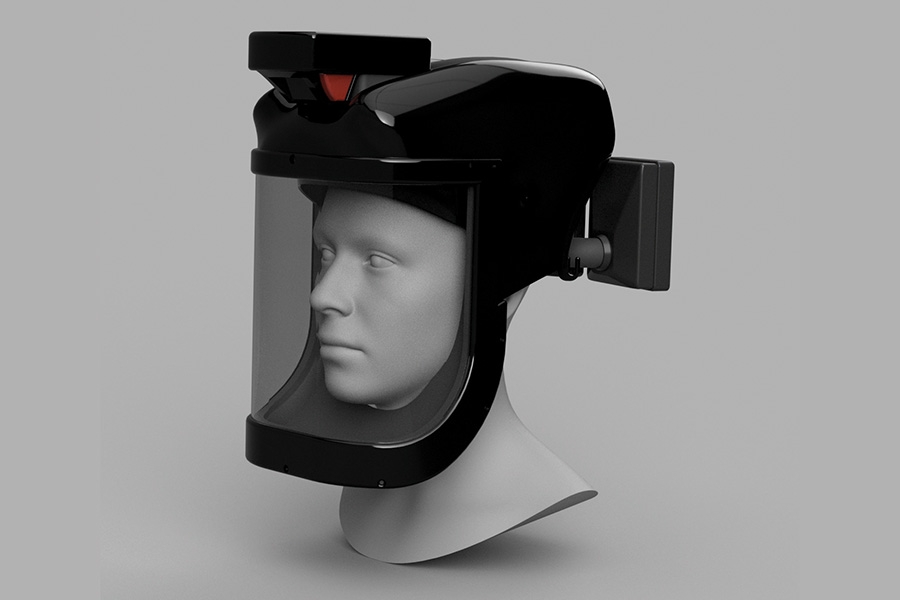
Led by UNMC’s Elizabeth Beam, PhD, the team is developing powered air-purifying respirators that allow health care workers and their patients to breathe safely in hazardous conditions, including this ruggedized prototype for austere conditions.