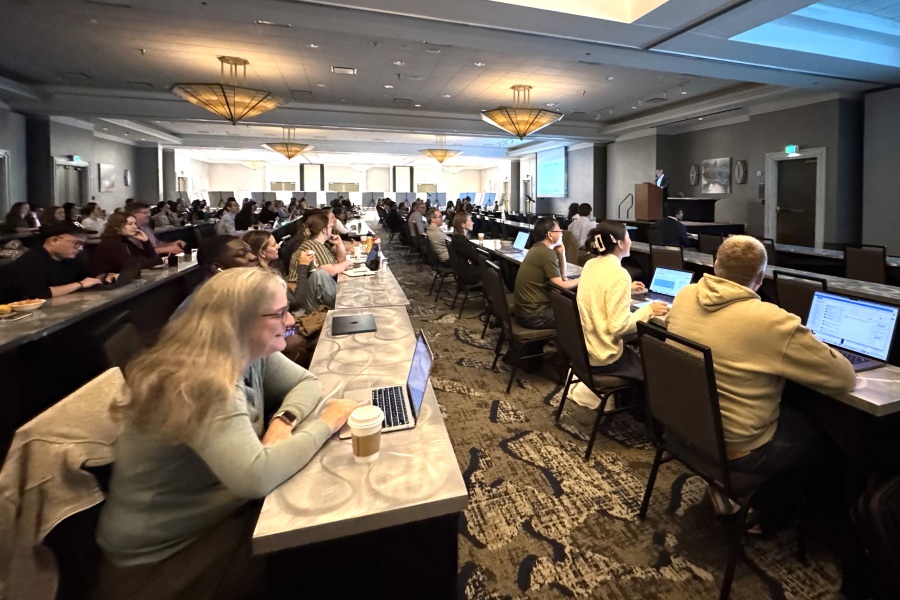
The 2026 International Conference on Gram-Positive Pathogens (ICG+P) hosted by UNMC’s Department of Pathology, Microbiology and Immunology, drew 135 graduate students, postdoctoral scholars, lab personnel, and faculty members to Omaha.
This year’s conference, which ran from May 17 to 20, included 28 oral presentations, four keynote addresses and 74 poster presentations. Dr. McKenzie Lehman, an assistant professor in the department, and Anna Sommers, a grad student in Dr. Vinai Thomas’ lab, gave oral presentations. Department members gave five poster presentations. Fourteen students and faculty from the department took part in all.
Dr. Thomas was co-chair of the organizing committee for this year’s conference, the 10th in a series that began in 2006. He said the conference is important because it brings together researchers from around the world who are working on Gram-positive pathogens such as staphylococci, streptococci, enterococci, and clostridia.
“One of the biggest strengths of meetings like ICG+P is that they give scientists working on different organisms and using different scientific approaches a chance to exchange ideas and learn from one another,” he said. “These conversations often lead to new collaborations and research directions that might not happen otherwise.”
That opportunity was too good for Brandon Kim to pass up. Dr. Kim, an assistant professor at the University of Texas at Dallas, made the 11-hour drive with a fellow faculty member, Dr. Nicholas Dillon, and a vanload of students. Was it worth it? “Absolutely,” he said. “It was fantastic.” This was his third ICG+P conference, but the first in 12 years. “It’s as I remembered—it’s awesome.” Dr. Kim gave a presentation on the impact of sex hormone signaling on bacterial disruption of the blood-brain barrier. Dr. Dillon and many of their students gave poster presentations.
Dr. Thomas said: “It was great to see so many trainees participating. These meetings give students and postdocs valuable opportunities to present their work, meet people in the field, and become part of the larger scientific community.”