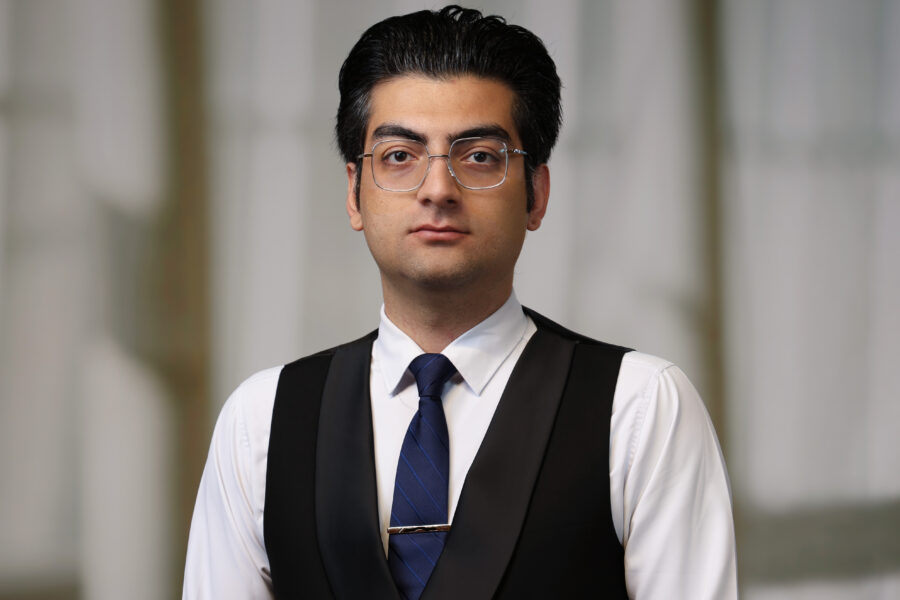
When Amin Foroughi-Nezhad submitted his application to the Allen Institute’s 2026 Computational Cell Types Workshop, he wasn’t sure what to expect. What he got was four days of intense collaboration, a new research avenue and confirmation that his work is pointing in the right direction.
Foroughi-Nezhad, a second-year PhD student in the lab of Gurudutt Pendyala, PhD, was one of just 18 researchers selected from a global applicant pool to attend the hackathon-style workshop in Seattle this May. Participants came from institutions across the United States, Canada, Germany, Israel, China and South America, and all were chosen based on the scientific merit and feasibility of their proposed project ideas.
“When they sent me the acceptance letter, it reinforced that I was focused on the right path,” Foroughi-Nezhad said. “I’m thinking about the correct angle of the Alzheimer’s disease field.”
Foroughi-Nezhad’s proposed project focused on microglia, the resident immune cells of the central nervous system, and how their molecular states and spatial organization vary across cortical layers in Alzheimer’s disease. At the workshop, he collaborated with researchers from Cornell University and Northwestern University to analyze data from the Seattle Alzheimer’s Disease Brain Cell Atlas (SEA-AD), a multimodal human brain atlas that integrates single-nucleus transcriptomics, spatial transcriptomics, epigenomics, neuropathology and clinical metadata. Their work used SEA-AD spatial transcriptomic resources, including cell-resolution MERFISH data from postmortem human middle temporal gyrus tissue, to study how disease-associated cell states and gene-expression patterns are organized within real human brain tissue.
“In spatial transcriptomics, we can measure where specific genes are expressed within intact tissue,” Foroughi-Nezhad said. “It is location-aware molecular profiling, almost like building an atlas of gene activity across the tissue.” Because generating high-quality spatial transcriptomic datasets can be expensive-with some single-sample workflows costing thousands to more than $10,000 depending on the platform, tissue type, sequencing depth, and analysis pipeline-access to the Allen Institute’s SEA-AD resources represented a rare opportunity to work with large-scale human brain spatial data.
The workshop moved fast. Teams worked 10-hour days using Allen Institute computing resources and were expected to present results by the end of day four — a pace Foroughi-Nezhad said differed sharply from many academic research settings. He said one strength of corporation research institutes such as the Allen Institute is their structured, collaborative environment, where research questions, study designs, analyses and interpretations are repeatedly reviewed by senior scientists with different expertise.
“In an academic setting, we may start with one project, but over time it can become something completely different because the question evolves,” Foroughi-Nezhad said. “That freedom is valuable because it allows you to exercise your own intellectual ideas.”
At the same time, he said, corporation-based research offers continuous multidisciplinary review, helping teams assess whether a question is meaningful, a hypothesis is well justified, and the design can truly answer it.
“Strong science is not only about doing the experiment or running the analysis,” he said. “It is about asking the right question and designing the project in a way that produces meaningful and reproducible results.”
He said this collaborative structure can strengthen a project’s scientific rationale, reduce the risk of poorly designed experiments, and ensure resources support work aligned with broader research goals.
That scientifically rigorous spirit is also central to Foroughi-Nezhad’s thesis work at UNMC, where he uses artificial intelligence and machine learning to identify FDA-approved or clinically characterized drugs that could potentially be repurposed for Alzheimer’s disease. Drug repurposing can shorten parts of the development pathway because these compounds may already have known safety, dosing, pharmacokinetic or toxicity profiles, although they still require rigorous pre-clinical validation and clinical trials to determine whether they are effective and safe for Alzheimer’s patients.
The workshop expanded that work in unexpected ways. Foroughi-Nezhad came away with new analytical pipelines to apply to his own datasets, including Voronoi tessellation, a spatial analysis technique that maps tissue into cell-centered neighborhoods to examine how cells are arranged and how their gene-expression patterns relate to nearby cells. His group’s project is ongoing, and the Allen Institute has invited participants to continue developing their work, with the option to publish their findings.