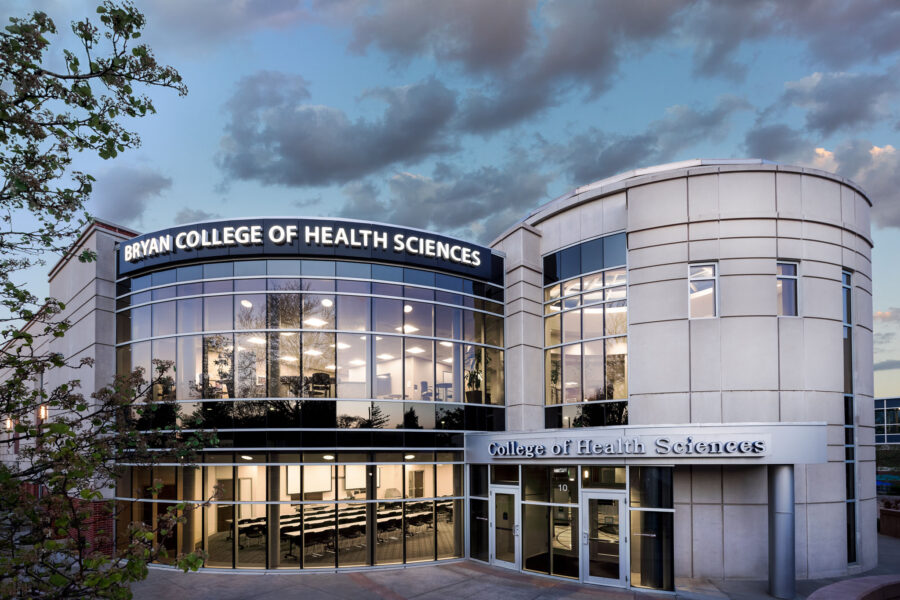
NE-INBRE students hail from 10 participating undergrad institutions, including Bryan College of Health Sciences in Lincoln, Nebraska, which is in its second full-year of participation.
This year, two Bryan College of Health Sciences students– Merlin Arevalo-Soriano and Ava Runnebaum – are taking part in lab activities respectively on the UNMC and University of Nebraska-Lincoln campuses.
“Last fall, we welcomed two primarily undergraduate institutions to the INBRE network: Bryan College of Health Sciences and the return of Nebraska Wesleyan University,” said UNMC’s Paul Sorgen, PhD, principal investigator and director of the INBRE program. “This year, six INBRE students joined us from these two campuses to explore research opportunities they otherwise might not have had.”
INBRE Scholar Merlin Arevalo-Soriano works in the UNMC lab of Amanda Brinkworth, PhD, to study how disease-causing bacteria, particularly spirochetes, colonize and interact with human tissue models, including skin and cervical tissue.
“Participating in the INBRE program allows me to explore the scientific side of healthcare and gain a better understanding of how discoveries are made,” Arevalo-Soriano said. “I am excited for the opportunity to step out of my comfort zone, learn new skills and contribute to meaningful research that could help answer important scientific questions and potentially advance medical care.
Arevalo-Soriano said she hopes to gain a deeper understanding of the research process while strengthening her critical thinking skills and developing new laboratory skills. “I am eager for the opportunity to learn from accomplished researchers and challenge myself in a new environment,” she said.
Fellow Bryan student, Ava Runnebaum, works in the lab of James Checco, PhD, at the University of Nebraska-Lincoln, where she focuses on reducing the bonds where peptides bind to their receptors. Such work, she said, can lead to discoveries as studying ligand-receptor interactions and receptor specific labeling allows for the development of therapeutic treatments.
“The INBRE program has provided me with an undergraduate research opportunity that I would not have been presented with elsewhere,” Runnebaum said. “Working alongside PhD students has been a valuable experience and a milestone in my academic journey…
“By the end of the summer, I hope to grow into a more confident and capable scientist.”
Overall, the INBRE partnership expands the professional pathways available to Bryan College of Health Sciences students, said Jason States, dean of healthcare studies at Bryan College of Health Sciences.
“Students who attend Bryan College of Health Sciences’ biomedical sciences program typically want to pursue a professional program to become a physician, a physician assistant or another type of healthcare professional. The experiences that INBRE gives our students open another pathway they may not have considered: research.
“Through this partnership, INBRE helps our students learn new skills in the laboratory, access equipment not available on our campus, connect with highly qualified researchers, and even present their work at state and possibly national conferences. We are excited to continue as an INBRE institution and provide these opportunities to our students.”