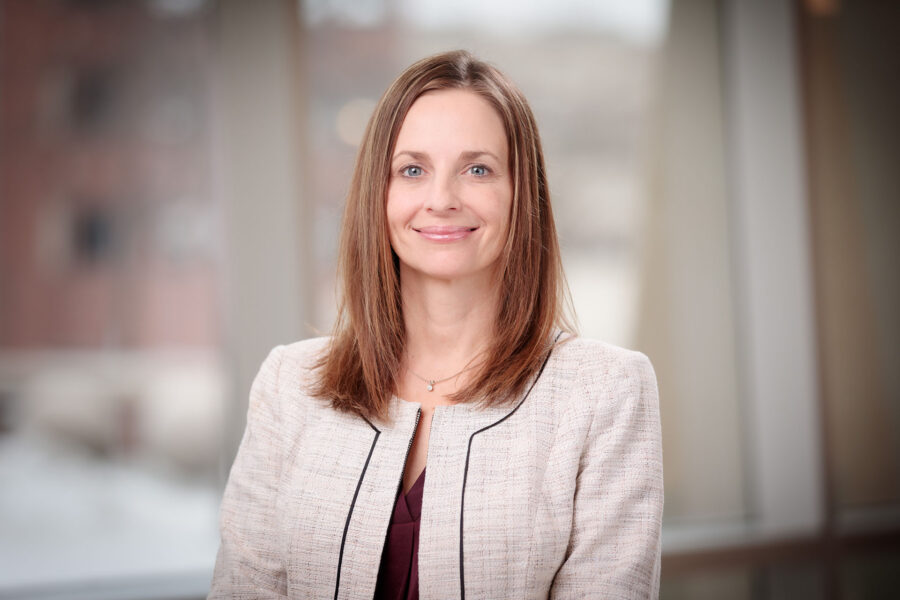
Amy Duhachek-Stapelman, MD, professor in the UNMC Department of Anesthesiology, has been named the recipient of the 2026 Outstanding Teaching and Instructional Creativity Award (OTICA) – the highest teaching honor given across the four-campus University of Nebraska system.
Dr. Duhachek-Stapelman was presented with the award at the Board of Regents meeting on Aug. 13.
She is one of two UNMC awardees this year — Benson Edagwa, PhD, the Howard E. Gendelman, MD, Professor of Pharmacology and Neuroscience, received the Faculty IP Innovation and Commercialization Award. (Watch Thursday’s UNMC Today for a story on Dr. Edagwa’s award).
The OTICA recognizes full-time faculty with sustained, meritorious records of excellence and creativity in teaching. Winners are selected by peer evaluation panels from across the university system and receive a stipend.
“It was truly humbling to be recognized for doing the work I love every day,” Dr. Duhachek-Stapelman said. “Our learners are the reason I’m here. What I love most about academic medicine is the opportunity to help train the next generation of healthcare professionals who will serve Nebraska and communities far beyond.”
At the center of her teaching philosophy is a single idea: meet learners where they are.
“The most important thing is really getting to know the learner and understanding their knowledge level. From there, you can distill the content in a way that meets them where they are,” she said, describing her approach as interactive rather than one-directional. That focus sharpened after she completed a master’s degree in education through Johns Hopkins University, which she said reshaped how she thinks about individual learning styles. “There’s not a one-size-fits-all approach to education.”
That philosophy has driven her to rethink – and sometimes rebuild – how the department of anesthesiology teaches its residents. Over the years, she has helped shift the program away from traditional lectures toward an interactive e-learning platform, then reintroduced lectures for learners who benefited from them.
“If you’re not changing things, then you’re not working to make things better,” she said.
Nationally, several faculty members have become known for their work training clinicians in echocardiography, traveling across the country and internationally to teach the skill – work she calls a point of pride for the department.
But some of the most meaningful moments, she said, come from former residents who return years later to tell her she changed the course of their careers.
One conversation with a former resident has stayed with Dr. Duhachek-Stapelman. “I was thinking about leaving anesthesiology because I was really struggling,” the former resident told her. “The fact that you believed in me and gave me confidence in what I was doing helped me through those tough times.”
For Dr. Duhachek-Stapelman, moments like that reinforce the impact of teaching. “It makes me feel like I’m making a difference,” she said.
She traces her own investment in struggling learners back to her own medical school experience, when an anatomy professor, Robert Binhammer, PhD, told her that her difficulties weren’t a matter of intelligence but of not yet knowing how to study. That vote of confidence, she said, changed the trajectory of her career and gave her a lasting soft spot for students who are working harder than most to keep up.
“Dr. Duhachek-Stapelman’s career has been defined by a sustained commitment to teaching at every level,” said Andrew Patterson, MD, PhD, Robert Lieberman Endowed Chair of Anesthesiology. “This recognition is richly deserved.”
“There are so many exceptional educators across the university system, which makes this recognition especially meaningful,” Dr. Duhachek-Stapelman said. “It’s a tremendous honor to be recognized alongside so many outstanding colleagues.”
Congratulations, Dr. D-S! Very well deserved.
Congratulations on your well-deserved award! Can’t wait to see what you do next!
Congratulations! I am inspired by your dedication and advocacy for the learner.